


Many B2B companies' core product messaging still reflects past versions: high precision, long lifespan, low maintenance, stable delivery. These statements are not necessarily wrong – but if customers now care more about ROI, risk control, internal consensus, and verifiable evidence, old messaging can no longer fully explain the product's current value.
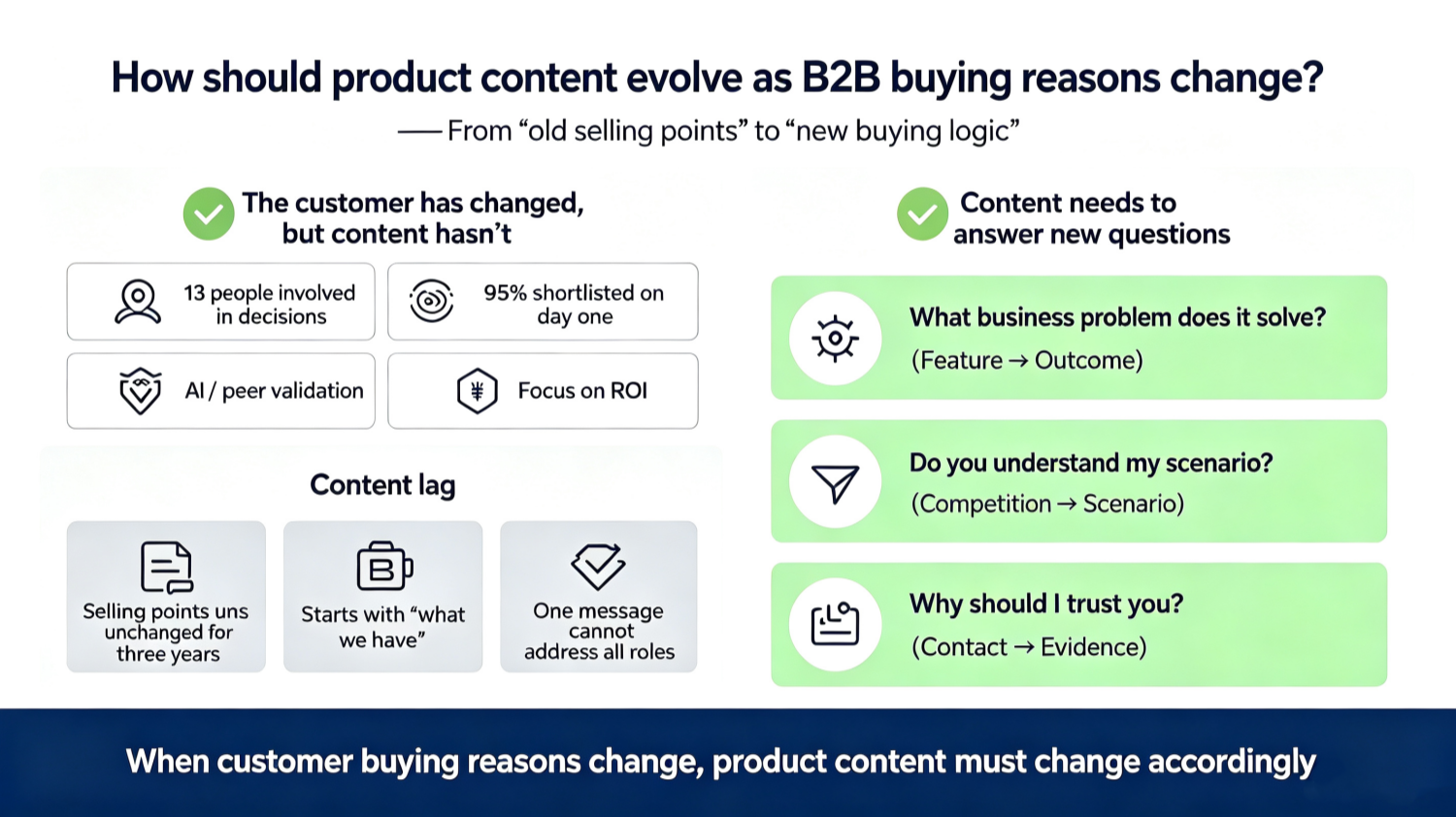
According to Forrester's 2025 Buyer Journey Survey, 73% of purchasing decisions involve three or more departments, with an average of 13 internal and 9 external participants. Customers have shifted from single‑point‑of‑contact decision‑making to multi‑stakeholder involvement, pre‑purchase research, and evidence validation.
Therefore, product content must answer not just “what features does the product have”, but “how do these features map to the customer's current reasons for buying”.
I. What changes have occurred in B2B buyers' purchasing logic?
Over the past two years, the B2B purchasing process has become more complex. Companies need to contend not only with changes in customer needs but also with shifts in decision‑making participants, information‑gathering methods, and validation criteria.
1. More roles involved in decision‑making
Procurement is no longer a single person's judgment, but a collective decision made by a “buying network”. Technical leads, procurement, finance, management, and end‑users – each role has different decision criteria.
2. Higher proportion of pre‑purchase research
Buyers have completed most of their research before engaging with sales. 6sense research found that in 95% of cases, the eventual winner was already on the buyer's shortlist from day one.
3. More diverse validation channels
Buyers are using AI tools, peer reviews, and third‑party platforms to validate supplier capabilities, rather than simply trusting what companies say about themselves.
4. More pragmatic value assessment
With economic uncertainty and pressure to reduce costs while improving efficiency, procurement teams are increasingly focused on “can this investment be justified”. Trust remains the primary factor, but the basis on which customers form trust is changing. Reputation, professional perspectives, and verifiable evidence are becoming more important references when customers evaluate suppliers.
These changes mean that the focus of customer evaluation has shifted. If effective messaging from the past is not updated accordingly, it may fail to address customers' current decision criteria. This is precisely why content system building cannot be a one‑off project – it must be an ongoing process that continuously responds to changes in customer decision‑making logic.
II. Why does product content still stay with old messaging?
After customers' purchasing logic changes, many companies' product content does not get updated accordingly. The reason is usually not a lack of willingness to adjust, but a lack of regular review of how customer purchasing logic has evolved.
1. Content has inertia
Product messaging written three years ago has become embedded in the company's content system through sales training, channel distribution, and website updates. Revising a core set of messaging often means updating the website, product brochures, sales PPTs, exhibition materials, and social content simultaneously – affecting the consistency of expression across multiple touchpoints.
2. Internal perspective dominates
Product teams habitually write from “what we have” – technical specs, feature lists, performance indicators. But customers have shifted from “looking at features” to “looking at outcomes” – what specific problems can this solve and what business value can it deliver.
3. Messaging still targets a vague customer profile
When purchasing decisions involve multiple internal roles, the same messaging cannot simultaneously address everyone's judgment needs. Technical teams focus on specs and compatibility, procurement on total cost of ownership, management on ROI. If product content still targets a generic “customer”, it may not feel relevant to any specific role.
Landelion Insight: Many companies do not lack the willingness to update – they lack a content management mechanism that can periodically review the timeliness of their messaging. This is precisely where content system building begins.
III. New questions that product content needs to answer
From a content system building perspective, the question product content needs to answer has shifted from “what is the product” to “how does the product fit into the customer's business scenario”.
This is product‑centric content logic. Specifications, feature lists, technical specs – this information is still necessary, but no longer sufficient to support customer judgment.
New question: What business problem does it solve?
B2B customers evaluate not just the product itself, but whether it delivers clear business outcomes. Product content needs to shift from feature descriptions to business outcome descriptions – not “what we have”, but “what happens after you use it”.
Old question: Where are we stronger than competitors?
This is competition‑centric content logic. Companies emphasise in their content how they are better than competitors.
New question: Do you understand my scenario?
Customers care more about “whether you understand my business scenario and specific challenges”. Product content needs to demonstrate not “we are strong”, but “we understand the challenges you face and have a way to solve them”.
Old question: How can I contact you?
This is sales‑centric content logic. The endpoint of the content is “contact us for more information”.
New question: Why should I trust you?
Customers have already completed most of their research before contacting sales. They need verifiable evidence – peer case studies, customer reviews, quantifiable results. Gartner research shows that 73% of B2B buyers actively avoid suppliers who send irrelevant promotional content. Product content needs to provide not just a contact entry point, but information that allows customers to complete validation independently.
IV. Updating messaging through the lens of content system building
| Dimension | Sticking with old messaging | Updating content based on new purchasing logic |
|---|---|---|
| Content starting point | The company's own technical specs and feature lists | The customer's current business scenarios and decision concerns |
| Core question | “What do we have” | “What business problems does it solve and what outcomes does it deliver” |
| Target audience | A vague “customer” image | Multiple roles within the buying network |
| Validation method | Relies on company self‑statements | Relies on verifiable case studies, data, and third‑party endorsements |
Product content is not a static asset that can be written once and used forever. When customers' reasons for buying change, product content needs to be updated accordingly – not piecemeal, but by redefining at the content system level “what our product should look like in the customer's eyes”.
When serving cross‑border B2B companies, Landelion often sees the same messaging used across all touchpoints – website, exhibitions, sales tools – yet failing to address the differentiated judgment needs of customers across different channels.
V. Is your product content still answering old questions?
If you are unsure about your team's current state, these three questions can help you determine whether your current content system needs a systematic messaging update.
⬜ When was the core messaging last updated?
If the core messaging is still from two years ago or earlier, and customer structure, business scenarios, or competitive landscape have changed in the meantime, messaging updates have a break.
⬜ Does the content cover the different roles within the buying network?
Pick a product brochure or website page at random – after reading it, can the three roles – technical, procurement, and management – each find judgment criteria relevant to them? If the content only meets one role's needs, content coverage has a break.
⬜ Can customers complete initial validation without contacting sales?
Does the product content provide enough verifiable information – customer case studies, specific data, traceable results – for customers to independently determine whether “this product can solve my problem”? If customers must contact sales to get this information, the content's standalone carrying capacity has a break.
Conclusion: Customers have changed – product content needs to change too
The B2B purchasing process is becoming more complex: more roles involved, more pre‑purchase research, more diverse validation channels, and higher demands for ROI and risk control. If product content still follows old messaging frameworks, it will fail to accurately convey current business value and struggle to influence the customer's buying network effectively.
Content System Building addresses precisely this transition – from “using the same messaging for years” to “continuously updating product content based on customers' purchasing logic”. Landelion can help companies re‑examine the core messaging framework of their product content – starting from customers' current purchasing logic, assessing which messaging remains valid, which needs adjustment, and which needs to be redefined – so that product content more accurately matches customers' current decision needs.
Act now Is your product content still using old messaging, or has it been updated based on your customers' latest purchasing logic?Landelion can help B2B companies assess the timeliness and relevance of their product messaging from the perspective of Content System Building – diagnosing whether the issue lies in messaging framework, role coverage, content structure, or insufficient validation information. Explore Content System Building solution Book a product messaging update diagnosis |
📚 Further reading
Why B2B Tech Showcase Fails to Deliver Value
Why Can't Customers Quickly Decide If Your Company Is Right for Them?
From Patchwork to Professional: Content System Building for the B2B Evaluation Phase