


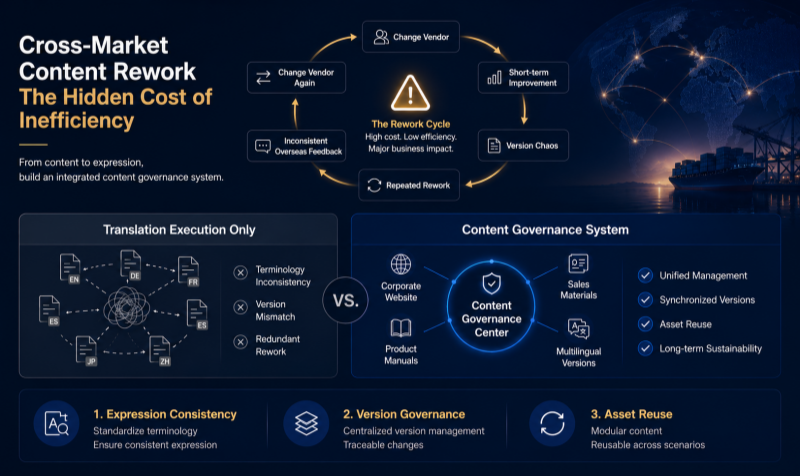
In post-project reviews with many globalizing companies, we often see the same cycle repeat itself: a translation vendor is selected at the beginning of the project, but six months later overseas teams complain that the content"doesn't sound local enough,"while headquarters believes"the key messaging has drifted."The company then replaces the vendor.
At first, the new supplier seems to improve things. But before long, the same problems reappear: inconsistent versions, terminology confusion, and repeated rounds of revision.
Most companies assume this is simply a vendor capability issue. But the deeper problem is usually this: the issue is not a single translation delivery—it is that after delivery, no one is responsible for cross-market content alignment and governance.
When companies try to solve structural problems merely by changing execution vendors, they often end up repeating the same mistakes. The real challenge of cross-market content is not finding"better translation,"but establishing a layer responsible for the content system itself.
I. Why Do Companies Instinctively Choose to"Change Vendors"?
When cross-market content problems arise, replacing vendors feels like the most direct solution. This reaction is usually driven by two intuitive assumptions.
1. The Problem Must Be Execution
When overseas teams say the language feels unnatural, or headquarters says the messaging is inaccurate, the most immediate conclusion is:"the translation quality is poor."
As a result, companies search for a new vendor claiming native-level fluency or stronger industry expertise, expecting this alone to solve the issue.
2. A New Vendor Might Bring a Better Perspective
Companies hope new suppliers will better understand cultural context and local market expectations, solving the issue of content not feeling localized enough.
These assumptions may work in isolated delivery scenarios. But in complex environments involving continuous updates, multiple languages, and multiple channels, changing execution teams usually brings only temporary improvement—not structural resolution.
💡 Landelion Insight: Replacing vendors answers the question of who executes. Cross-market content governance addresses how content is managed and maintained.
II. Why Does Rework Continue Even After Changing Vendors?
Many companies discover that even highly committed new vendors struggle with the same recurring problems. The reason is not lack of effort—it is that they are inheriting an unmanaged content environment.
1. No Unified Expression Standards
New vendors often receive no centralized terminology database, tone-of-voice guidelines, or aligned core messaging references. As a result, they rely on their own interpretation, creating inconsistencies between old and new versions, as well as across languages.
Industry discussions around brand consistency increasingly emphasize the importance of creating a “unified experience for target audiences” through a cohesive strategy across teams and channels. In multi-market communication environments, inconsistent messaging often leads to additional rework and coordination costs.
Result: Headquarters feels the meaning has changed, while overseas teams still feel the language lacks local fluency.
2. No Version Governance Mechanism
When products evolve or market strategies shift, there are often no rules defining: which content must be updated, what can be reused, and how changes should synchronize across channels and languages.
Vendors simply modify content on demand, gradually fragmenting websites, brochures, presentations, and sales materials.
Result: The more channels the company operates, the more chaotic the content becomes.
3. No Content Asset Reuse Logic
Every new task is treated as an entirely new project. Previously approved translations and messaging are never consolidated into reusable assets. New vendors cannot leverage historical work, leading to repeated labor and repeated revisions.
Result: Budgets continue increasing, but no long-term content assets are accumulated.
💡 Landelion Insight: Without governance, replacing vendors simply means assigning new people to manage the same chaos.
III. What Companies Really Lack Is a Layer Responsible for the Cross-Market Content System
To break the cycle of"change vendor → rework → change vendor again,"companies must recognize that what they truly lack is not another translation provider, but a governance layer responsible for cross-market content systems.
This layer creates value through three core mechanisms.
1. Expression Alignment Mechanism
The goal is not identical wording everywhere, but consistent core messaging, brand tone, and key terminology across languages and channels. This requires centralized terminology and expression guidelines applied before every delivery.
Value: Ensures global audiences hear the same brand story, reducing cognitive confusion.
2. Version Governance Mechanism
Companies need clear rules defining: who can update content, how updates synchronize across markets, and how previous versions are archived. This requires structured version management and update protocols.
Value: Maintains long-term content accuracy while reducing compliance risks and customer misunderstandings.
3. Long-Term Reuse Mechanism
Approved content should become reusable assets. When new projects arise, companies should reuse existing structures and expressions instead of rebuilding from scratch. This requires structured content asset libraries and onboarding rules for future markets and languages.
Value: Lowers marginal costs and allows content investment to accumulate over time rather than repeatedly resetting.
💡 Landelion Insight: Cross-market content systems do not replace translation vendors—they provide all execution teams with a unified operational framework and governance structure.
IV. How to Tell Whether the Problem Is Translation Execution or the Content System Itself
Not every company immediately needs a fully structured governance solution. But when the following signals appear, simply replacing execution vendors is unlikely to solve the issue.
1. Rework Rates Remain High
Every delivery requires heavy revisions from either headquarters or overseas teams, with feedback focused on inconsistent tone, unclear priorities, or messaging drift rather than language errors alone.
2. Multiple Versions Cannot Stay Aligned
Websites, brochures, presentations, and multilingual versions frequently contradict each other or update asynchronously.
3. Historical Assets Cannot Be Reused
Every new project requires re-explaining context and reconfirming terminology because previous work cannot be directly reused.
When these issues appear, companies should first conduct a structural review of existing websites, product materials, and multilingual content. The key is to determine whether the root problem lies in translation execution or the content system itself—before deciding whether to replace vendors or introduce governance capabilities.
💡 Landelion Insight: Diagnose governance gaps before changing execution strategy.
Conclusion: Move from"Changing People"to"Building Systems"
The core challenge of cross-market content management is not finding the perfect execution partner—it is building a sustainable governance framework.
For globalizing companies, recognizing the absence of a content governance layer is the first step toward ending ineffective trial and error.
Through cross-market content system development, companies can ensure their messaging is consistently understood, maintained, and scalable across markets and languages—turning content investment into long-term strategic assets.
At Landelion, we focus not just on translating content, but on helping companies establish unified, governable, and reusable cross-market content systems.
🚀 Take Action: Evaluate Your Cross-Market Content Governance Risk
Is your multilingual content operation trapped in a cycle where changing vendors no longer solves the problem? Landelion provides cross-market content system assessments for B2B companies, evaluating messaging consistency, version governance, and content asset reuse capability, to help identify whether the root issue lies in execution—or in the system itself.