


In B2B sales progression, a common scenario unfolds when a customer enters the formal evaluation phase and begins requesting more comprehensive decision‑making materials.
They may ask the company to submit a full proposal within a short timeframe, supplemented by peer case studies, product white papers, quality certifications, capability statements, and delivery process documents. For the customer, these are not “optional attachments” – they are critical evidence for deciding whether a supplier is worth further consideration.
Yet many companies discover at this stage that while the relevant content has been created at some point, it is scattered across different departments, folders, and versions. Content teams have to dig out old case studies, sales teams have to repeatedly verify versions, and product and delivery teams have to supplement explanations. The final compiled materials may be usable, but they often appear unsystematic, inconsistent, and lacking a clear sales‑support structure.
The evaluation phase is the most critical step before a purchasing decision. At this point, the customer needs not just a single piece of content, but a complete set of sales‑support materials covering proposals, case studies, white papers, FAQs, product data, certifications, and delivery processes. However, many companies still resort to “scrambling to piece together materials” when faced with such requests.
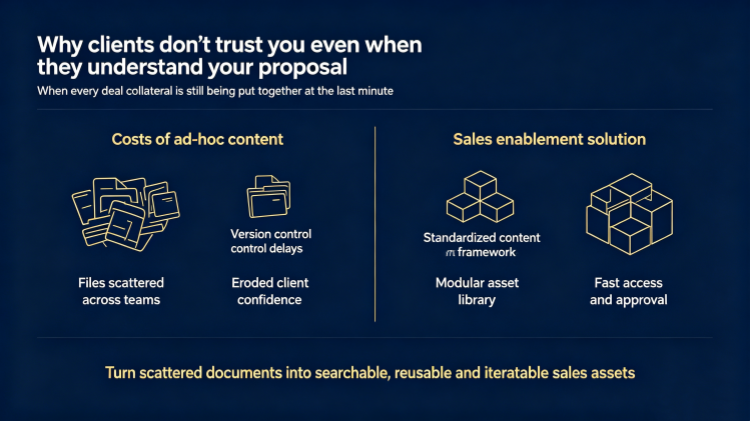
I. The cost of “scrambling to piece together materials” is higher than you think
Many companies believe that preparing materials on demand is just “a bit more work” – a few extra days. But the actual toll is far greater.
1. Enormous time cost.
Sales spend significant time searching for materials, verifying versions, and chasing content teams; content teams spend their time digging through old files, filling gaps, and reconciling information. The evaluation window is tight – the slower the material preparation, the longer the customer waits, and the lower the progression efficiency.
2. Quality is uncontrollable.
Materials assembled on the fly often lack completeness and consistency. The same data may not match across the proposal and case studies, certification documents may be missing key pages, or terminology in the white paper may conflict with the website – these issues are magnified during the evaluation phase and directly undermine the company’s professionalism and credibility.
3. Increased friction between sales and content teams.
Sales want to get deliverable materials to the customer quickly, while content teams need to repeatedly confirm customer needs, document versions, and usage boundaries. Both sides are filling gaps, but without a directly accessible sales‑support material system, collaboration becomes reactive to ad‑hoc demands.
4. Trust with large accounts is hard to build.
The evaluation phase is when customers scrutinize details most. If material quality is inconsistent, delivery is slow, or information is contradictory, the customer will directly question the company’s delivery capability, management level, and collaborative maturity.
II. Why is evaluation‑phase content the hardest to prepare?
The content needed during the evaluation phase is fundamentally different from day‑to‑day marketing content. Regular content can focus on branding and ongoing exposure, but evaluation‑phase materials must directly address the customer’s specific procurement criteria.
This type of content shares several characteristics:
1. High specificity – must match the customer’s unique scenario.
The customer does not want a generic product introduction – they want “a solution based on our industry and operating conditions”. Each customer’s needs differ, requiring tailored adjustments each time on top of standard content.
2. Broad coverage – spanning proposals, case studies, white papers, certifications, delivery processes, and more.
The evaluation phase is not satisfied by a single article – the customer needs a comprehensive package: a proposal explaining how, case studies proving past success, white papers demonstrating depth, certifications proving compliance, and delivery processes showing how it will be executed.
3. Tight timelines – the customer’s evaluation window is usually short.
Once a customer formally starts the evaluation, the time window given to the supplier is typically narrow. If the company cannot provide complete materials in time, the customer’s momentum may be affected.
These characteristics mean that evaluation‑phase content cannot be solved by “writing on the fly” – it requires a content‑asset system that can be quickly accessed and flexibly assembled.
III. From “scrambling to piece materials” to “reusable sales toolkit”
Solving the material‑preparation problem during the evaluation phase cannot rely on “spending more time to write better each time”. Instead, content‑asset management must evolve from “folder‑based storage” to “component‑based toolkit”. Specifically, this can be approached from the following aspects:
1. Establish a reusable sales‑toolkit structure
Start by asking: what content does the customer need during the evaluation phase? Fix these categories – proposal framework, case library, white papers, FAQs, certification documents, delivery process descriptions. Each category becomes a “module” in the sales toolkit, rather than isolated files scattered around.
2. Decompose core content into standard, assemblable modules
Each module should be a customisable standard component – fixed framework, consistent core information, while preserving room for client‑specific adjustments. For case modules, each case should include standard fields: customer industry, project background, core pain points, solution, implementation results. For the proposal framework, include standard sections: problem understanding, solution path, delivery plan, success criteria. When sales face a new customer, they only need to make targeted adjustments on top of the standard modules, not start from scratch.
3. Define update responsibilities and cadence
Once modules are established, a maintenance mechanism is needed to ensure timeliness and accuracy. Case modules should be updated at a fixed cadence, adding newly delivered projects; certification documents need to be updated electronically after each renewal; white papers and product materials should be revised alongside product iterations. Clear ownership must be assigned to avoid “everyone’s responsible, no one’s accountable”.
4. Establish a rapid‑access process for evaluation‑phase content
When sales receive an evaluation request, they should be able to retrieve the corresponding material modules through a unified process, with the content team handling integration and customisation according to the customer’s specific needs – rather than starting over each time with “searching folders, chasing materials, and reconciling versions”.
IV. Evolution from “single‑piece content” to “sales toolkit”
| Evolution dimension | Starting from “single‑piece content” | Gradually moving to “sales toolkit” |
|---|---|---|
| Content organisation | Files scattered across departments and folders | Categorised by evaluation needs, structured as a sales toolkit |
| Content reuse | Rewriting proposals and re‑finding cases each time | Rapidly assembled based on standard modules, with targeted adjustments |
| Update mechanism | Changed on the fly, used and modified without archiving | Fixed update cadence, version records maintained |
| Sales access method | Chasing content teams via WeChat/email, waiting for responses | Access, assemble, and customise through a unified process |
| Multilingual versions | Translating proposals, cases, or certifications on demand when needed | Core proposals, cases, certifications, and process descriptions prepared as standard multilingual versions in advance |
Content assets are not one‑off documents – they are tools that can be repeatedly accessed and continuously iterated. Through systematic management, companies can enable sales to deliver what the customer needs faster and more consistently when the customer enters the evaluation phase – no longer scrambling to piece materials together.
V. Where does your evaluation‑phase content readiness stand?
If you are unsure of your team’s current state, use these quick self‑check questions:
⬜ When sales receive an evaluation request, do they know where to find ready‑made proposal and case frameworks?
If the sales team’s first reaction is to ask the content team “do we have any cases in XX industry?”, the access path is unclear.
⬜ Can core proposal content and case information be quickly retrieved?
When a customer asks for three peer case studies, can you select, anonymise, and compile them within a short time? If not, the case library structure is flawed.
⬜ Are white papers, certifications, and delivery processes maintained and synced regularly?
Is someone consistently maintaining and updating these materials? If you have to check “is this the latest version?” every time you use them, version management and update mechanisms are missing.
If any of the above issues exist, your evaluation‑phase content assets have not yet formed true sales‑support capabilities.
Conclusion: Enable sales to stop scrambling for materials when customers are evaluating
After the customer enters the evaluation phase, what the company truly faces is not “preparing a few more documents”, but whether it can consistently deliver a set of content evidence sufficient to support the customer’s judgment within a limited time.
Proposals, case studies, white papers, certifications, and delivery processes should not be patched together only after the customer asks. They should be organised in advance as searchable, reusable, updatable, and accessible sales‑support content assets. This way, sales can quickly assemble professional, complete, and consistent materials when facing different customers, scenarios, and evaluation requirements.
Content System Building addresses precisely the break between “having content” and “being effectively usable by sales”. Landelion can help companies reorganise fragmented sales materials into a content system oriented to the customer evaluation phase – ensuring that content does not merely sit in archives, but actively supports customer judgment and sales progression at critical decision points.
Act now Is your content pieced together for every customer evaluation, or have you built a sales‑support system that can be quickly accessed and flexibly assembled?Landelion can help B2B companies build an evaluation‑phase content‑asset system from the perspective of Content System Building – diagnosing whether the problem lies in content structure, reuse mechanisms, update cadence, or access processes. Understand Content System Building solution Book a sales content asset readiness diagnosis |