


Content impressions, profile follows, and engagement metrics on overseas social media are all growing – but what the sales team cares about more is: how many of these touchpoints come from the key roles that actually influence purchasing decisions?
The problem is not just content exposure – it is also whether the audience being reached is precise enough.
When a company’s social media operations still run on “broad reach” logic, the proportion of people with real purchasing influence in the reached audience may not be high. Content gains exposure, but does not necessarily enter the field of view of the people who influence purchasing progress.
Related LinkedIn ad audit data points to a similar problem. The 2026 B2B SaaS LinkedIn Ads Waste Report published by GrowthSpree audited the LinkedIn ad accounts of 56 B2B SaaS companies, covering $9.4 million in ad spend, and found an average waste rate of 32% – decision-makers received less than 33% of the ad budget, while the target proportion should exceed 60%. Data like this reminds companies that social media reach cannot be measured by impressions and clicks alone – it must also examine whether budget, content, and ongoing follow-up truly cover the key roles in the purchasing decision chain. In its work with manufacturing companies going global, Landelion has also observed that the problem with many accounts is not a lack of exposure, but that reach does not enter the field of view of key roles.
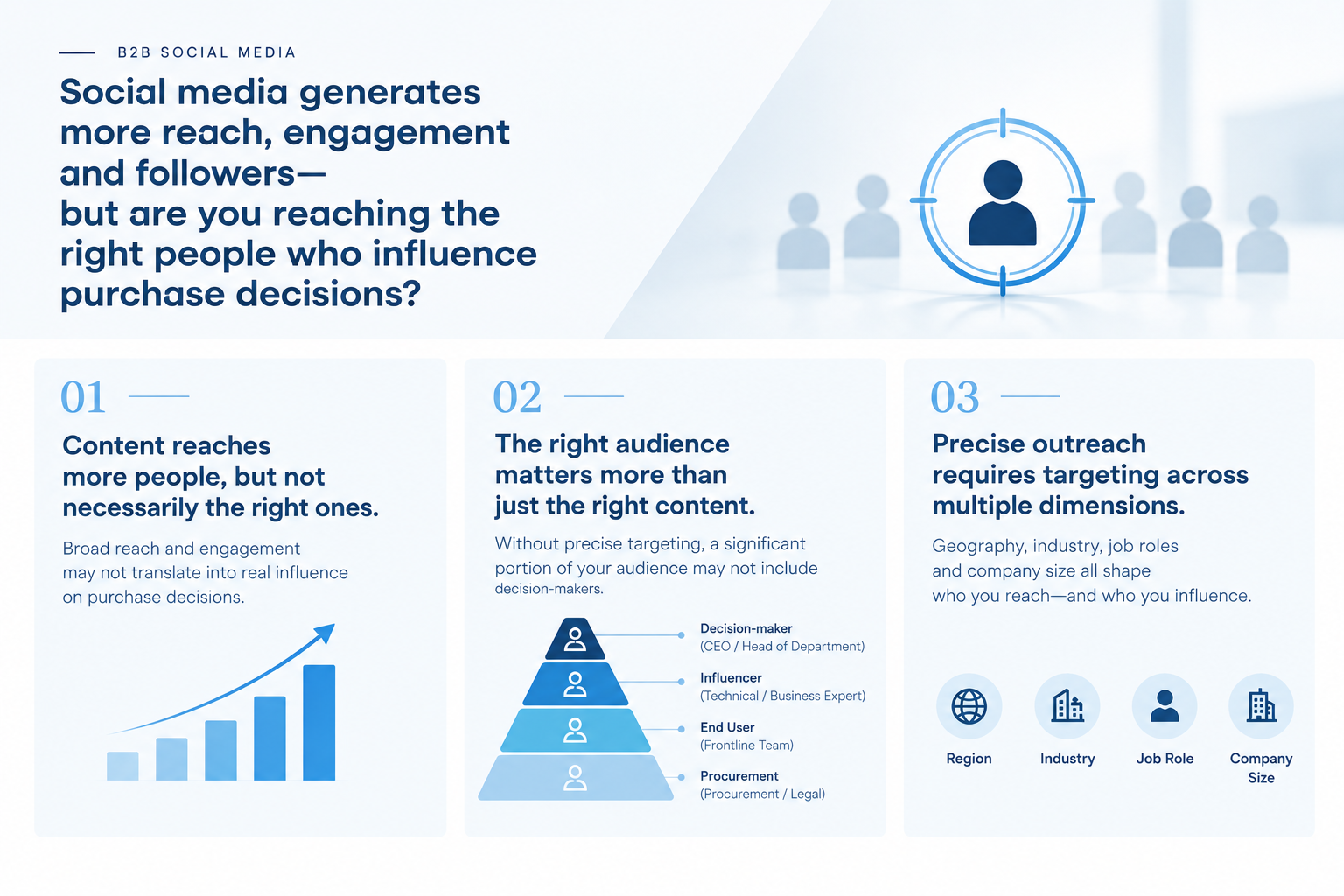
I. Key decision-makers are not “all customers” – they are an identifiable group of people
Many B2B companies operate on the logic that if content is good enough and coverage is broad enough, decision-makers will naturally see it. But the reality is that decision-makers are surrounded by vast amounts of information every day – relying on them to discover content naturally is usually limited in efficiency.
Key decision-makers are not “all customers” – they are a group of people who can be identified, segmented, and targeted. They are distributed across specific industries, specific company sizes, and specific job levels. LinkedIn’s targeting capabilities provide the foundation for precise reach – combining job function and job level allows you to reach decision-makers in a specific professional field. By combining multiple parameters such as industry, job title, company size, and geography, social reach can effectively cover key decision-makers.
The question is: has the company first clearly defined “who our key decision-makers are”?
If the definition is vague – such as “manufacturing customers” or “overseas procurement leads” – then the reach strategy is vague. Precise reach requires precise definition: which region is the target market? Which sub-sector is the target industry? Is the target role a procurement director, a technical lead, or management? What is the target company size?
The answers to these questions determine the direction of all subsequent outreach actions. In practice, Landelion recommends that companies start from a “target account list” – screening out the target companies most likely to close in the coming period, and designing content strategies around their shared pain points, rather than making generic statements to all potential audiences.
II. Roles in the decision chain have different reach logic
B2B purchasing decisions typically involve multiple types of roles, each with different reach logic and content needs. Based on its work with B2B companies, Landelion categorises decision-chain roles as follows:
1. Decision-makers (CEO / department director)
They focus on ROI, strategic fit, and risk control. What they need to see is “can this investment be justified” and “what is the overall value of this partnership to the company”. To reach this type of role, the content focus should be business value and risk avoidance – presenting quantifiable business outcomes and long-term partnership value, rather than technical details.
2. Influencers (technical / business experts)
They focus on solution depth, validation data, and peer practices. What they need to verify is whether the technical capability is feasible and whether the solution fits their own business scenario. To reach this type of role, the content focus should be logical architecture and empirical data – presenting the technical path, solution logic, and verifiable practical results.
3. Users (frontline teams)
They focus on ease of operation, problem-solving, and efficiency improvement. What they need to see is “is it easy to use” and “can it reduce the frontline execution burden and improve daily work efficiency”. To reach this type of role, the content focus should be actual experience and operational value – presenting how to simplify processes and improve efficiency.
4. Procurement roles (procurement / legal)
They focus on delivery assurance, contract terms, and service SLAs. What they need to verify is the executability of the partnership and the controllability of risk. To reach this type of role, the content focus should be clear explanations of delivery capability, compliance certifications, and service mechanisms.
For the same company and the same project, different roles care about different questions. If social reach uses only one set of content and one logic to cover everyone, the information will struggle to effectively reach the key roles that truly influence purchasing progress. Landelion recommends building a strategic framework based on “content objective” (brand building vs. sales conversion) and “core audience” (decision-makers vs. influencers/users) to achieve precise allocation of content resources.
III. Four core dimensions of precise reach
To make social reach truly hit key decision-makers, a precise reach framework needs to be built across the following four dimensions:
Dimension 1: Target region
There are clear differences between overseas markets. North America, Europe, Southeast Asia, and the Middle East each have different decision-maker priorities, communication habits, and information channels. Companies need to clarify: which regional market is the current focus? In which countries and cities are the region’s decision-makers mainly distributed? How do time zones, languages, and cultural differences in different regions affect the approach to reach?
Dimension 2: Industry circles
B2B decision-makers tend to gather in specific industry circles – industry groups, professional communities, and vertical media audiences. Companies need to clarify: which industry sub-sector are target customers concentrated in? In which online and offline scenarios are the industry’s decision-makers typically active? How can the company enter these circles and establish a professional presence? Brands validated by professional communities or peers are more likely to enter the buyer’s initial consideration set.
Dimension 3: Job roles
This is the most fundamental dimension – and the one most easily overlooked. Many companies target only “manager and above”, but a “manager” and a “vice president” have completely different decision authority. Precise reach needs to be refined to specific job titles: procurement director, VP of engineering, supply chain lead, plant manager… The clearer the job definition, the easier it is to implement audience settings and content matching.
Dimension 4: Layered reach and ongoing follow-up
The role of social media is not one-off conversion, but continuous “being seen” – through a long-term content cadence, ensuring that at key decision-making moments (such as budget approval periods or technical selection periods), content remains consistently visible during the customer’s critical decision stage. Reach is not a one-time action, but a process that requires ongoing follow-up.
IV. The upgrade from “broad reach” to “precise reach”
| Dimension | Broad reach logic | Key-role reach logic |
|---|---|---|
| Goal setting | Follower count, impressions | Target customer coverage, decision-layer engagement rate |
| Audience definition | “Manufacturing customers” or “overseas procurement leads” | Specific industry, specific job title, specific company size |
| Content strategy | Generic industry hot topics | Layered content design targeting customer pain points |
| Reach method | Broad ad delivery | Targeted reach to key roles with layered follow-up |
| KPIs | Click-through rate (CTR) | Key-role engagement, qualified inquiry quality, follow-up conversion |
Precise reach also requires establishing layered logic at the ad delivery level. Not all decision-makers should be reached in the same way. Based on the different roles in the decision chain, a multi-tier audience structure can be built: core layer (decision-makers), influence layer (technical/business experts), and user layer (frontline teams). Different tiers use different ad creatives, different information emphasis, and different conversion goals.
Companies are increasing their investment in LinkedIn, but if that investment is not accompanied by precise audience segmentation and ongoing data review, the budget may be consumed more on broad reach – making it difficult to convert into higher-quality customer reach and follow-up opportunities.
V. Is your social reach missing key decision-makers?
If you are unsure about your team’s current state, use these quick self-check questions:
⬜ Is the definition of key decision-makers specific enough?
Target region, target industry, target job title, target company size – are all four dimensions clearly defined? If the definition remains at the level of “overseas customers” or “manufacturing decision-makers”, the reach strategy lacks precision.
⬜ Does the reach strategy distinguish between different roles in the decision chain?
Decision-makers, influencers, users, procurement roles – do different roles have different reach logic and content strategies? If all reach uses the same set of content, layered reach has a break.
⬜ Does ad delivery have clear audience segmentation and ongoing follow-up mechanisms?
Are ad audiences segmented by decision role? Has a complete rhythm been established from first touch to ongoing follow-up? If not, the ad strategy has a break.
Conclusion: The key to social growth is continuously covering the key roles in the purchasing decision chain
The value of B2B overseas social media is not just expanding exposure – it is ensuring content continuously enters the field of view of the key roles in the purchasing decision chain. Companies need to first define the target region, industry circles, job roles, and decision-chain tiers, then match the corresponding content and reach methods. Otherwise, even if account metrics grow, they may not drive effective business opportunities.
Key decision-makers do not appear automatically – they are precisely identified, reached in layers, and followed up consistently. From audience definition and role segmentation to content matching and ongoing follow-up, every step requires systematic design and execution. Landelion’s Target Audience Reach & Conversion service, centred on social account operations and social ad delivery, helps companies consistently reach target customers, decision-makers, and partners – so that social growth is not just about expanding exposure, but about continuously covering the key roles that truly influence business progress.
Act now Is your overseas social reach covering a lot of people, or the right people?Landelion can help B2B companies examine the precision of their reach to key decision-makers from the perspective of Target Audience Reach & Conversion – diagnosing whether the issue lies in target definition, audience segmentation, content matching, or ongoing follow-up. Explore Target Audience Reach & Conversion solution Book an audience segmentation diagnosis |
📚 Further reading
B2B Social Media Strategy for Manufacturing: Target 200 Key Accounts, Not Mass Traffic
Say No to the “Zombie Website”: Using LinkedIn & YouTube to Increase Global Inquiries
LinkedIn's New Algorithm Can't Replace These Three B2B Growth Essentials