


In the context of increasingly complex B2B purchasing decisions and stronger customer validation needs, case studies are no longer just about “what the company has done” – they have become a critical basis for judging whether a supplier understands similar problems and possesses verifiable experience. Publicly available data from the LinkedIn Manufacturing Buyer Research 2025 indicates that 78% of manufacturing buyers report that the size and seniority of their purchasing decision committee have increased over the past year. For such customers, whether case content supports evaluation and judgment is becoming even more important.
However, the problem with many B2B companies’ case studies lies right here: they appear to include clients, projects, and results, but lack problem diagnosis, process breakdown, risk control, and reusable value. Such cases can prove that “you have done it”, but they hardly help customers judge whether “similar problems can be stably solved if entrusted to you”.
A B2B case study is not a success story – it is a customer’s risk‑validation path. The question it must answer is not “have you done this before”, but “why can similar problems be stably solved when entrusted to you”.
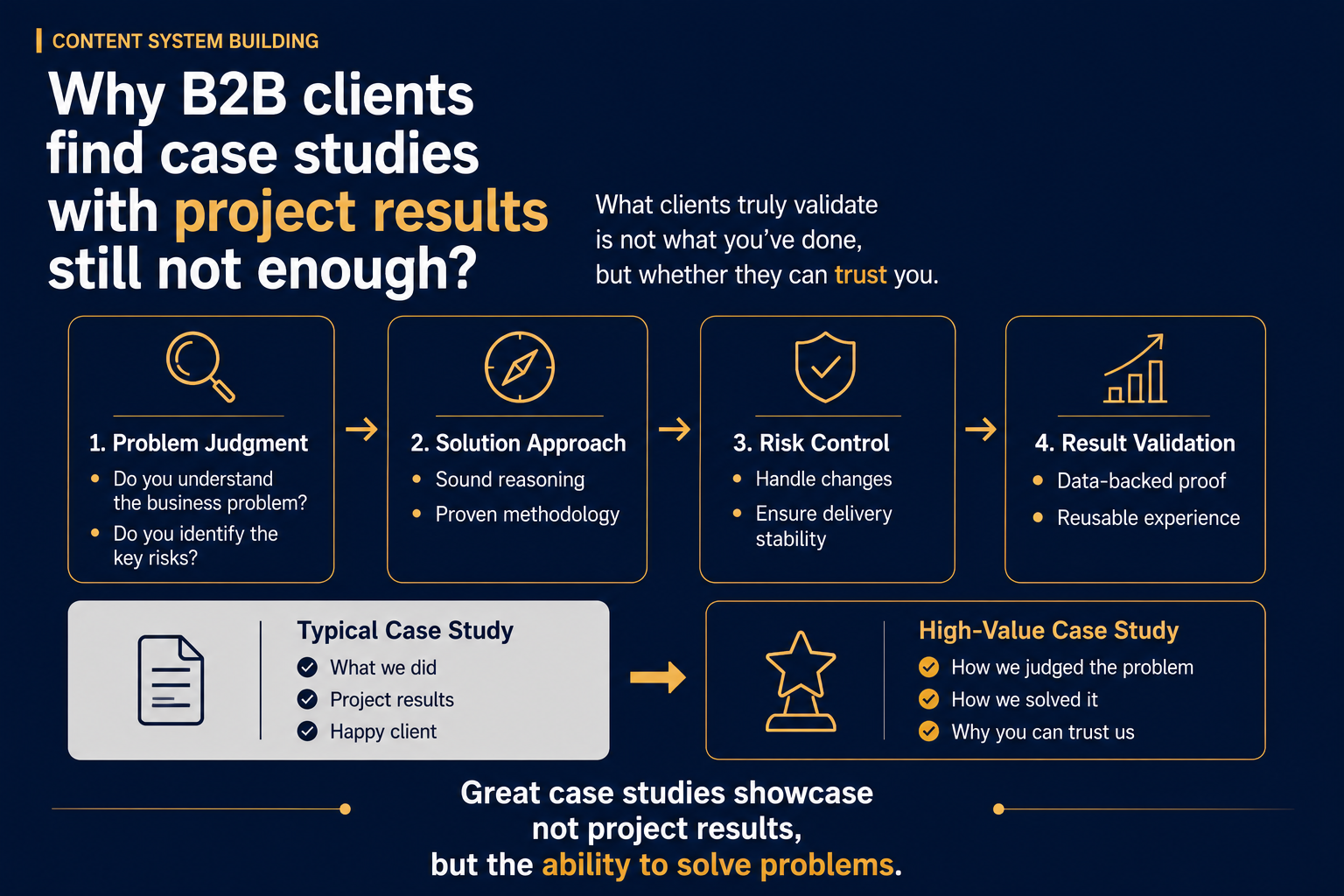
I. If a case only reports results, why do customers still hesitate to choose?
Many companies’ case studies seem structurally complete – client background, cooperation content, and project results – all three are present. Yet after reading them, customers still cannot form a clear judgment.
The reason: the case only proves “you have done it”, but not “you understand me”.
When customers read a case, they typically have a set of implicit questions: Is this case similar to mine? What problems did the client face at the time? Where were the difficulties? How did the supplier diagnose the situation? Were there adjustments midway? How were results verified? If applied to my scenario, what can be reused and what needs to be re‑evaluated?
When a case presents only outcomes, none of these questions are answered.
1. Outcomes fail to convey diagnostic capability.
What a project ultimately achieved only shows that the project was completed. It does not reveal “what was done right along the way”. What customers need to know is: at the outset, how did the company diagnose the nature of the problem? Among multiple feasible paths, why was this one chosen? These diagnostic rationales are exactly what customers rely on to assess whether “you can solve my problem”.
2. Outcomes cannot demonstrate risk‑control processes.
Complex B2B projects almost inevitably encounter uncertainties – changing requirements, technical hurdles, coordination issues. Customers know this, perhaps even better than the supplier. They do not want to see whether you encountered problems; they want to see how you diagnosed, adjusted, and controlled risks when problems arose. If a case portrays the process as too smooth, customers may find it unrealistic.
3. Outcomes cannot build transferable confidence.
One client’s success is, to another client, merely “someone else’s story”. Unless the case explains which experiences from the project can be transferred to similar scenarios, under what conditions they apply, and what types of problems they address, the customer cannot judge “what this success has to do with me”.
II. What do customers really seek to validate from a case?
When B2B customers read a case study, they are essentially conducting risk validation – especially for high‑value, long‑cycle projects involving multiple departments and significant outcomes. Their primary concern is not how the supplier praises itself, but whether similar problems have been solved before, whether there were risks along the way, and whether the results are verifiable.
Specifically, customers look for four types of validation information in a case:
1. Accuracy of problem diagnosis.
Customers want to know: Have you accurately understood the essence of our type of problem? Do you have the ability to identify key risks and bottlenecks? This determines whether you can make the right judgments early in the project.
2. Soundness of the solution path.
Customers want to know: When faced with complex problems, how did you break them down, design the path, and implement? Is your logic clear and executable? This affects whether the project can proceed as planned.
3. Reliability of risk control.
Customers want to know: How did you respond and adjust when difficulties arose? Do you have the capability to maintain delivery quality amid uncertainty? This determines whether the project can be delivered reliably.
4. Verifiability of results.
Customers want to know: Is there tangible, measurable, or verifiable evidence for the results you claim? Can the outcomes be traced and audited? This determines whether the promises are credible.
If a case only covers the fourth item while ignoring the first three, the customer’s risk‑validation path is incomplete.
III. How should case content be structured to support customer evaluation?
Based on customer validation needs, case content should be organised around the following structure:
1. Client background – let readers self‑identify.
Not a generic introduction to how large or famous the client is, but an explanation of their industry, business context, and stage at the time. The background should serve to answer “why this problem matters”.
2. Original problem – help readers understand complexity.
Why did the client need change? What were the shortcomings of the previous solution? What pressures arose in business, efficiency, cost, risk, or management? Without a problem, the case has no driving logic.
3. Key challenges – reveal the boundaries of capability.
The most valuable part of a B2B project often lies in the challenges – complex environments, tight timelines, multiple interfaces, insufficient data, or internal coordination difficulties. The clearer the challenges, the more visible the problem‑solving capability becomes.
4. Action taken – show diagnosis and path.
Do not just write “provided a solution”; describe specifically how the problem was broken down, how the path was designed, how it was executed, coordinated, and validated. This section is the core basis for customers to judge whether you can solve their problem.
5. Evidence of results – convince readers that outcomes are verifiable.
Results should not remain at vague statements like “customer satisfaction” or “significant improvement”; instead, provide tangible, measurable, or traceable evidence wherever possible.
6. Reusable value – help readers judge “what this means to me”.
Conclude the case by telling the reader what insights it offers to similar customers: under what conditions it applies, what problems it can address, and how to proceed with the next evaluation step.
IV. Evolution from “project showcase” to “evaluation support”
| Evolution dimension | Starting from “project showcase” | Gradually moving to “evaluation support” |
|---|---|---|
| Case positioning | Show “what we have done and what results we achieved” | Help customers validate “whether you can solve my problem” |
| Content structure | Client background + cooperation content + project results | Background → problem → challenges → solution path → results → reusable value |
| Process presentation | Skip the process, only report results | Present diagnostic logic, path choices, and risk control |
| Result expression | Vague “customer satisfaction”, “significant improvement” | Measurable, traceable, verifiable evidence |
| Customer perspective | Starting from the company’s own achievements | Starting from the customer’s validation needs |
| Sales usage | Published and left to sit on the website | Can be retrieved by sales during customer evaluation by industry, problem, and scenario |
A case study is not a one‑off promotional piece – it is a trust asset that can be continuously accumulated and repeatedly accessed. Through systematic management, companies can upgrade their case studies from “project showcases” to the “decision‑support tools” that customers truly need during the evaluation phase.
V. Where does your case content stand?
If you are unsure about the current state of your case content, use these questions for a quick self‑check:
⬜ Does the case present the process of problem diagnosis and path selection?
Pick any case at random – does it clearly explain “how the problem was diagnosed at the time” and “why this particular path was chosen”? If it only states “provided a solution”, the process presentation is missing.
⬜ Does the case describe the key challenges and how they were addressed?
Does the case mention any difficulties or uncertainties in the project? Does it explain how they were handled and adjusted? If every case is presented as smooth sailing, risk‑control information is missing.
⬜ Does the case help the customer judge “what this means to me”?
After reading the case, can the reader determine “whether this experience can be transferred to my scenario”? If the only conclusion is “they have done it”, the reusable value has not been distilled.
If any of the above issues exist, the case content has not yet truly fulfilled its role as evaluation support.
Conclusion: Make case studies the validation basis for customers evaluating suppliers
B2B customers read case studies not just to learn about projects a company has delivered, but to reduce the uncertainty of the next decision step.
If a case only reports outcomes, the customer sees only a completed proof. But if a case presents how problems were diagnosed, how paths were chosen, how risks were controlled, and how results were verified, then customers can more easily judge: whether this company understands similar problems, whether it has transferable experience, and whether it is worth moving to the next conversation.
Content System Building addresses precisely the transformation of case studies from “project showcase” to “evaluation support”. Landelion can help companies restructure case content and transform project experience into trust assets that are understandable to customers, callable by sales, and sustainably reusable.
Act now Are your case studies only showcasing project outcomes, or have they formed a complete trust path from problem diagnosis, path selection, risk control, to result verification?Landelion can help B2B companies restructure case content from the perspective of Content System Building – diagnosing whether the problem lies in challenge presentation, process description, result expression, or the distillation of reusable value. Explore Content System Building solution Book a case content asset diagnosis |