


The quality of simultaneous interpretation at large international conferences depends both on the interpreter's professional ability and on whether pre‑conference information preparation is sufficient. Especially when there are many speakers, dense agendas, and a tight schedule, whether terminology, agenda, and speech materials are aligned in advance directly affects how well interpreters understand the content and deliver on site.
Simultaneous interpretation requires interpreters to listen, comprehend, convert, and output almost at the same time. On‑site time for checking and correcting is limited. If key terminology has not been unified and speech materials have not been provided in advance, interpreters must spend more effort figuring out unfamiliar concepts and the logic of the speech, increasing the risk of misunderstanding or information loss.
An experimental study on simultaneous interpretation of professional speeches found that providing preparation materials in advance helps improve interpreters' accuracy. The related research also shows that pre‑conference preparation is an indispensable part of simultaneous interpreting.
Therefore, pre‑conference preparation for large international conferences is not just about collecting documents – it is about enabling the client, the conference organiser, and the language services team to align information in advance and reduce the pressure of last‑minute judgments on site.
I. Why does simultaneous interpretation at large international conferences depend more on pre‑conference preparation?
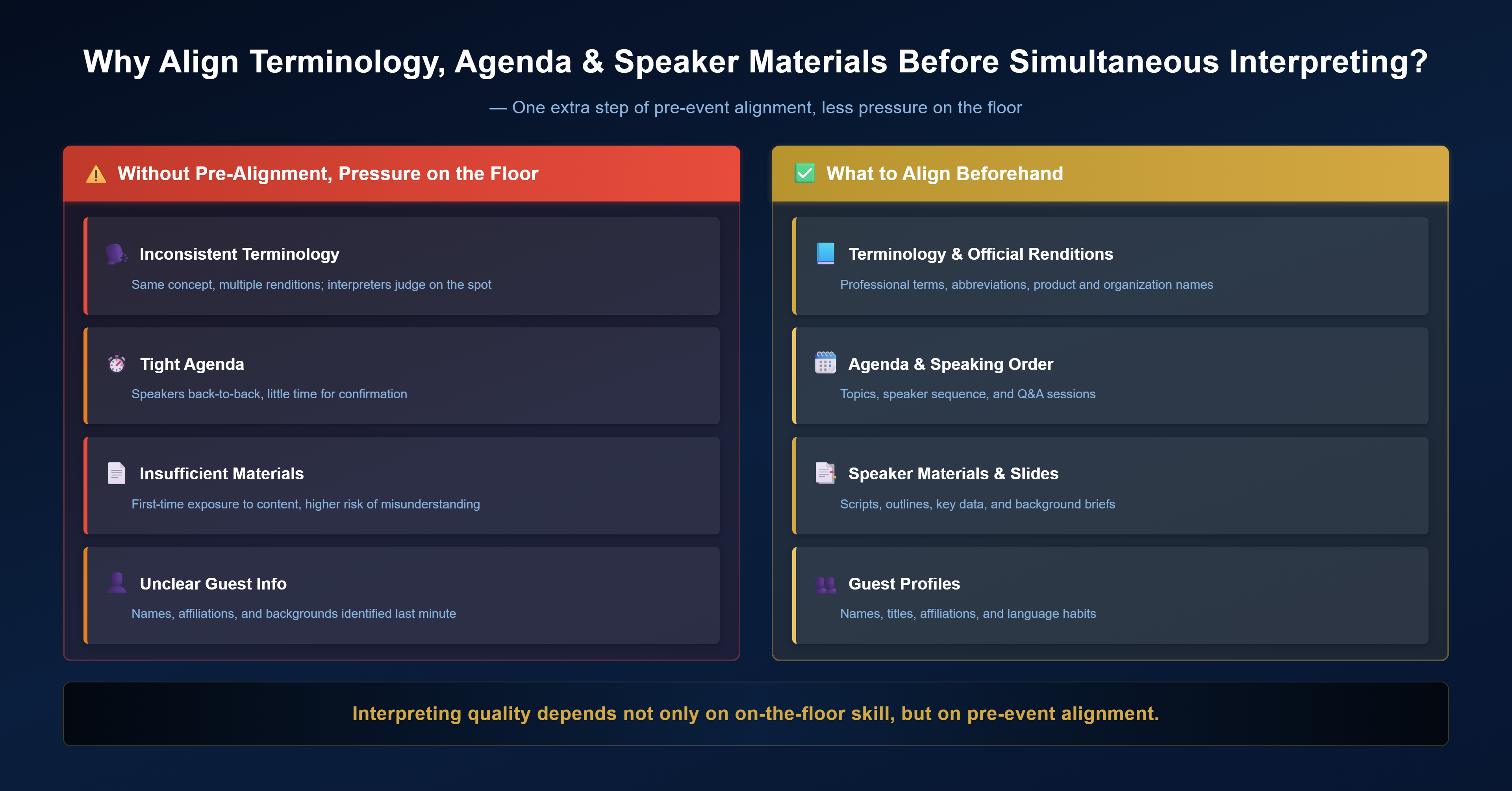
Compared with smaller meetings with fewer participants and more flexible communication rhythms, large international conferences typically involve more speakers, more complex professional content, and tighter agendas. The following aspects especially require advance preparation.
1. Multiple speakers mean terminology variations are likely
An international conference may cover different fields such as technology, products, business, and management. Different speakers may express the same concept differently, and product names, organisation names, and technical abbreviations are also likely to be inconsistent.
If the relevant terminology has not been confirmed in advance, interpreters must judge the specific meaning on site, which increases the difficulty of comprehension and delivery.
2. Tight agendas leave limited room for on‑site confirmation
Large conferences usually proceed according to a predetermined agenda, with presentations and Q&A sessions tightly interlinked. Interpreters need to understand in advance the theme of each session, the speaking order, and the key points of content in order to prepare accordingly.
If the agenda changes at short notice, or if the actual speech content differs significantly from expectations, a lack of background information increases the pressure of handling things on site.
3. Insufficient information preparation increases on‑site coordination costs
A conference site usually requires the client's point of contact, the event team, interpreters, and the equipment team to work together. If speech materials, terminology conventions, or speaker information have not been confirmed in advance, problems may surface all at once on site, affecting communication efficiency and making last‑minute adjustments harder.
These situations show that simultaneous interpretation at large conferences cannot rely solely on interpreters' on‑the‑spot adaptability – the conference organiser and the language services team must also complete the necessary information preparation in advance.
II. What information needs to be aligned before the conference?
Preparation for large international conferences can focus on the following five categories of information.
1. Terminology, abbreviations, and proper names
Compile professional terminology, industry abbreviations, product names, organisation names, and technical indicators in advance to form a bilingual reference list, and confirm the official translations.
For terms with multiple possible translations, a unified convention should be established in advance to avoid the same concept being expressed differently in different sessions.
2. Agenda and speaking order
Provide interpreters with the complete agenda, including the conference theme, speaker order, arrangements for each session, and Q&A segments.
If the agenda changes, updated versions should be synchronised promptly to help interpreters adjust their preparation priorities.
3. Speech materials and slides
Wherever possible, provide speakers' slides, scripts or core outlines, key data, and related background materials in advance.
What interpreters need to understand is not just individual terms, but also the overall logic of the speech, the core viewpoints, and the data conventions. Familiarity with this information in advance helps them understand the content more accurately.
4. Speaker information and background
Confirm in advance the speakers' names, titles, affiliated organisations, and relevant professional backgrounds. For conferences with participants from multiple countries, it is also helpful to understand their language characteristics and speaking habits as far as possible.
This information helps interpreters become familiar with the participants and reduces the difficulty of identifying proper names and understanding expressions on site.
5. Product names and business terminology
Company products, business units, solutions, and brand names usually have fixed official translations. Confirm the relevant expressions in advance and keep them consistent with existing product materials and external documents.
If multiple business departments or multiple speakers are involved, it is also necessary to confirm that all parties use the same set of names and conventions.
III. How does pre‑conference preparation reduce on‑site deviations and pressure?
The value of aligning information before the conference is not only to familiarise interpreters with the content in advance, but also to reduce repeated confirmation and last‑minute remediation on site.
1. Reduce terminology and comprehension deviations
Unifying terminology and proper names reduces the risk of multiple translations appearing across different sessions. Understanding the agenda and speech materials in advance also helps interpreters grasp the content background and accurately understand professional expressions.
2. Lower the pressure of on‑site judgments
When interpreters have the relevant background, terminology, and speech logic in advance, they can more easily judge complex content or unfamiliar expressions by drawing on the context, rather than relying entirely on on‑site guesswork.
Pre‑conference preparation cannot eliminate all unexpected situations, but it can reduce the problems that could have been solved in advance.
3. Improve multi‑party coordination efficiency
Large conferences involve multiple interpreters, event staff, client contacts, and the equipment team. Clarifying the agenda, material versions, terminology conventions, and on‑site arrangements in advance helps all parties work from consistent information, reducing ad‑hoc communication and repeated confirmation.
4. Provide a basis for post‑conference review
Pre‑conference records such as glossaries, agenda versions, and material lists can serve as references for post‑conference review. When information deviations occur, the team can further check whether materials were complete, terminology was unified, and the agenda was updated in time – and improve the preparation process accordingly.
IV. What is the difference between sufficient and insufficient pre‑conference preparation?
| Dimension | Information not aligned beforehand | Information aligned beforehand |
|---|---|---|
| Terminology handling | Judging meanings on site, with possible variations in translation | Terminology and official translations confirmed in advance |
| Agenda anticipation | Speaking topics and order not sufficiently clear | Agenda and key speaking points known in advance |
| Material preparation | Some content encountered only on site | Slides, scripts, and key data familiarised in advance |
| Speaker information | Identifying names, organisations, and backgrounds on the spot | Speaker information and backgrounds understood in advance |
| On‑site coordination | Last‑minute confirmation of information, increasing communication costs | All parties work from consistent information |
| Post‑conference review | Lack of complete preparation records | Issues can be checked against glossaries, agendas, and material lists |
Pre‑conference preparation cannot guarantee that no unexpected situations will arise on site, but it enables interpreters and the relevant teams to grasp the necessary information before entering the conference, so they can focus more energy on the on‑site communication itself rather than filling in background materials at the last minute.
V. Is your conference interpretation properly prepared in advance?
If your company is preparing for an international conference, start by checking the following three questions.
⬜ Have terminology and official translations been confirmed in advance?
Have professional terminology, product names, organisation names, and abbreviations been compiled and provided to the relevant interpreters? If different departments still use different expressions, terminology preparation needs further alignment.
⬜ Are speech materials and the agenda synchronised in time?
Have the speakers' slides, scripts, or core outlines, along with the complete agenda, been provided in advance? If materials are still being revised repeatedly close to the conference, a clear version management and update notification mechanism should be established.
⬜ Are speaker information and on‑site coordination arrangements clear?
Have the speakers' names, titles, affiliated organisations, and relevant backgrounds been confirmed? Among the client contacts, the event team, interpreters, and the equipment team, have responsibilities for information transfer and on‑site coordination been clearly defined?
These questions may seem like details of pre‑conference preparation, but they directly affect whether the language services team can fully understand the conference content, and whether changes on site can be coordinated and handled in time.
Conclusion: Interpretation quality starts with pre‑conference preparation
Simultaneous interpretation at large international conferences is not just about interpreters converting languages on site – it also requires the conference organiser and the language services team to prepare information and coordinate in advance.
Ununified terminology, an agenda that has not been synchronised in time, and insufficiently prepared speech materials can all increase the difficulty of on‑site comprehension and communication. Completing information alignment in advance reduces unnecessary on‑site judgments and provides more thorough preparation for the smooth running of the conference.
Landelion's Multilingual Communication & Coordination service covers pre‑conference terminology preparation, agenda and material alignment, and language service coordination during the conference – helping B2B companies prepare for international conferences in a more orderly way and reduce uncertainty in on‑site communication.
Act now Has your international conference interpretation aligned terminology, agenda, and speech materials in advance?Landelion can help B2B companies map out the preparation steps for conference language services from the perspective of Multilingual Communication & Coordination – checking what needs to be confirmed in advance across terminology alignment, material synchronisation, speaker information, and on‑site coordination. Explore Multilingual Communication & Coordination solution Book a pre‑conference language service consultation |
📚 Further reading
Why B2B Companies Must Identify Communication Audiences First in Overseas Project Collaboration
Don't Let Language Gaps Undermine Your Expertise – Build a Multilingual Communication System
How to Structure B2B Sales Materials for Internal Customer Handover and Decision Advancement