


Neither choice is inherently wrong. The problem is that if content and advertising are planned separately from the start, two outcomes tend to follow: ads bring clicks, but when customers visit the brand’s profile or website, the content feels thin and lacks professional substance; or content is published consistently, but without ad amplification and audience testing, reach remains limited and it becomes difficult to validate market feedback quickly during the launch phase.
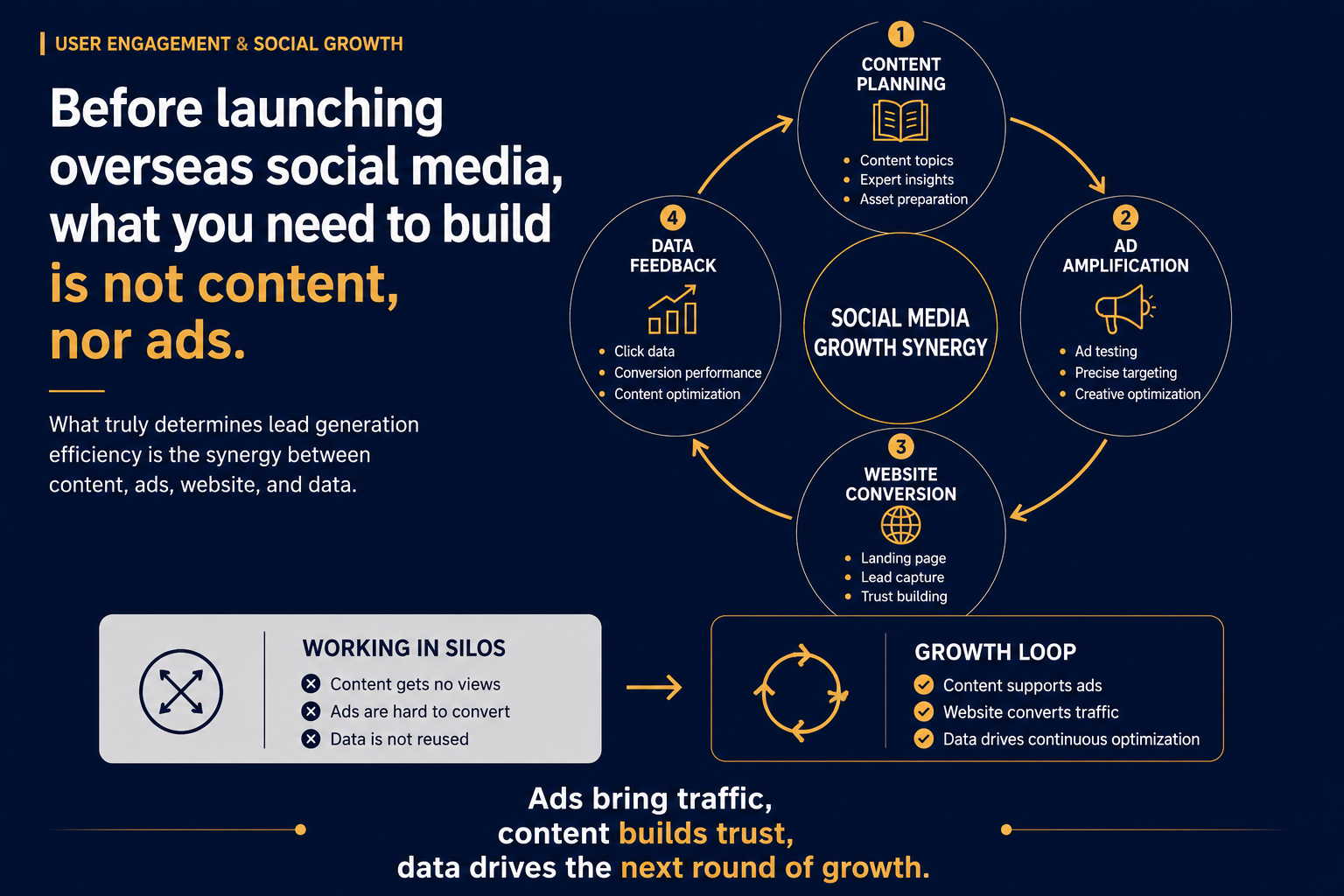
Before launching overseas social media, what needs to be set up is not just a publishing cadence for a particular platform or a one‑off ad configuration, but a collaborative framework where content production, ad testing, website handover, and data review feed into one another.
I. The relationship between content and advertising is not sequential, but mutually reinforcing
Many companies view content and advertising as a linear sequence – “create content first, then run ads”. However, B2B purchasing decisions are characterised by long cycles and fragmented touchpoints, meaning content and advertising need to work together continuously throughout the customer journey, not hand off to each other.
Content provides material and validation data for advertising.
The basis for ad copy, creative direction, and audience preferences should come from data feedback on existing content. Which topics generate high engagement, which content formats keep customers’ attention, which value propositions prompt further questions – these insights are the foundation for optimising ad creatives. Running ads without content data is essentially guesswork.
Advertising amplifies reach and accelerates validation for content.
Quality content takes too long to reach audiences through organic traffic alone. Ads can push content to precisely targeted prospects in a short time, quickly validating which content directions work and which selling points resonate more. Advertising is not just about “buying traffic” – it is about “buying speed of feedback”.
The collaboration between the two runs throughout. Content is continuously produced, ads are continuously run, data continuously flows back, and creatives are continuously optimised – this is a cycle, not a straight line. Advertising helps companies start reaching and testing faster, while content operations ensure the brand is consistently seen, understood, and validated. Only through synergy can overseas social media evolve from mere publishing into a reviewable, optimisable growth path.
II. Four alignment points that need to be in place before launch
Content and advertising synergy is not something you “coordinate when you think of it” – it requires four alignment points to be designed before launch.
Alignment point 1: Content planning and ad testing.
Ad testing requires content assets – copy from different angles, visuals for different scenarios, and varied content formats. If content planning does not cover these needs in advance, ad launch will face the dilemma of “no creatives to test”.
Conversely, content topics should also draw on feedback from ad tests. Directions with high click‑through rates and expressions with high engagement rates in ad campaigns should feed back into content planning, becoming priorities for the next phase of content creation.
Alignment point 2: Account content and ad creative.
After clicking an ad, customers may also visit the brand’s profile page to see what the company typically posts, how professional it appears, and whether it is worth further exploration.
The alignment between content and ad creative means: the value proposition promised in the ad should have corresponding content support on the profile page; the professional capabilities showcased in the ad should be backed by consistent evidence accumulation in the profile content. The customer experience from ad to profile should be coherent, not disjointed.
Alignment point 3: Ad traffic and website handover.
In B2B purchasing, customers rarely complete a transaction directly on social media. The landing page after an ad click is the most critical link in the conversion chain.
The value points, cases, and data mentioned in the ad copy should have corresponding detailed content on the landing page; the target audience defined in the ad should be matched with appropriate information hierarchy and calls‑to‑action on the landing page. If the ad says “helping manufacturers reduce quality risks”, but the landing page is a generic homepage, customers will quickly lose motivation to continue.
Alignment point 4: Data feedback and content iteration.
Ad performance data – click‑through rates, time on site, conversion rates, and creative variations – is the most direct basis for content optimisation. Which headlines attracted clicks, which visuals retained attention, which value propositions prompted further action – these data points should be systematically recorded, reviewed, and used to guide the next round of content production and ad optimisation.
III. From “content and ads done separately” to “synchronised before launch”
| Evolution dimension | Starting from “content and ads done separately” | Gradually moving to “synchronised before launch” |
|---|---|---|
| Content and advertising relationship | Create content first, then run ads, or run ads first, then fill in content | Content planning and ad testing start simultaneously, feeding into each other |
| Profile content and ad creative | Ad creative is independent of profile content | Ad promise matches profile content, creating a seamless experience |
| Ad to website handover | Ads direct to the homepage | Dedicated landing pages, clear lead capture, and timely sales follow‑up |
| Data feedback and content iteration | Ad data and content production are isolated | Ad data feeds back to guide content topics and creative direction |
The coordination between content and advertising is not a “nice‑to‑have” – it is the infrastructure for B2B social media acquisition. The 2025 B2B Brand-to-Demand Maturity Study published by ANA and Stein focuses on integrating brand and demand marketing for B2B companies, reminding us that brand content, demand conversion, and marketing handover cannot operate separately over the long term. For overseas social media, the synergy between content and advertising is precisely the concrete embodiment of this integration capability at the launch stage.
IV. Where does your content‑advertising alignment stand?
If you are unsure about your team’s current state, use these quick self‑check questions:
⬜ Is ad creative backed by content data?
Before launching ads, do you have engagement and click data from past content to inform creative direction? If ad creative is based purely on intuition, the data feedback loop between content and advertising is broken.
⬜ Does the brand profile support trust after a click?
Pick a live ad at random, click through to the brand profile – does the profile content help customers quickly form an initial judgment? If the profile is sparse or inconsistent, the handover from profile content to ads is broken.
⬜ Is there a dedicated landing page for ad traffic?
Does the page after the ad click align with the value points and target audience in the ad copy? If all ads point to the homepage, the alignment between ads and the website is broken.
⬜ Is ad data used to guide content iteration?
Are the click‑through rates, engagement metrics, lead data, and conversion results from the latest campaign incorporated into the next content planning cycle? If ad data and content production operate independently, the optimisation loop is broken.
If any of the above issues exist, the coordination framework between content and advertising is incomplete.
Conclusion: Build the coordination framework before you start
Overseas social media is not a binary choice between “publishing content first” or “running ads first”. Content builds awareness and trust, advertising amplifies reach and accelerates validation, the website handles further explanation and lead capture, and data review determines how the next cycle of content and ads should be optimised.
If these elements are not coordinated before launch, content and advertising tend to operate in silos: content is published but lacks amplification, ads generate clicks but lack handover, and data shows results but does not feed back into the next optimisation cycle.
Target Audience Reach & Conversion addresses precisely this coordination break. Landelion can help B2B companies, before launching overseas social media, map out the interplay between content planning, ad testing, website handover, and data review – ensuring that social media investment enters a trackable, reviewable, and optimisable growth path from day one.
Act now Is your overseas social media operating in silos, or has it formed a complete alignment chain from content production, ad testing, website handover, to data review?Landelion can help B2B companies, from a target audience reach and social growth perspective, examine the coordination breaks between content and advertising before launching overseas social media – diagnosing whether the issue lies in content planning, ad testing, website handover, or data review. Explore Target Audience Reach & Conversion solution Book a social media launch diagnosis |