


For many B2B companies, acquisition efforts often stop at the first contact.
Ads bring customers to the website, content earns a like, and a first DM conversation happens on social media – but after that, many leads go quiet. They haven’t disappeared; they just haven’t reappeared or moved to the next step.
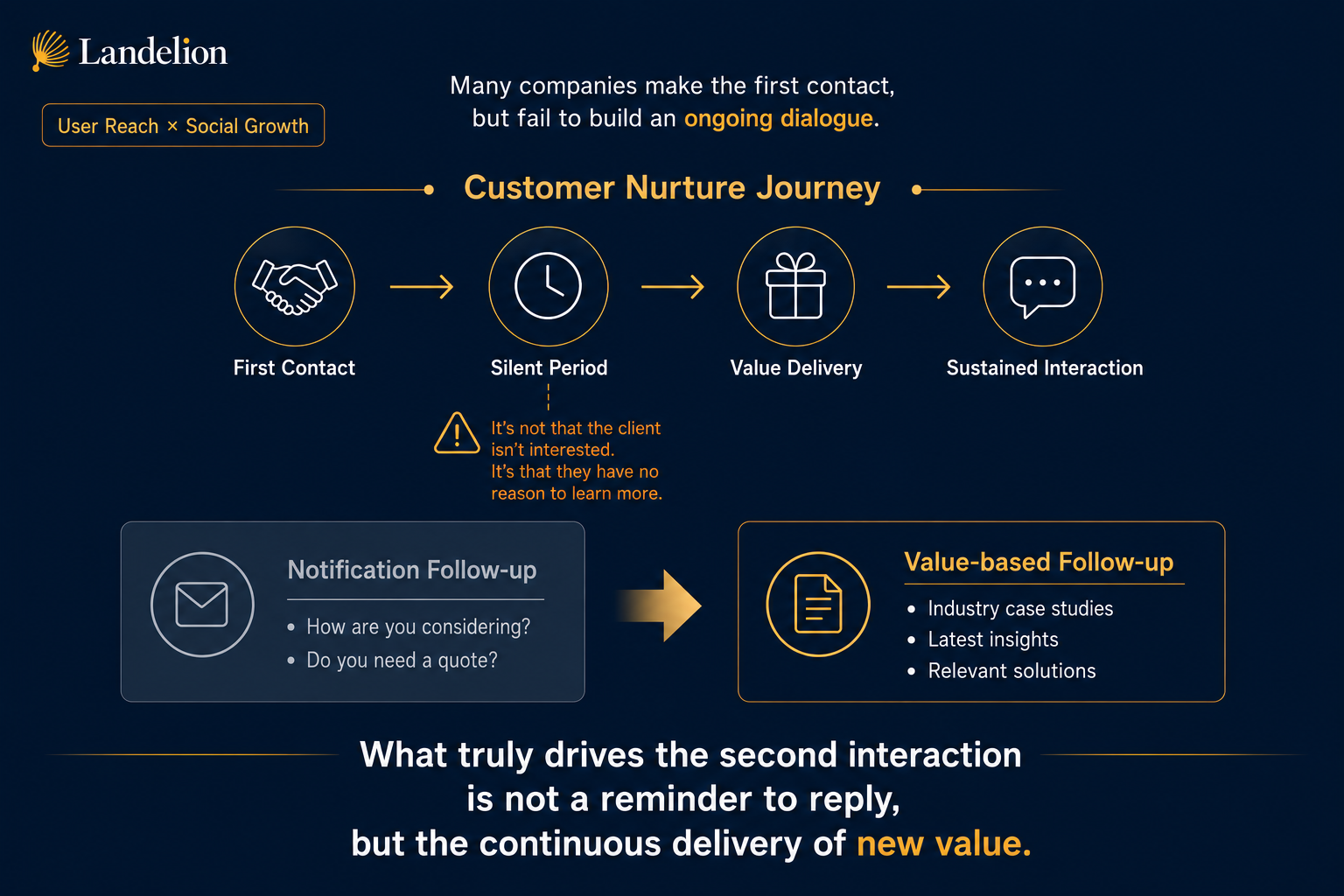
This gap is often attributed to “lack of interest” or “still considering”. But from the customer’s perspective, the more common scenario is that after the first contact, they didn’t receive enough relevant, valuable information to prompt them to open, reply, or continue exploring.
As acquisition costs rise, the challenge is not just about the quality of the first contact, but about whether there is a reach design that makes customers willing to continue learning and conversing – from first touch to second interaction.
I. Silence after first contact is usually not because they “don’t need it”
B2B purchase cycles are long and involve multiple stakeholders. A customer’s first touchpoint might be a piece of content, an event, or a DM question. But that touch is often far from project initiation, budget approval, and final decision.
During this interval, customer silence generally falls into three categories:
First, “not yet in the decision window”.
The customer is interested, but now is not the procurement moment. Budget may be in the next quarter, the project is still being internally scoped, and the team hasn’t reached consensus. These customers are not without value – they need to be included in ongoing reach and content nurturing. Otherwise, by the time they start their formal selection process, your company may no longer be on their shortlist.
Second, “not enough information to decide”.
The first contact may have provided only fragments – an article, a product page, a brief chat. That’s insufficient for the customer to judge “is this company worth exploring further?” Without follow‑up cases, materials, scenario explanations, or new perspectives, the lead is easily set aside.
Third, “no clear next step”.
After the first contact, the customer doesn’t know what happens next – will the company send more materials, assign a sales rep, or expect the customer to reach out again? If neither side has a clear expectation, the conversation stalls after the first touch.
In essence, none of these cases are a “no” from the customer – they are a failure of the company to give them a reason, at the right time with the right content, to continue exploring.
II. One contact ≠ opportunity – “nurturing” is what lies in between
Many companies treat “lead generation” and “opportunity conversion” as disconnected stages: marketing drives the first contact, sales handles the rest. But in reality, many B2B leads are not ready for immediate conversion after the first touch – they need a transitional phase: ongoing reach and content nurturing.
The absence of this phase is often the key reason why “customers were contacted but never engaged again”.
Data shows that 80% of deals require at least 5 follow‑ups, yet 44% of salespeople give up after just one unanswered follow‑up. In other words, most customers are not lost to competitors – they are lost to “no second interaction”.
In practice, top‑performing companies significantly outpace average ones in lead nurturing – 69% of high‑performing teams rate themselves as “very good” or “excellent” at nurturing, while only 10% of low‑performers say the same.
What does this mean? It means the “second interaction” itself is a filter. Many companies lack follow‑up after the first contact, while planned second and third touches keep the company in the customer’s view and gradually supply the information they need to decide.
III. From “notification follow‑up” to “value‑based follow‑up”
Many teams do follow up, but their approach remains at the level of “reminding the customer to reply”.
The most common practice: send a message after the first chat – “How are things going since we last spoke?” This “notification follow‑up” essentially asks for a response without offering new information, new decision‑making inputs, or new conversational value.
When customers don’t reply, it may not be that they missed the message – it may be that the message didn’t offer enough new value.
A more effective second interaction is a value delivery – so that when customers receive your message, they gain a new case, new material, new decision evidence, or a lower‑threshold path to learn more. Specifically, consider these approaches:
1. Content extension based on the first touchpoint
If the first contact was sparked by an article or a question, the second interaction can offer extended information on that topic – relevant case studies, deeper data, peer practices. The key is to make the customer feel you are not just “following up”, but “continuing to provide value”.
2. Targeted information based on the customer’s industry or scenario
If you learned the customer’s industry or focus area during the first contact, the second interaction can deliver industry‑specific data – for example, how peers in that sector use your solution, or common pain points and solutions. The more relevant the content, the easier it is for the customer to judge whether you understand their problems.
3. Natural reach based on timing milestones
Industry reports, new feature launches, or regulatory changes in the customer’s sector – these can all serve as natural entry points for a second interaction. “We just released the annual trend report for your industry” is much more likely to get a response than “How have you been?”
4. Provide a low‑threshold path to learn more
The second interaction doesn’t have to require a reply or confirmation. A better approach is to offer a low‑commitment next step – like a white paper, a customer case to review, a brief diagnostic session, or a small‑scale online discussion. Let customers continue learning without having to commit to anything.
IV. Evolution from “single reach” to “ongoing conversation”
To turn a single contact into an ongoing conversation, adjustments are needed across three dimensions: objectives, content, and cadence.
| Evolution dimension | Starting from “single reach” | Gradually moving to “ongoing conversation” |
|---|---|---|
| Core objective | Acquire contact info, complete first chat | Build a sustainable dialogue cadence to keep customers active |
| Content strategy | No follow‑up content after initial contact | Continuously deliver relevant value based on customer stage and interests |
| Follow‑up rhythm | Reach out when remembered, drop when forgotten | Planned touchpoints, each with new information or a fresh angle |
In practice, this means three things:
First, establish a customer information recording mechanism.
Information gathered during the first contact – industry, areas of interest, current stage – must be recorded and used to personalise subsequent content pushes. Without records, there is no personalised second interaction.
Second, use “content” as the vehicle for follow‑up.
Every time the sales team reaches out, they should attach something “worth opening” – an industry report, a customer case, a relevant insight. Content turns follow‑up from “interruption” into “service”.
Third, set a clear reach cadence.
When to do the second interaction after the first contact, through which channel, with what content – these need to be planned in advance, not done at random.
V. Where does your secondary reach system stand?
If you are unsure of your team’s current state, use these quick self‑check questions:
⬜ Is there an active second interaction after the first contact?
If most customers are never actively reached after the first conversation, there is a clear break in the secondary reach mechanism.
⬜ Does the second interaction offer “new value” or just a “nudge”?
Review your recent follow‑up messages – are they providing new, useful information, or just asking “how are things?” If the latter dominates, content nurturing has a break.
⬜ Is customer information recorded and reused?
Has the industry and focus area learned during the first contact been recorded and used to tailor subsequent content? If not, customer information management has a break.
Any of the above issues affects the same outcome – customers have been in contact but never enter a second interaction and ongoing conversation.
Conclusion: Make every contact lead to the next
The key to acquisition is not just completing the first contact, but making customers willing to continue the conversation.
When a company builds a complete chain from reach to nurturing to conversion, social media operations are no longer a one‑off exposure activity – they become a sustainable acquisition system. What customers experience is not just a marketing message, but continuous decision‑support and communication value at every stage.
For companies going global, the value of social media is not “how many people saw you”, but “how many of those who saw you are willing to keep talking to you”. Landelion can help companies integrate every exposure, inquiry, and interaction on social media into a trackable, nurture‑ready, and optimisable acquisition system – making the first contact truly the beginning of an ongoing dialogue, not the end.
Act now Does your overseas social media only deliver one‑off exposure, or has it built a complete chain from first touch to second follow‑up, ongoing nurturing, and conversion?Landelion can help B2B companies identify breaks in the acquisition chain from the perspective of Target Audience Reach & Conversion – diagnosing whether the issue lies in first touch, content nurturing, follow‑up cadence, or sales alignment. Explore Target Audience Reach & Conversion Solution Book an overseas social reach chain diagnosis |