


In B2B sales reviews, a common issue is that after the initial conversation, the customer expresses interest but then fails to move forward. When asked, the reason is often not price or feature mismatch, but that the customer still cannot determine: “Is this company really right for us?”
This hesitation is not always about sales scripting or language barriers. Often, the website pages, sales decks, product materials, and case studies that the customer encounters early on do not provide sufficiently clear signals for decision‑making.
The content may look comprehensive – specs, features, and capabilities are all there – but the customer can only see “what this company can do”, not whether those capabilities can solve their specific problem. In today’s information‑overloaded B2B environment, customers are not uninterested; they simply cannot quickly assess the fit between your capabilities and their needs.
If content cannot help customers complete this self‑screening step, sales conversations stall at the very beginning. The core value of content is not about how exhaustive it is, but whether it can clearly answer the critical questions in the customer’s mind and reduce their cognitive and decision costs.
I. Why does more complete content actually make it harder for customers to decide?
Many companies believe that the more detailed their website, product materials, and sales presentations are, the easier it is for customers to understand their value. However, when content merely lists capabilities, specs, and service scopes, it often increases the customer’s decision burden.
First, lack of scenario mapping.
Customers face concrete business pains – such as “low yield rates” or “delivery delays” – not abstract “high‑performance equipment”. If content only talks about equipment parameters without contextualising applications, customers have to mentally translate “can this spec solve my problem?” – and that translation often leads to abandonment.
Second, vague audience targeting.
A company may serve multiple industries, but if content does not differentiate “solutions for automotive” from “solutions for electronics”, customers cannot confirm “do you really understand my industry’s nuances?” This uncertainty drives them toward competitors that appear more specialised.
Finally, unclear value of next steps.
After reading content, customers do not know what extra value “further discussion” will bring. A generic “contact us for a quote” is far less compelling than “contact us to get industry benchmark data”. Vague calls‑to‑action directly stall leads.
The root of these problems is that content is organised around “product features” rather than around “how customers decide”.
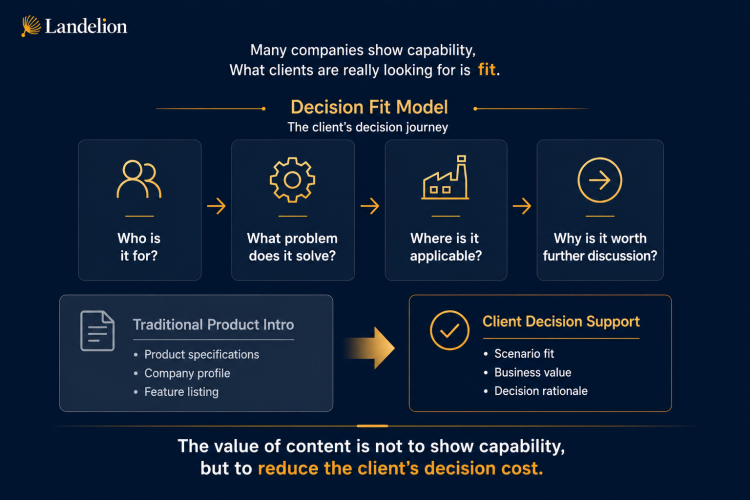
II. To help customers judge “fit”, content must answer four questions
To solve the “holding” problem, companies must architect content around “customer fit”. Regardless of industry or stage, customers are internally asking four questions. If content addresses each one, the decision burden drops significantly.
| Customer’s question | What content must answer | Wrong example | Better expression |
|---|---|---|---|
| Who do you serve? | Clearly define target customer profiles so they can self‑identify | This product suits all manufacturing companies | Designed for quality inspection in mid‑sized medical device manufacturers |
| What specific problem can you solve? | Talk about business outcomes, not just features | Equipped with high‑precision sensors | Reduces rework and quality variation in high‑precision inspection scenarios |
| In which scenarios does it apply? | Provide specific use cases or peer examples | Suitable for various working conditions | Designed for stable inspection needs in high‑temperature, high‑humidity, or continuous production environments |
| What value will I get from the next step? | Clarify the unique benefits of further engagement | Contact us for a quote | Book a session to get an industry‑specific assessment or resource pack |
1. Who you serve – help customers self‑identify
Content should explicitly state target industries, company sizes, or specific roles. Clear audience positioning is the first step to building trust. When customers see “designed for…”, they naturally feel “this is made for me” rather than “I’m not sure if this applies to me.”
2. What problem you solve – talk outcomes, not specs
Avoid merely listing features; directly articulate the pain points you address. Translating features into business outcomes is key to helping customers perceive value. This aligns with Harvard Business Review’s insight that effective sales proposals hinge on understanding and responding to customer needs, not just showcasing product attributes.
3. Suitable scenarios – lower the imagination cost with examples
Provide concrete application scenarios or peer case studies. Scenario‑based descriptions help customers relate to their own working conditions – the lower the imagination cost, the stronger the trust. Peer cases directly answer the unspoken concern: “Is anyone else like me?”
4. Why it’s worth further conversation – set clear expectations
What will the next conversation deliver? A customised assessment, industry benchmark data, or a free trial? Clear expectation management increases the customer’s willingness to engage. Let them know “what I’ll walk away with” rather than “let’s talk and see”.
III. Content evolution: from “feature showcase” to “scenario mapping”
Fixing the fit‑judgment problem cannot be done with isolated copy tweaks. It requires reorganising website pages, sales materials, product brochures, and case studies within a unified content system.
This system must answer at least five things: who you serve, what problem you solve, which scenarios you cover, what proof you have, and how to proceed. Only when this information forms a consistent structure can customers more easily complete the “is this for me?” assessment.
| Evolution dimension | Starting from “feature showcase” | Gradually moving to “scenario mapping” |
|---|---|---|
| Content structure | Listing specs by product model | Organising solutions by industry scenario |
| Value expression | Emphasising “what technology we have” | Emphasising “what business outcomes we deliver” |
| Call‑to‑action | Generic “contact us” | Differentiated “get industry‑specific solutions” |
Content assets are not one‑off outputs; they are reusable, governable strategic resources. Through systematic management, companies ensure that every content investment accumulates as long‑term brand equity rather than expiring after a project ends.
IV. Self‑assessment of content‑value clarity
Companies can self‑diagnose whether their content system supports customer fit‑judgment by answering three key questions. This is not just a content check but an evaluation of the customer decision experience.
⬜ Can customers quickly find case studies relevant to their industry or scenario?
If customers have to scroll multiple pages to find a relevant case, scenario categorisation is broken.
⬜ Does the value proposition include business outcomes?
Check whether core copy only covers technical specs without explaining the business results those capabilities enable. If missing, value expression is broken.
⬜ Does the next‑step action offer differentiated value?
Are the calls‑to‑action the same for customers in different scenarios? If completely generic, action design is broken.
Any of the above issues affects not only customer experience but also the efficiency of the sales team.
Conclusion: Let content become a guide for customer decisions
Competition is not only about products – it is about decision efficiency.
When a company starts building its content system, it no longer passively displays information – it gains a trusted decision‑support tool. Customers feel not only product professionalism but also the respect of being understood.
For B2B companies, content is not about laying out all capabilities; it is about helping customers quickly judge: Does this company understand my industry? Can it solve my problem? Is it worth moving to the next step?
Content System Building addresses exactly this decision break. Landelion helps companies reorganise website pages, sales decks, product brochures, case studies, and landing pages into a content system structured around customer scenarios, value propositions, and action paths – so that when customers encounter your brand, they don’t just see “what you can do”, but quickly understand “whether you are right for them”.
Act now Does your brand content only showcase features, or has it formed a complete decision‑support structure covering customer scenarios, value propositions, case evidence, and next steps?Landelion can help B2B companies identify decision breaks in website pages, sales materials, and product content from the perspective of Content System Building – diagnosing whether the issue lies in customer profiling, scenario categorisation, value expression, case evidence, or call‑to‑action guidance. Explore Content System Building solution Book a content asset readiness diagnosis |