


Every year, the Consumer Electronics Show (CES) brings together some of the world’s most influential technology companies and industry decision-makers. According to Xinhua, CES 2024 was held in Las Vegas and attracted more than 4,300 exhibitors from over 150 countries and regions. Chinese companies were among the most active participants, showcasing advanced capabilities across consumer electronics, automotive electronics, medical technology, and other fields.
Yet behind the growing scale of international exhibitions, many companies face a sharp contrast after the event: the number of qualified leads remains low. The issue is often not product maturity or technical capability, but a hidden threshold that has long been underestimated — professional language capability in high-stakes meetings.
In high-end B2B settings such as CES, language is not merely a tool for information transfer. It is a core infrastructure for professional judgment, risk assessment, and trust building. When technology cannot be explained accurately, and value cannot be understood clearly, even a strong product may be quietly excluded in the first round of communication.
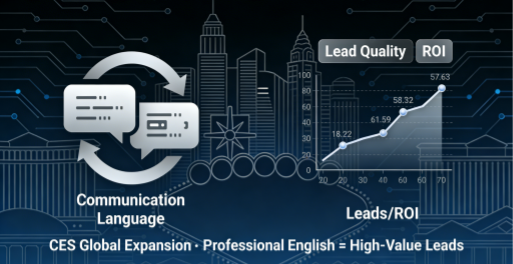
1. The Language Pain Point in High-Stakes Meetings: Not “Can They Understand?” but “Can They Trust It?”
Many companies still simplify language issues as a matter of English fluency or translation accuracy. But in high-end technology exhibitions, the deciding factor is not vocabulary. It is whether technical value can be transferred in a complete, verifiable, and credible way.
1. Technical communication is essentially risk judgment
The core audiences at high-end exhibitions such as CES, MWC, and Hannover Messe are not general visitors. They are technical buyers, system integrators, and ecosystem partners. They want to know whether the technical route is clear and reproducible, whether performance indicators have defined boundaries, and whether the solution meets industry standards.
McKinsey’s research shows that in B2B technology sales, customers’ key decision criteria are not limited to price or features. They are closely tied to how they assess technical risk and uncertainty. If communication fails to reduce risk, the customer may end the conversation early.
2. “Fluent but vague” is more dangerous than language errors
In high-stakes meetings, the most damaging communication is often not broken English, but language that sounds fluent while lacking a clear technical logic chain. When information is not structured or logically connected, listeners quickly lose confidence in its completeness and professionalism.
This is especially common in technology exhibitions:
🔹 Complex architecture is simplified into “faster and better”
🔹 Compliance progress is vaguely described as “in progress”
🔹 Performance boundaries are summarized as “industry-leading”
These expressions may sound safe in a Chinese communication context. But in European and North American technical contexts, they are often interpreted as signs that the risks have not been sufficiently controlled.
3. Cultural context differences amplify language misjudgment
Different countries have different levels of tolerance for ambiguous information. In countries with a higher tendency toward uncertainty avoidance, such as Germany and Japan, vague wording is more likely to be read as a risk signal. This means that direct translation alone is often not enough to build trust. Effective language support must adjust the way information is expressed so that it fits the professional context of the target market.
2. Why “Bringing a Temporary Interpreter” Is Not Enough for High-Stakes Meetings
Many companies bring temporary interpreters to exhibitions, assuming that “basic communication is enough.” But in a meeting environment with high information density and high uncertainty, this approach often reduces communication quality in a systematic way.
1. High-density conversations leave little room for error
In high-end exhibition meetings, conversations are often highly concentrated and fast-paced. Customers may ask a series of questions about technical details, application scenarios, and cooperation boundaries within a short period of time. If the conversation is frequently interrupted by consecutive interpreting, the continuity and logical integrity of the information may quickly decline, increasing the customer’s cognitive burden.
2. Language is part of the professional system
Gartner’s research on the B2B buying journey points out that at the first contact stage, any technical point that cannot be clearly explained may be treated as a risk factor rather than simply “information to be supplemented later.” In other words, language distortion is not easily forgiven by customers. It is directly included in their negative evaluation.
3. Effective Language Support Is a Cognitive Alignment System
Language services in high-stakes meetings are not merely a translation arrangement. They are a cognitive alignment system. Their core objective is simple: to help customers accurately understand your technical value within a limited period of time, while reducing their perceived decision risk.
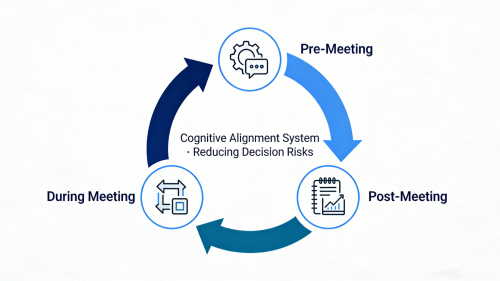
This requires support across three stages:
1. Before the meeting: Build shared professional context
Clarify technical keywords and standards systems, align with the technical background and priorities of target customers, and rehearse high-frequency technical questions and risk points in advance.
2. During the meeting: Maintain continuity and professional completeness
Ensure that communication does not break the technical logic. When necessary, provide cultural and standards-based interpretation, avoid vague commitments, and prioritize explanations based on standards, data, and implementation paths.
3. After the meeting: Turn conversations into follow-up assets
Record the customer’s real concerns, clarify the next technical or compliance milestones, and provide precise follow-up input for sales and technical teams.
4. Language Cost Is Not the Same as Translation Cost
Many companies still treat language services as a cost item that can be reduced. But they often overlook the opportunity cost and trust cost behind it. The effectiveness of an exhibition does not depend only on on-site exposure. It depends on whether the company can trigger high-quality and sustainable business conversations after the event. If the first round of communication fails to establish professional trust, additional marketing investment will deliver diminishing returns. In this context, language is no longer just a cost. It is a key lever that can either amplify or erode ROI.
Conclusion: Language Is the Infrastructure of Trust
CES is not simply a place to display products. It is an entry point into the global technology trust network. When your engineers can clearly respond to technical questions using a language logic recognized by the target market, and when customers proactively request further technical meetings after the first conversation, language has truly moved beyond being a translation tool. It has become an amplifier of international business ROI.
In high-stakes meetings, language is never a supporting role. If ignored, ROI will be systematically eroded. If managed properly, communication itself becomes a competitive advantage.
Take Action
If you need a professional, efficient, and executable language support plan for your technical field, target exhibition, and current stage of international expansion, contact the Landelion team.
📩 Contact Us | Learn More About Multilingual Translation Services
💬 Add us on WeCom to receive a tailored solution
📚 Further Reading
Why Your Overseas Exhibition Fails to Attract Attention: 5 Critical Reasons and Solutions