


On July 28, 2026, the U.S. Federal Communications Commission (FCC) added foreign‑produced advanced robotics equipment and networked power inverters to its Covered List. Under the FCC’s related guidance, new models of such products will generally be unable to obtain equipment certification authorisation, meaning they cannot be imported, marketed, or sold into the U.S. market.
At the same time, Chinese autonomous driving company WeRide has been accelerating its European expansion: after entering Madrid, Spain, and Zurich, Switzerland, in June 2026, it advanced a commercial autonomous mobility partnership in Denmark in August, securing multiple European market entries within a short period.
One involves changing market access and compliance boundaries; the other involves the same type of business facing different operating environments across countries. They point to the same issue: when the same product enters different countries, customer priorities, access requirements, application scenarios, and risk boundaries may vary. Product materials cannot simply be translated from headquarters versions into different languages – they need to be reorganised according to each market’s decision‑making logic.
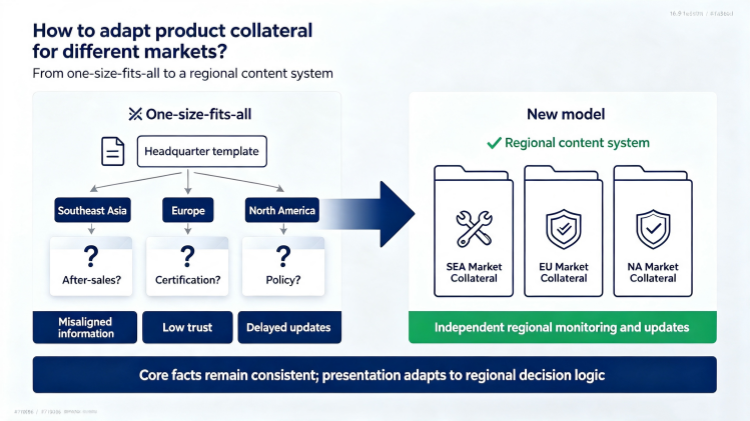
I. The market has changed – why haven’t the materials?
An industrial equipment company sold its products into three markets: Southeast Asia, Europe, and North America. Headquarters used a single set of English materials – product brochures, technical specifications, case studies, and certification documents – translated into local languages and sent directly to customers.
The feedback from the three markets was completely different. Southeast Asian customers asked: “How soon can after‑sales maintenance arrive on site?” European customers repeatedly confirmed: “Which product ranges does the CE certification cover, and what is its validity period?” North American customers asked directly: “Can your inverters still be imported under the new FCC rules?”
The company discovered that customers across the three markets all “could not understand” the same materials – not because of language barriers, but because the materials did not address the specific concerns each group cared about.
The root of the problem is: headquarters materials carry “what the company wants to say”, while customers in different markets need to know “what this has to do with me”.
II. What are customers in different markets evaluating?
When the same product enters different countries, the content dimensions that customers truly care about may be entirely different:
1. Different access requirements – customers focus on compliance boundaries
The new restrictions on advanced robotics and inverters in the U.S. market mean that product materials must clearly state compliance status and model applicability. In Europe, scrutiny of CE certification has been intensifying – customers need not just a scanned certificate, but clarity on which product ranges the certification covers, which standards it applies to, and its validity period. If materials only say “complies with international standards” without specifying which market’s which standard, customers cannot determine whether the product can enter compliantly.
2. Different application scenarios – customers need alignment with their own operating conditions
The same piece of equipment might be used in Southeast Asia for continuous production in high‑humidity, high‑temperature environments; in Europe for precision manufacturing; and in North America for energy infrastructure. Different scenarios mean completely different performance metrics, technical specifications, and case references that customers care about. A single set of generic specifications cannot cover the evaluation needs of all scenarios.
3. Different risk concerns – disclosure boundaries for information vary
Different markets have different expectations for information transparency and different compliance boundaries. In March 2026, the Indian Cabinet approved amendments to the foreign direct investment guidelines, introducing a 60‑day approval timeline for investments in sectors such as electronic components, polysilicon, and wafer manufacturing. Australia has continued to tighten foreign investment screening in critical minerals, with the review focus shifting from case‑by‑case approvals to ongoing dynamic monitoring of foreign shareholding and influence.
In such markets, customers not only look at product performance, but also pay attention to supply chain sources, partnership models, project data, customer case studies, and compliance identity. Which content in product materials can be publicly disclosed, which needs to be anonymised, and which requires further confirmation from sales, legal, or local teams – all of these should be assessed in advance when organising the materials.
Regionalised product materials, therefore, are not simply about adding more information – they are about finding the right balance between “building customer trust” and “controlling disclosure risk”.
III. Why is “translating headquarters materials” not enough?
Many companies’ approach is: headquarters produces a set of materials, translates them into English, and then into each market’s language. This may work in the early stages of business, but once the business enters multiple differentiated markets, three problems emerge:
1. Information misalignment.
Headquarters materials are designed for “typical customers”, but what is “typical” varies greatly across markets. Southeast Asian customers care about after‑sales response, European customers care about compliance certifications, and North American customers care about policy risks. One set of materials cannot address all three concerns simultaneously.
2. Insufficient trust.
When customers see materials that do not answer their most pressing questions, they conclude that “this company doesn’t understand our market”. Trust is undermined from the very first impression.
3. Outdated updates.
Market rule changes can outpace the cadence of material updates. When new certification restrictions, import requirements, tariff adjustments, or local compliance requirements come into effect, if product materials still carry outdated information, customers will question the company’s professionalism and responsiveness.
IV. Three questions a regional content strategy must answer
For product materials to truly work in different markets, companies need to answer three questions before entering each market:
Question 1: What do customers in this market care about most?
Not “what are our product’s advantages”, but “what information do customers in this market most need to verify when making purchasing decisions”. Southeast Asian customers may care more about delivery and after‑sales; European customers may care more about compliance and certifications; North American customers may care more about policy risk and supply chain stability. The content structure of the materials should be organised around these concerns, rather than starting from headquarters templates.
Question 2: What are the market access requirements?
Does the product require additional certifications? Are there any recent import restrictions or tariff adjustments? When evaluating suppliers, will customers prioritise compliance qualifications? The answers to these questions directly determine which information needs to be highlighted in the materials.
Question 3: What information can be disclosed in the materials?
Different markets have different expectations for transparency and different compliance boundaries. In some markets, detailed customer case studies and project data are key to building trust; in others, data privacy or compliance considerations may require such information to be anonymised. The boundaries of what to include in the materials need to be determined based on local laws, regulations, and business practices.
V. Evolution from “one set of materials for all markets” to a “regionalised content system”
| Dimension | One set for all markets | Building a regionalised content system |
|---|---|---|
| Content starting point | Headquarters product introductions and spec sheets | Decision‑making concerns and validation needs of customers in each market |
| Information structure | Uniform structure, same for all markets | Organised by region based on market access, application scenarios, and risk boundaries |
| Compliance information | Vague “complies with international standards” | Clearly specifies which certifications, standards, and policy status apply to each market |
| Case presentation | Global cases mixed together | Categorised by region, industry, and application scenario for easy customer self‑identification |
| Update mechanism | Headquarters updates and distributes | Each region has independent monitoring and update cadence to respond to market changes |
The goal of a regionalised content system is not to rewrite a full set of materials from scratch for each market, but to establish a composable, adjustable, and updatable content structure. Core facts remain consistent, but presentation, key information, case selection, and compliance language need to be adapted to each market’s decision‑making logic.
VI. Are your product materials adapted to different markets?
If you are unsure about your team’s current state, use these quick self‑check questions:
⬜ Can customers in different markets find information relevant to them in the materials?
Pick a product document sent to overseas customers at random – can Southeast Asian customers quickly find after‑sales and delivery information? Can European customers quickly find certification and compliance information? If all customers see the same content, the materials have not been adapted to different markets’ concerns.
⬜ Is compliance information specific to each market?
Do the certifications and standards mentioned in the materials clearly specify which market they apply to, which product ranges they cover, and their validity period? If they only say “complies with international standards” without market‑specific details, compliance information has a break.
⬜ Can the materials respond promptly to market rule changes?
After the most recent policy or access condition change in a target market, were the product materials adjusted and updated within a reasonable timeframe? If the response cycle is too long, the content update mechanism has a break.
Conclusion: When products enter new markets, materials need to be reorganised too
Rules, access requirements, and customer concerns are continuing to diverge across markets. When the same product enters different countries, customer priorities, application scenarios, compliance requirements, and risk boundaries may not be the same. Companies cannot simply translate headquarters materials and assume they cover all overseas markets.
Product materials need to be reorganised according to each market’s decision‑making logic – not by rewriting a full set, but by building a composable, adjustable, and updatable regionalised content system.
Landelion can help B2B companies build the content framework for regionalised product materials – starting from each market’s customer concerns, access requirements, and risk boundaries – and reorganise headquarters materials into a content system adapted to the decision‑making logic of different regions.
Act now Are your product materials using one set for all markets, or have they been regionally adapted to different markets’ decision‑making logic?Landelion can help B2B companies assess the adaptability of product materials across different markets from the perspective of Content System Building – diagnosing whether the issue lies in market insights, information structure, compliance language, or update mechanisms. Explore Content System Building solution Book a product material adaptation diagnosis |
📚 Further reading
From Patchwork to Professional: Content System Building for the B2B Evaluation Phase
Why Can't Customers Quickly Decide If Your Company Is Right for Them?
B2B English Product Brochures: Why Overseas Buyers Still Struggle to Make Purchasing Decisions