


As manufacturing companies expand globally, many operate both overseas social media channels and multilingual websites. The goal is clear: move from being seen to being chosen.
In reality, however, results often fall short. Social media posts generate engagement but few qualified inquiries. Websites receive traffic, yet conversion rates remain low.
The real growth bottleneck is not a lack of traffic—but a breakdown in how trust transfers between social media and the website. When content fails to create continuous validation across touchpoints, buyers drop out midway through the decision process.
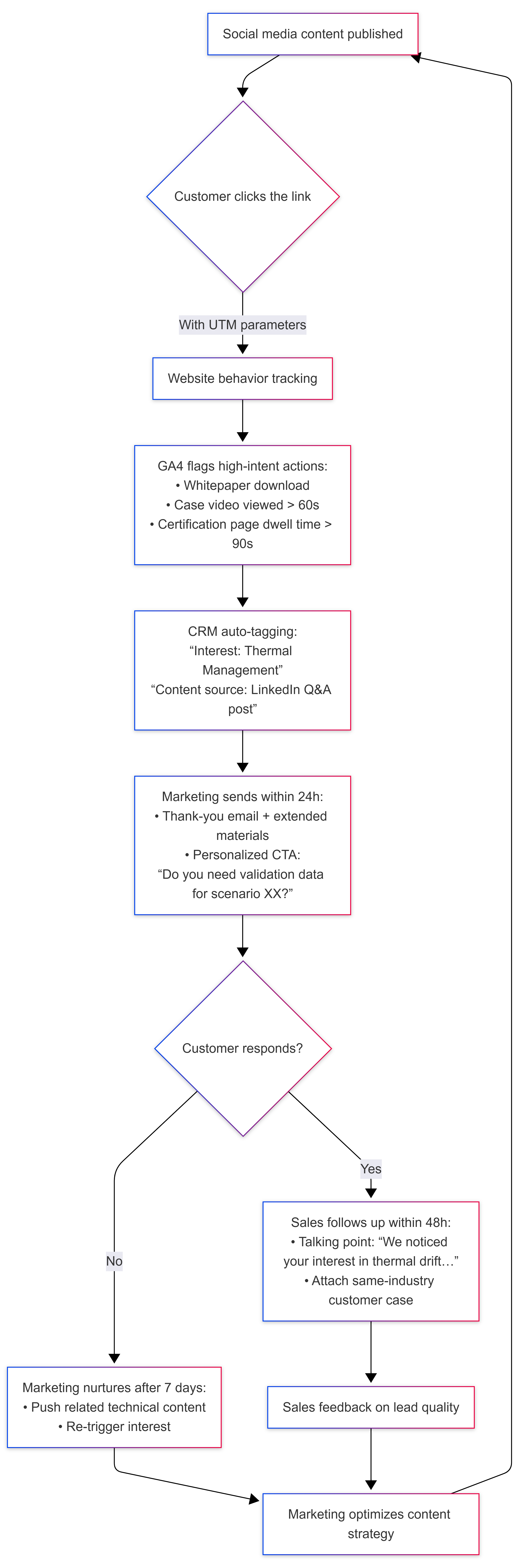
This article examines real manufacturing B2B buying scenarios and explains why social media and website collaboration often fails. More importantly, it introduces a practical Social Media × Website Trust Architecture to help manufacturing companies systematically convert social visibility into qualified purchase leads.
I. The Root Problem: Why Social Media Feels Busy While the Website Feels Cold
1. Fragmented Data: The Invisible Buyer Journey
In many manufacturing organizations, social media and the website are still managed as separate systems:
Social teams track engagement and follower growth
Website teams analyze visits and bounce rates
Sales teams only see whether a lead form was submitted
When a buyer clicks a technical LinkedIn post and lands on the website, their actual intent is often lost in the data. Sales cannot tell why the visitor came, what they care about, or how qualified they are.
As a result, high-potential prospects are treated like generic visitors—lowering follow-up quality and slowing conversion cycles.
2. Content Discontinuity: Broken Cognitive Validation
Social media may successfully raise industry problems and resonate with engineers. The website, however, often responds only with specification tables and a generic “Contact Us” button.
When a problem is raised but not validated, buyers naturally question: “They seem to understand the issue—but can they actually solve it?”
B2B content research consistently shows that buyers prefer to validate supplier capability step by step along a logical path. When content continuity breaks between social media and the website, trust collapses at the verification stage (summary insights via MarketingCharts).
3. Missing Trust Signals: The “Professional Black Hole”
Common trust gaps on manufacturing websites include:
🔹No real customer case studies (only vague claims like “Serving Global Fortune 500 Clients”)
🔹Technical documents gated behind registration, with no preview
🔹Team pages showing photos without professional backgrounds
These gaps silently undermine credibility—especially in high-risk, long-cycle industrial purchases.
4. Organizational Misalignment: KPI-Driven Silos
Team | KPI Focus | Resulting Bias |
Social Media | Engagement, follower growth | Trend chasing, entertainment content |
Website | Time on page | Overloaded technical specs |
Sales | Lead volume | Blind follow-up of low-quality leads |
The outcome: conflicting brand signals, confused buyer perception, and a single unresolved question: “What does this company actually specialize in?”
II. How Manufacturing Buyers Actually Build Trust
Manufacturing B2B decisions are rarely linear. They are multi-touch, long-cycle, and verification-heavy trust journeys.
Key Trust-Building Stages
1. Trigger stage (Social Media)
Buyers ask: “Do you understand my problem?” — not “How good is your product?”
Example:
A post titled “How Thermal Drift Causes Calibration Failure in Automotive Sensors” achieved 4.3× higher CTR than “XX Sensor Specifications Overview”.
2. Verification stage (Website)
Buyers look for three evidence chains:
✅Technical credibility: white papers, test reports, patents
✅Case credibility: peer-industry customers with names, roles, challenges, outcomes
✅Compliance credibility: visualized certifications (IATF 16949, CE, UL, etc.)
3. Confirmation stage (Pre-inquiry)
Buyers evaluate whether this is a team worth long-term cooperation, not just a supplier.
Any missing link significantly reduces conversion probability.
III. From Traffic Silos to a Trust Flywheel: A Four-Stage Architecture
We propose a four-stage Social Media × Website Trust Architecture that turns engagement into qualified leads.
Stage 1: Precision Trust Triggers on Social Media
Trust Entry Point
Social media content should focus on industry problems and technical judgment, not product promotion.
Problem-driven and analytical content performs best in early decision stages.
Stage 2: Deep Trust Validation on the Website
Trust Core
Every social media post should map to a specific verification page, not the homepage. Essential trust elements include:
Trust Type | Core Elements | Manufacturing-Specific Needs |
Technical | White papers, test reports | Simulation videos, failure analysis |
Case | Logos + testimonials | Peer-industry use cases |
Compliance | ISO certificates | IATF 16949, AS9100 |
Stage 3: Data-Driven Feedback Loops
Trust Amplification
By connecting behavioral data with sales feedback, companies can identify which content actually produces high-quality leads—and continuously optimize both social topics and website structure.
Stage 4: Annual Asset Accumulation
Trust Compounding
High-performing content should be systematized into sales tools, industry materials, and evergreen assets—ensuring each year’s investment strengthens the next.
Conclusion: Trust Is Manufacturing’s Hardest Currency
When social media insights are continuously validated on the website, and every click receives a professional response, traffic stops being a cost—and becomes a compounding trust asset.
Manufacturing global growth is not about adding more channels.
It is about building a system where expertise is visible, value is verified, and trust is sustained.
Get Practical Guidance
📩 Contact us | Explore marketing solutions
💬 Add us on WeChat for a tailored solution
📚Further Reading
How Manufacturers Can Fix Multilingual Website Update Chaos
Manufacturing Website SEO: Five Key Strategies to Boost Google Indexing and Organic Traffic