


In the first four months of 2026, China's total imports and exports of goods increased by 14.9% year-on-year, with strong export growth in sectors such as electric vehicles, lithium batteries, and industrial robots. The numbers look promising. Yet in conversations with many companies expanding overseas, we continue to hear a different reality:
"Export numbers are growing, but overseas buyers are still hesitant."
"Traffic has increased, but inquiry quality hasn't improved."
"Our products are competitive, but customers still feel something is missing."
This contrast reveals an often-overlooked truth: global manufacturing expansion is not about selling one product the same way to every market — and global social media marketing cannot rely on one universal message either.
Once product hype fades, what truly determines lead generation efficiency is no longer visibility alone, but whether a company has the ability to interpret markets and anticipate customer concerns.
The real value of global social media is not repeating product specifications — it is helping customers make market decisions.
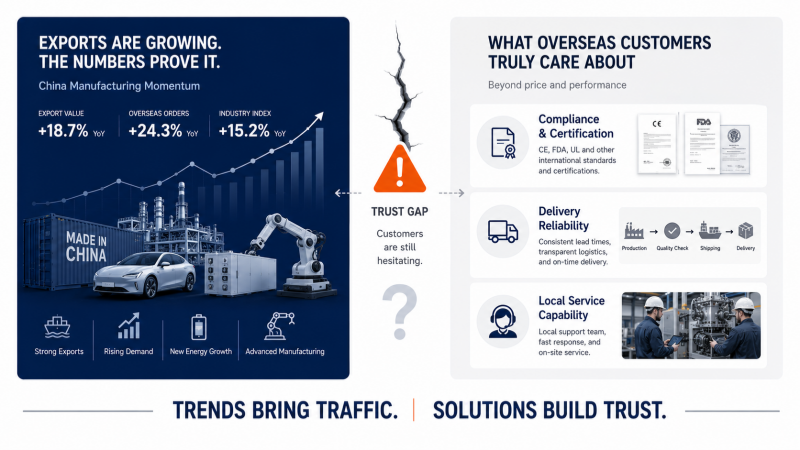
I. Attention Does Not Equal Trust: The Rationality Behind Export Growth
Rising export figures clearly reflect the growing competitiveness and market attention surrounding Chinese manufacturing in key sectors. But in B2B purchasing decisions, attention does not automatically translate into trust.
For overseas buyers, fast-growing industries often trigger even more cautious evaluation. They are not only asking whether a sector is booming — they are asking whether the growth is sustainable and reliable:
Are compliance standards fully met?
Is the supply chain stable?
Is local service support available?
As a result, global social media content that simply reposts positive industry news may generate short-term traffic, but rarely addresses deeper buyer concerns. The real opportunity lies in shifting from"reporting trends"to"explaining solutions"—using content to reduce perceived implementation risk.
💡 Landelion Insight: Trends attract attention. Solutions build trust.
II. Different Markets Require Different Messaging
"One message for every market"remains one of the most common mistakes in manufacturing globalization. Buyers in Europe and North America, Southeast Asia, and the Middle East all prioritize very different concerns.
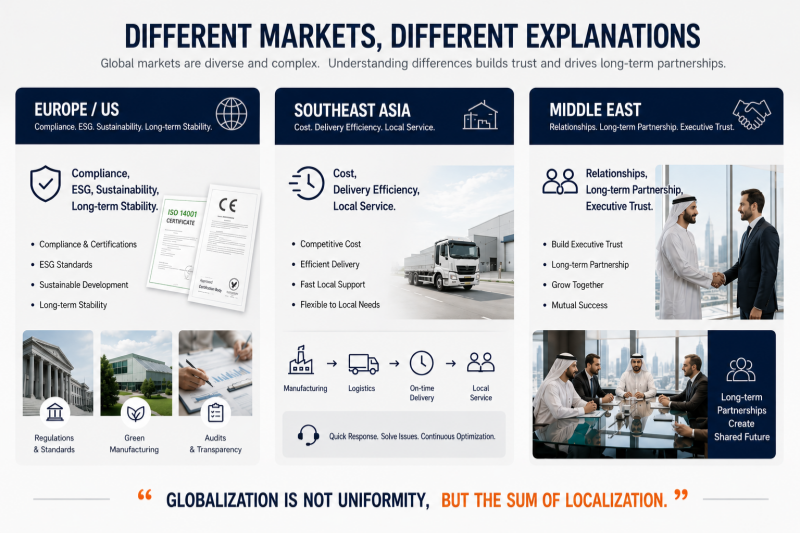
1. Europe & North America: Compliance and Sustainability
Buyers focus heavily on:
Carbon footprint
Regulatory compliance
Data security
Long-term operational reliability
Content for these markets should emphasize compliance with local standards, sustainability, operational stability, and corporate responsibility.
2. Southeast Asia: Cost and Delivery Efficiency
Buyers care more about:
Price-performance ratio
Delivery timelines
Localized service responsiveness
Content should highlight fast response capabilities, cost advantages, and successful implementation cases.
3. Middle East: Relationships and Long-Term Partnership
Buyers place stronger emphasis on:
Trust-building
Executive-level engagement
Long-term commitment
Content should therefore focus on partnership philosophy, leadership vision, and long-term service commitments.
When messaging fails to adapt to market realities, it does not simply become ineffective — it can also create misunderstandings due to cultural differences. This is why content systems matter as foundational infrastructure. But more importantly, global social media operations must actively identify market differences and deliver the right information to the right audience.
💡 Landelion Insight: Globalization is not standardization. It is the sum of localized understanding.
III. The Three Factors Buyers Actually Care About: Scenarios, Delivery, and Service
When buyers compare multiple suppliers, product specifications often look very similar. What truly drives decisions is whether the supplier can support the customer's real-world operating environment.
1. Scenario Fit > Generic Specifications
Buyers do not care that"machine precision reaches 0.01mm."They care whether the machine can operate reliably inside their high-temperature workshop.
Content therefore needs to demonstrate application-specific solutions, operating environment adaptability, and real-world implementation scenarios — not just generic specification sheets.
2. Delivery Capability > Factory Scale
Buyers are less interested in"how large the factory is"than in:
Whether delivery deadlines can be met
How disruptions are managed
Whether supply remains stable during uncertainty
Content should therefore showcase delivery workflows, project management systems, contingency planning, and logistics coordination.
3. Service Capability > Warranty Statements
Buyers do not simply care how many years of warranty are offered. They care about:
How quickly support arrives
Whether local teams exist
How service escalation is handled
Content should demonstrate local service infrastructure, response times, and support team capabilities.
Ultimately, customers are not evaluating specifications alone. They are evaluating operational certainty. This means global social media content must evolve from"showing strength"to"proving capability."
💡 Landelion Insight: Specifications are the entry ticket. Scenario fit and service capability drive the final decision.
IV. The Real Role of Manufacturing Social Media: Market Interpretation and Customer Anticipation
Based on all of the above, the role of global social media in manufacturing needs to evolve. It should not function merely as a corporate news channel. It should become a system for market interpretation and customer anticipation.
1. Market Interpretation
Explain why your solution fits a specific market. For example: how products comply with local regulations, how systems adapt to local environmental conditions, why your delivery structure suits regional business realities.
2. Customer Anticipation
Identify likely customer concerns before they are raised — and answer them proactively through content. For example: if buyers are concerned about after-sales support, publish local service team introductions in advance.
3. Trust Building
Use consistent, professional content to position the company as a reliable long-term partner rather than a one-time vendor. This is exactly what Landelion aims to achieve through its User Reach & Social Growth services: turning content into a decision-support tool rather than a one-way corporate broadcast. At the same time, this also requires structured content governance to ensure consistent messaging across markets.
💡 Landelion Insight: The best social media strategy makes customers feel:"They truly understand my market."
Conclusion: From Selling Products to Selling Certainty
The next phase of global manufacturing competition will shift from product cost-performance to operational certainty.
Global social media marketing cannot rely on one universal message anymore. It must become a core channel for interpreting markets, anticipating customer concerns, and building trust.
When companies develop true"market interpretation capability,"the path from export growth to customer trust finally becomes connected.
Landelion focuses not only on publishing content, but on helping companies integrate global social media into a scalable, optimizable lead generation system — supported by cross-market content frameworks that turn every piece of content into a trustworthy market explanation.
Cross borders. Build visibility. Earn professional trust.
🚀 Take Action: Schedule a Manufacturing Overseas Social Media Diagnostic
Is your global social media content simply repeating product specifications — or actually explaining the market? If customers still do not fully understand your market fit, delivery capability, or service reliability, the issue may not be exposure. It may be that your content is not performing its explanatory role. Landelion provides global social media diagnostics for manufacturing companies, evaluating market interpretation capability, audience reach effectiveness, and scenario-based content strategy.
📚 Further Reading
How Overseas Social Media Becomes Trust Infrastructure for Manufacturing Companies
Overseas Social Media for Tech Manufacturers: How to Move from “Being Seen” to “Being Remembered”