


Since the beginning of 2026, uncertainty surrounding global manufacturing exports has intensified. On the tariff front, after the U.S. Supreme Court ruled tariffs imposed under the IEEPA unlawful, the Trump administration invoked Section 122 of the Trade Act of 1974 to introduce a temporary 10% global tariff on most imported goods in February 2026. At the same time, volatility in logistics costs, tightening supply chain compliance requirements, and broader macroeconomic uncertainty are directly influencing overseas buyers'purchasing decisions.
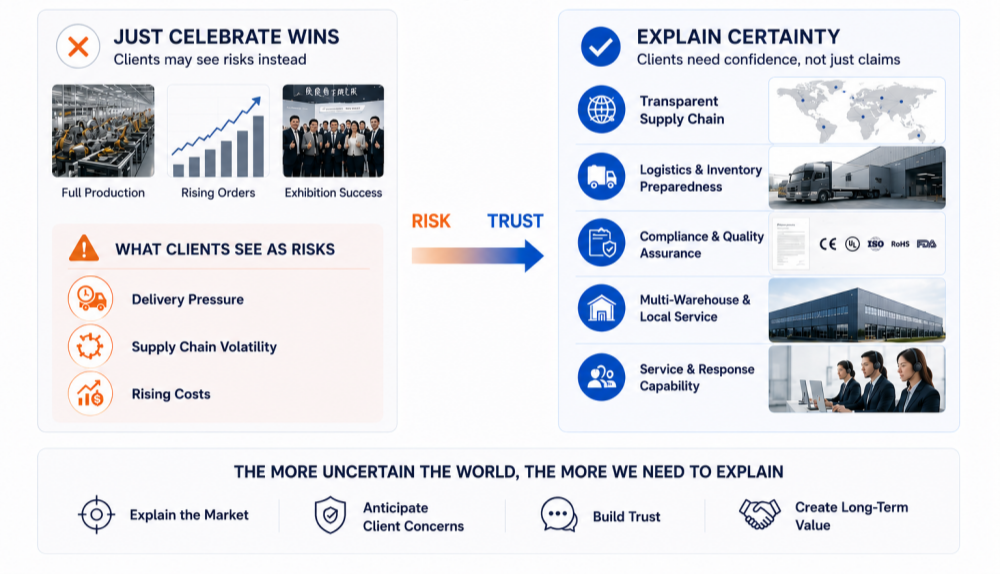
Yet under these conditions, many manufacturing companies continue flooding their overseas social media channels with celebratory posts about "record orders", "full-capacity production", and "successful exhibitions". While the intention is to demonstrate strength, customers may interpret these signals very differently — as indicators of production bottlenecks, delivery risks, or a lack of awareness about shifting market conditions.
The more uncertain the market becomes, the less customers need "strength showcases"— and the more they need explanations of certainty.
At times like these, the value of overseas social media should not be promotional decoration. It should function as a confidence-building mechanism that proactively addresses delivery reliability, cost stability, compliance readiness, and service continuity.
I. Why “Good News” Can Backfire
In periods of economic expansion, showcasing growth attracts attention. But during periods of volatility, growth signals can trigger concern instead. B2B procurement decisions are fundamentally driven by risk management, and when buyers become more sensitive to uncertainty, they begin interpreting"success signals"through a defensive lens.
1. Full Production Capacity = Delivery Risk?
Company intention: "We want to show strong business performance and manufacturing capability."
Customer interpretation: "If production is already overloaded, will my order be deprioritized?""Could supply chain disruptions occur under this level of pressure?""What contingency plans exist if delays happen?"
Insight: During unstable periods, spare capacity often provides customers with more reassurance than maximum utilization.
2. Growing Orders = Rising Costs and Lower Quality?
Company intention: "We want to show strong market demand and customer recognition."
Customer interpretation: "Will prices increase next?""Will quality control be sacrificed to maintain delivery speed?""Will customized needs be ignored because the company is too busy?"
Insight: Customers do not care how many orders you receive. They care whether your growth negatively affects their interests.
3. Busy Trade Shows = Focus on Acquisition Instead of Service?
Company intention: "We want to demonstrate market visibility and brand activity."
Customer interpretation: "If you spend heavily on exhibitions, are you still investing in after-sales service?""Are you prioritizing new customers while neglecting existing partners?""Are you prepared for tariff changes, or are you simply chasing exposure?"
Insight: Visibility alone is superficial. Customers want evidence that you understand and are actively managing market risks.
💡 Landelion Insight: Customers do not care how busy you are. They care whether your busyness affects their security.
II. Explain What Customers Worry About
In uncertain environments, procurement priorities shift from "best value" to "lowest risk". Overseas social media strategies therefore need to evolve from "showcasing strength" to "explaining certainty".
| Customer Concern | What Social Media Should Explain | Core Message |
|---|---|---|
| Market Adaptability | Compliance updates, certifications, carbon footprint methodologies, tariff response strategies | "We understand the rules. Choosing us is low risk." |
| Delivery Stability | Multi-source procurement strategies, inventory systems, logistics backup plans, emergency response procedures | "Even under disruption, we can still deliver reliably." |
| Cost Predictability | Pricing logic, long-term price lock mechanisms, hidden cost avoidance, TCO analysis | "Our pricing is transparent and predictable." |
These are precisely the blind spots that traditional"good news"content fails to address. They are not just"answer assets"— in uncertain times, they become confidence assets.
💡 Landelion Insight: In volatile markets, reassurance becomes the highest-value premium.
III. Three Content Shifts for Uncertain Markets
Periods of uncertainty require companies to operate with greater strategic discipline and adopt a more counter-cyclical communication approach. This is not simply a change in topics — it is a shift in operational logic.
1. Reduce Pure Celebratory Content and Increase Explanatory Content
Before: "Celebrating a major new order!""Our factory is running at full capacity!"
After: "How we help customers stabilize costs amid tariff changes.""Our multi-warehouse inventory strategy during global logistics volatility."
Underlying logic: Celebratory posts are self-focused. Explanatory content supports customer decision-making and directly helps buyers evaluate risk internally.
2. Reduce Broad Exposure and Increase Targeted Reach
Before: Prioritizing follower growth and maximizing impressions through generalized content.
After: Using platforms like LinkedIn to target existing customers and key decision-makers with highly relevant updates.
Underlying logic: During uncertainty, mass visibility becomes less valuable. What matters is whether key stakeholders see your ability to provide stability.
3. Reduce Reactive Communication and Increase Proactive Guidance
Before: Waiting for customers to ask whether operations are affected.
After: Publishing explanations before customers ask — including response plans before new policies officially take effect.
Underlying logic: Reactive responses position companies as service providers. Proactive explanations position them as trusted advisors. Silence is often interpreted as risk. Professional explanation creates reassurance.
💡 Landelion Insight: During volatile periods, the core function of social media is not traffic acquisition — it is trust preservation.
Conclusion: In Uncertain Markets, Trust Wins
In uncertain times, overseas social media should not function as a corporate trophy wall. It should function as a platform for risk explanation and trust reinforcement. The earlier companies explain the risks customers are already evaluating internally, the easier it becomes to establish confidence before formal inquiries even begin.
At Landelion, we focus not only on publishing content, but on helping manufacturers integrate overseas social media into a scalable, optimized lead generation system. Through strategic audience engagement and social media growth services, we ensure that every piece of content reinforces confidence — even during periods of volatility.
🚀 Take Action: Book a Manufacturing Social Media Diagnostic
Is your overseas social media still focused on announcing achievements — or is it helping customers understand markets, evaluate risks, and build trust? Landelion provides overseas social media diagnostics tailored for manufacturing companies. From content strategy and risk explanation capabilities to audience engagement efficiency, we help identify trust-building gaps in your current social media operations.
Book Manufacturing Diagnostic Add us on WeChat for a tailored plan
📚 Further Reading
How Overseas Social Media Becomes Trust Infrastructure for Manufacturing Companies
Manufacturing Global Social Media Marketing: Why Global Buyers Still Hesitate Despite Rising Exports