


For many B2B companies going global, the most frustrating issue with overseas social ads is not the lack of clicks – it’s the harder problem: clicks are there, backend data looks decent, but quality inquiries reaching sales remain low.
In review meetings, marketing leads often say: “We’re spending on LinkedIn and other platforms, CTR is fine – why are valuable inquiries still scarce?”
Companies tend to tweak audiences, budgets, bids, and creatives – but the problem may not lie in the ad setup itself.
For B2B, an ad click is only the start of the customer journey. What truly decides lead quality is what happens after the click: what the customer sees, whether trust is built, whether they’re willing to leave information, and whether they’re nurtured afterwards.
Overseas social ads are not about buying traffic in isolation – they amplify content, landing pages, trust signals, and lead capture paths that are already prepared.
If the back‑end capture system isn’t ready, more accurate targeting only burns budget faster. The true value of overseas social ads lies not in backend tweaks, but in building a closed‑loop system from “reach” to “conversion”.
I. Why do ads get clicks but still fail to convert into quality inquiries?
Many believe poor ad performance is due to “wrong audience” or “low bids”. But given B2B’s long decision cycles, isolated setup fixes cannot solve the root problem.
1. Traffic ≠ Leads
A high CTR may only mean the creative is eye‑catching – it does not signal purchase intent. Without proper filtering, you’ll attract low‑quality traffic.
2. Targeting ≠ Trust
No matter how precise the targeting, if the landing page lacks trust signals, visitors will not leave their information.
3. Click ≠ Deal
B2B decisions rarely happen after a single click. The first click may be initial awareness; the second, case studies; the third, white papers or product insights – only then does a real conversation start. Without retargeting and lead nurturing, most clicks are lost.
💡 Landelion Insight: Ad setup decides “who sees you” – but the conversion system decides “what happens after they arrive”.
II. Four critical handover links behind every ad
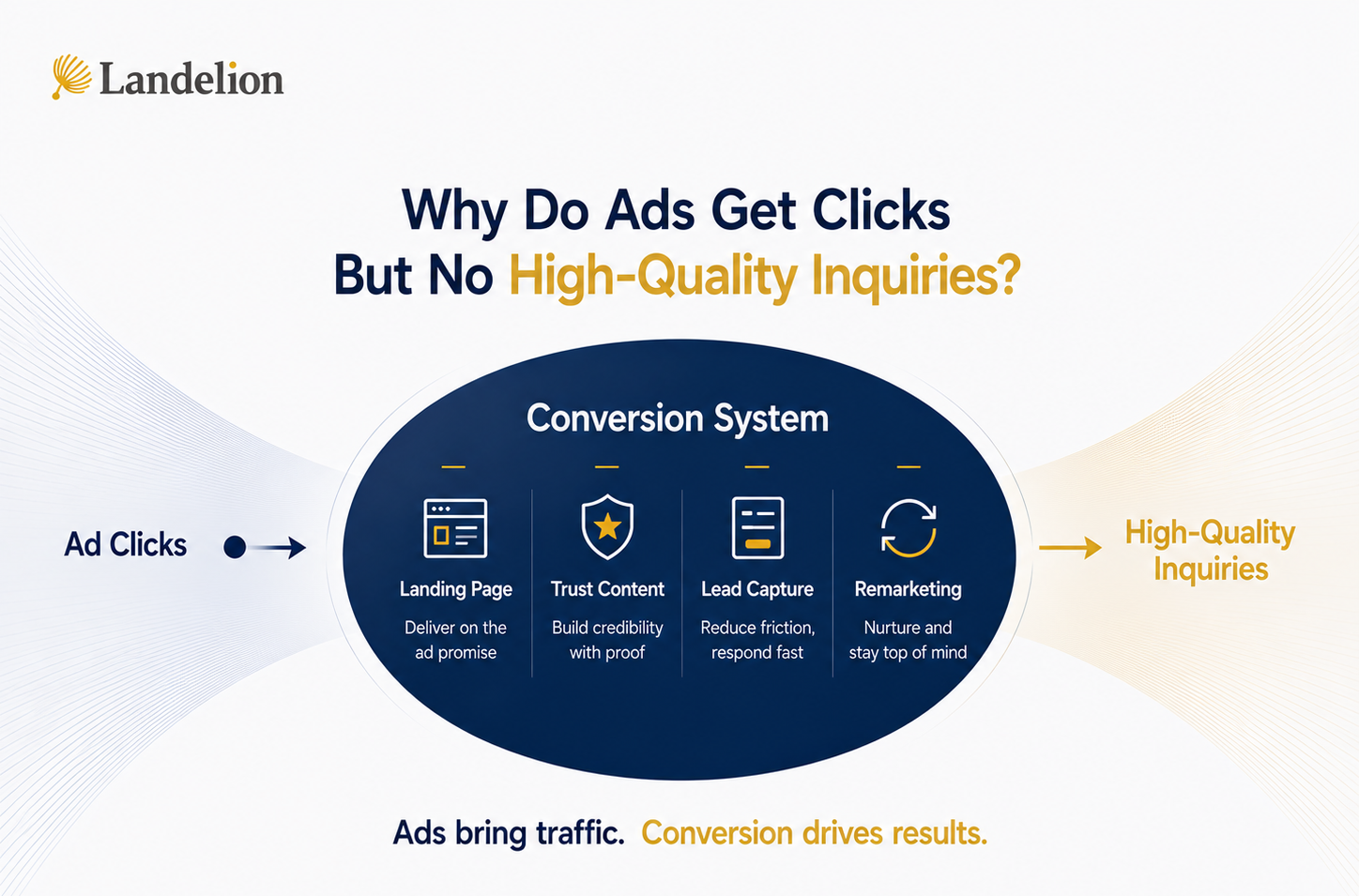
To improve ad efficiency, you must focus on the four handover links after the click. These are the key areas that our “Target Market Reach & Social Growth” services help optimise.
Ad conversion does not happen at the moment of the click – it happens along a continuous chain: clear ad promise → relevant landing page → low‑friction form → timely lead follow‑up → retargeting of non‑converted visitors.
1. Where does the click land?
Common issue: The ad link goes straight to the homepage, forcing visitors to search for relevant information.
Optimisation: Ads should point to dedicated landing pages that match the ad’s promise, reducing bounce rates.
Value: Longer time on site, lower bounce rates, ensuring traffic is not wasted.
2. Does the content build trust?
Common issue: The landing page only lists product specs, missing case studies, certifications, or client testimonials.
Optimisation: Embed trust signals such as industry cases, compliance certificates, and client stories on landing pages. This aligns with the “answer assets” logic – ads amplify what is already there.
Value: Shorter decision cycles, higher form submission rates.
3. How do forms / DMs / emails capture leads?
Common issue: Too many form fields, or lack of instant response mechanisms.
Optimisation: Simplify forms, offer multiple contact options (e.g. Calendar booking, WhatsApp). Ensure auto‑reply or sales follow‑up once leads enter the CRM.
Value: Lower barrier to leave information, no missed leads.
4. Is there retargeting and lead nurturing afterwards?
Common issue: Visitors who don’t convert on first visit are never re‑engaged.
Optimisation: Set up retargeting campaigns that serve case studies or white papers to visitors who left without leaving information. Also nurture them through email sequences.
Value: Reactivate dormant traffic, improve overall conversion rate.
💡 Landelion Insight: Ads are about traffic distribution – conversion is about trust handover.
III. How to run overseas social ads systematically?
Fixing conversion breaks requires more than “backend optimisation” – you need a systematic ad operation strategy that aligns traffic, content, and data.
| Dimension | Systematic strategy | Core value |
|---|---|---|
| Traffic & channel strategy | Combine organic content with paid ads. Use organic posts to test creative, then turn high‑engagement organic content into ad assets. | Lower testing costs, ensure ad creatives are market‑validated before scaling. |
| Content & path alignment | Maintain consistent tone and messaging across ad creative, landing page, and nurture emails. Ensure a seamless customer journey. | Consistent brand experience throughout the journey, reduce friction, boost conversion intent. |
| Data & feedback loop | Track not only CTR but also lead conversion rate (CVR) and customer acquisition cost (CAC). Review lead quality with sales regularly. | Ensure budget is allocated to channels that actually generate opportunities – shift from “traffic data” to “opportunity data”. |
💡 Landelion Insight: Systematic operation means every dollar of ad budget serves the final conversion.
IV. Boundaries of ad operations: avoid over‑reliance on paid traffic
Building an ad system does not mean ignoring organic growth. Companies should be mindful of the following boundaries when running social ads.
1. Paid is not the only engine
Ads are an accelerator, not the engine. If product‑market fit (PMF) is not validated, ads will only accelerate failure.
2. Align, don’t isolate
The ad team must collaborate with sales and content teams to ensure ad promises match delivery capabilities.
3. Long term over short term
B2B ad performance needs time to accumulate. Avoid frequent, drastic changes due to short‑term fluctuations – they disrupt algorithm learning.
Conclusion: Turn ads into accelerators of your acquisition system
In the second half of going global, competition is no longer just about traffic – it’s about conversion efficiency.
When a company builds a systematic ad operation, it stops blindly buying traffic and starts owning a predictable, optimisable acquisition channel. After a click, what truly drives conversion is not “whether the ad appeared” but:
🔹 Whether the landing page fulfils the ad’s promise;
🔹 Whether the content builds trust;
🔹 Whether the form lowers the action barrier;
🔹 Whether sales follow up promptly;
🔹 Whether non‑converted visitors can be reached again.
Ad placement is just the starting point. Target market reach & social growth require paying attention to the handover chain after the click.
For B2B companies going global, what truly needs optimisation is not a single click cost, but the complete path from ad reach → content understanding → lead capture → sales follow‑up.
Act now Check if your ad clicks are actually entering a lead capture chainDo your overseas social ads only bring clicks, or have they formed a complete path from ad creative → landing page trust → form capture → retargeting nurture? Landelion can help B2B companies identify breaks in the post‑click handover chain – whether the problem lies in creative, landing page, form, sales follow‑up, or retargeting. Understand target market reach & social growth Book an overseas social ad handover diagnosis | ||
| Content system building Build ad-aligned landing pages, case studies & trust signals to turn clicks into quality inquiries. Learn more → | Multilingual communication & coordination Localize ad copy, forms & sales follow-ups to reduce friction and boost response rates. Learn more → | Target audience reach & conversion Use retargeting and lead nurturing to build a complete click-to-inquiry closed loop. Learn more → |
📚 Further reading
B2B Global Social Media Marketing: Why Company Pages Alone Fail to Build Trust
Manufacturing Global Social Media Marketing: Why Global Buyers Still Hesitate Despite Rising Exports