


In many post‑campaign reviews of global‑bound companies, marketing leads often ask: “We post weekly, our followers are growing – why isn’t our lead conversion rate improving?”
This is a common “acquisition illusion”. Companies tend to believe that as long as they keep posting, leads will naturally come.
In fact, research on the B2B buying journey emphasises that in B2B purchasing, customers rarely reach out immediately after seeing a single post. They continuously verify whether a company is worth engaging through multiple touchpoints: search, profile visits, content interactions, direct messages, and sales follow‑ups.
Consistent posting does not equal consistent customer acquisition.
If you treat social media only as a broadcasting channel, you miss critical reach points like search, interaction, direct messages, and retargeting. From the perspective of target market reach & social growth, the core value of social media is not how much content you produce, but whether you can build a reachable link from “exposure” to “conversion”.
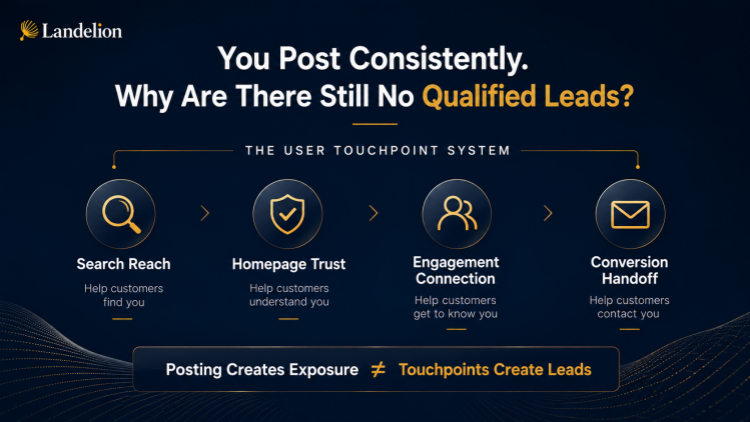
I. Why does “posting only” fail to generate effective leads?
Many equate social media management with content distribution. But under B2B’s long decision cycles, a pure posting model cannot cover the customer’s full evaluation path.
1. Algorithm shifts
Platform distribution increasingly depends on content engagement quality, audience relevance, and account credibility. Simply raising posting frequency does not guarantee more effective customer reach.
2. Fragmented customer behaviour
Customers no longer stay only in the newsfeed. They search keywords, check company profiles to verify credibility, and ask questions via DMs. If you only manage posts, you lose search and direct message opportunities.
3. Non‑linear decision path
B2B purchase decisions are rarely made after a single post. Customers need multiple touches (ads, organic content, sales DMs) to build trust. Without a systematic approach, traffic leaks.
💡 Landelion Insight: Posting solves “presence”; customer reach solves “conversion power”.
II. At which touchpoints do B2B customers form their purchase judgment?
To improve lead conversion, you must understand the “implicit judgments” customers make before contacting sales. Social media operations should cover four critical reach touchpoints.
1. Search reach (Search Intent)
Customer behaviour: Searches for “solution keywords” or supplier names on LinkedIn or Google.
Risk if missing: If your profile is not optimised for keywords, customers cannot find you – traffic lost.
Reach strategy: Optimise company page and personal profile keywords (SEO) so customers find you first when searching for solutions.
2. Profile reach (Profile Trust)
Customer behaviour: Clicks on company page or sales personal profile, checks about section, case studies, certifications.
Risk if missing: Vague profile information and lack of trust signals make customers perceive “unprofessional” and leave.
Reach strategy: Enhance banner, about section, pinned content – embed industry cases and compliance certifications.
3. Engagement reach
Customer behaviour: Comments on posts, likes updates, participates in industry discussions.
Risk if missing: If you broadcast without replies or respond mechanically, customers feel “no human service” and trust drops.
Reach strategy: Actively join industry conversations, reply to every comment, guide deeper dialogue, build human connections.
4. Conversation reach
Customer behaviour: Sends DMs, clicks on forms, books a meeting, or continues via email.
Risk if missing: Low‑threshold conversion entry missing, or slow DM response – customer intent cools down.
Reach strategy: Set low‑threshold entry points (white paper downloads, meeting booking, form enquiries) and guide DM conversations to email, WhatsApp, or sales follow‑up.
💡 Landelion Insight: The essence of customer reach is enabling customers to find you at any touchpoint – and be willing to leave their information.
III. How to upgrade social media from a “broadcast channel” to a customer reach system?
Solving “posts but no leads” requires more than “posting more” – you need a systematic customer reach strategy. This means upgrading across three dimensions: searchability, interactivity, and convertibility.
| Dimension | Traditional broadcast model | Customer reach & social growth model | Core value |
|---|---|---|---|
| Searchability | Relies on feed distribution, passive waiting | Optimise keywords & SEO, actively capture search intent | Ensure high‑intent customers can find you actively, lowering CAC. |
| Interactivity | One‑way broadcasting, slow replies | Two‑way dialogue, leading deeper discussions and DMs | Boost algorithm weighting, build genuine human trust connections. |
| Convertibility | No clear conversion entry, relies on customers reaching out | Set low‑threshold entries: forms, white papers, demo booking | Shorten conversion path, prevent traffic drop‑off, ensure leads are captured. |
💡 Landelion Insight: The essence of systematic operation is making every reach touchpoint serve the final customer acquisition.
IV. How to check for broken links in your social media reach chain?
Companies can self‑diagnose whether their social operations have formed an effective customer reach system by answering three key questions.
1. Can customers search for you?
Try searching for your core product terms or company name on LinkedIn. If customers struggle to find your company page, relevant content, or sales profiles using those keywords, your search reach is broken.
2. Does your profile build trust?
When customers click on your profile, can they understand “who you are, what you do, and what makes you different” within 5 seconds? Vague information means broken profile reach.
3. Can you capture leads effectively?
After a customer sends a DM or fills out a form, do they receive a professional response within 24 hours? Slow or no follow‑up means broken conversion reach.
If any of the above links are broken, no amount of posting will turn into effective leads.
Conclusion: Turn social media into a reachable acquisition engine
In the second half of going global, competition is not only about content – it is about reach efficiency.
When a company starts building a customer reach system, it no longer posts blindly – it owns a predictable, optimisable acquisition channel. Customers feel not just brand presence, but professional service that is always reachable.
For B2B companies going global, the value of overseas social media should not stop at “continuously publishing content”. It must enter the full path of customer search, understanding, interaction, enquiry, and sales follow‑up.
That is exactly what target market reach & social growth solves: helping companies integrate scattered social content, profile information, engagement mechanisms, DM capture, and conversion entry points into a runnable, optimisable acquisition reach system.
When customers can find you, understand you, trust you, and know how to proceed at every stage – only then does social media truly upgrade from a broadcast channel to part of an acquisition system.
Act now Check whether your social media operations have built a true customer reach chainDo your overseas social accounts only bring exposure, or have they formed a complete reach chain from search → profile → engagement → DMs → conversion entry points? Landelion can help B2B companies identify broken links in social media operations – diagnosing whether the problem lies in profile optimisation, engagement strategy, DM capture, or conversion paths. Understand target market reach & social growth solution Book an overseas social reach chain diagnosis |
📚 Further reading
B2B Global Social Media Marketing: Why Company Pages Alone Fail to Build Trust
Manufacturing Global Social Media Marketing: Why Global Buyers Still Hesitate Despite Rising Exports