


In early 2026, LinkedIn reported double‑digit growth in video uploads for the third consecutive quarter. Platforms and brands are increasing their investment in video content, and “video‑first” is becoming an important backdrop for many social media teams as they reassess content formats.
Faced with this trend, many B2B companies are reconsidering their content mix: should they shift more resources to video? Is text‑based content still worth investing in?
Data provides a fuller picture. Text‑based posts still reach 4% to 7% of target audiences on LinkedIn, higher than the 2.5% to 4.5% for native video. Meanwhile, carousel posts are currently the highest‑engagement format in B2B social media, with median engagement nearly double that of video. These figures don’t mean “text beats video” – they indicate that different formats serve different communication goals: text has unique strengths in deep explanation and long‑term retention, while video is equally irreplaceable for building connection and capturing attention quickly.
Platforms are pushing video, but text content hasn’t become obsolete. The key is to understand that video and text solve different problems in B2B social media – they are not substitutes, but complements.
I. What content tasks is video better suited for?
Video content holds real value in B2B social media—it is becoming one of the key ways B2B buyers vet potential vendors, and a format that brands must take seriously as platform algorithms continue to favor video.
1. Building personal connection
Founder or expert videos filmed on camera help customers feel “there is a real person on the other side”. LinkedIn research also shows that B2B marketing teams are increasing their use of video content. Video has become an important format for presenting expert perspectives, real people, and brand credibility.
2. Conveying emotion and impression quickly
A factory floor clip, a quick product demo edit, or a highlight reel from an event – video conveys “atmosphere” and “authenticity” in ways that text and images cannot match.
3. Capturing attention
In the feed, video naturally has higher visual impact than static text and images – which is one reason platforms and brands continue to invest more in video.
But video is not well‑suited to carrying complete, complex decision‑information on its own.
B2B purchasing involves multi‑stakeholder, long‑cycle, high‑risk decisions. Customers need to understand how a solution fits their specific scenario, whether technical specifications meet requirements, whether the implementation path is clear, and how risks are controlled. This information is difficult to convey fully in a 60‑second video.
When customers conduct internal evaluations, they need to reference materials, compare data, and explain to teams. Video is less efficient than text for these purposes – it’s harder to scan quickly, harder to highlight key points, and harder to copy‑paste for internal discussion.
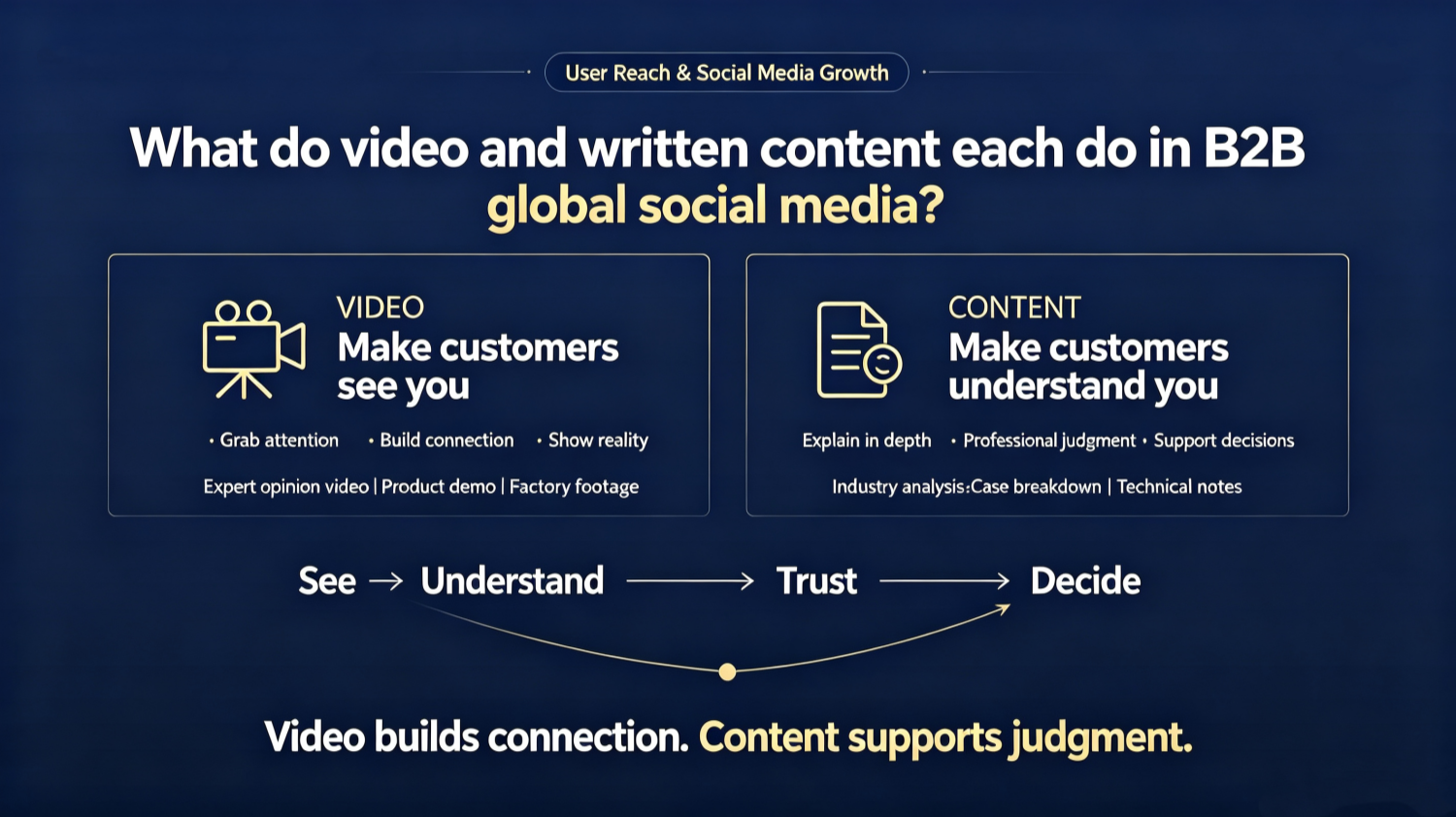
Video is better at helping customers “see” you, but helping them “understand” you typically requires text content as well.
II. Three strategic functions of text content in B2B social media
Function 1: Explaining complex business
B2B products and services involve multiple dimensions – technical specs, industry standards, implementation plans. Customers don’t just need to “know this product exists”; they need to “understand how this product solves my problem”. Text content – especially long‑form articles, carousels, and document posts – can present this information in a structured way.
Carousels (Carousel/Document Post) are currently one of the highest‑engagement formats in B2B social media. Their advantage lies in: paginated structure allows complex information to be digested step‑by‑step, swipe actions increase dwell time, and the save function enables repeated reference. These characteristics make carousels particularly strong for layered information, structured explanations, and repeated consultation.
Function 2: Building professional judgment
B2B customers validate a supplier’s expertise not by “what videos you made”, but by “what your judgment is on industry issues, what evidence you have, and whether it stands up to scrutiny”.
Text content is naturally suited to conveying judgment – it can show logical chains, cite data sources, and present case details. A deep industry analysis or a case breakdown with concrete data helps customers form the view that “this company knows their stuff”.
Function 3: Supporting internal customer decision‑making
B2B purchases are rarely made by a single person. The point of contact needs to pass information to technical teams, procurement, management, and other roles. In this process, text content’s value lies in being savable, shareable, annotatable, and incorporable into evaluation materials. Carousels and document posts are typically better suited for B2B evaluation scenarios when it comes to saving, sharing, and internal referencing. Customers cite “page X of that analysis article” in internal discussions, not “second Y of that video”.
III. How should video and text divide their work?
Once we understand their respective functional boundaries, the answer becomes clear. Video and text are not about “which one to choose” – they are about “which scenario each is used for”.
| Dimension | Video is better at | Text is better at |
|---|---|---|
| Core goal | Brand exposure, building connection, capturing attention | Deep explanation, professional judgment, supporting decisions |
| Suitable content | Founder sharing, product demos, factory footage | Industry analysis, case studies, technical explanations |
| Audience stage | Awareness (let customers know you) | Evaluation (let customers understand and trust you) |
| Content lifecycle | Short‑term exposure | Long‑term reference and retention |
| Conversion contribution | Directing to homepage or profile | Directly supporting internal evaluation and decisions |
In B2B social media, video and text each play distinct roles: video helps customers “see” you – building authenticity and connection; text helps customers “understand” you – presenting complex information, building professional judgment, and supporting internal decisions. Only together can they cover the entire decision path from awareness to evaluation.
IV. Does your content format mix align with your communication goals?
If you are unsure about your team’s current state, use these quick self‑check questions:
⬜ Is format selection driven by communication objectives or by format popularity?
Among content published in the last month, is there a clear logic to format choices – what content suits text, what suits video – or is it simply “everyone’s doing video so we do too”? If format selection lacks purpose, content strategy has a break.
⬜ Is deep content carried by text formats?
When it comes to industry analysis, technical explanations, case breakdowns, and other in‑depth content, is text (long‑form articles, carousels, document posts) the primary vehicle? If all deep content is presented as video, customers will struggle to absorb information and pass it on internally.
⬜ Is the searchable and citable advantage of text content being fully utilised?
Is text content designed to be easily saved, shared, and cited? Do carousels include clear chapter structures? Are long‑form articles easy for customers to excerpt key information? If text is only “written casually”, its decision‑support function is not being leveraged.
Conclusion: Video helps customers see you, text helps customers understand you
Platforms are pushing video – that’s a fact. But the goal of B2B social media operations is not “to please the platform” but “to serve customer decisions”.
Video and text each have their place. Video excels at building connection and quickly capturing attention; text excels at carrying complex information and supporting internal decisions. B2B content strategy does not need to choose between the two – it needs to let each format play its role according to the customer’s decision stage and communication goals.
Landelion’s Target Audience Reach & Conversion service can help B2B companies reassess their content format mix amid platform trends – starting from customer decision needs, determining what role text and video should each play, and ensuring every format serves the right purpose.
Act now Is your overseas social content blindly following the video trend, or have you developed a clear strategy for text‑video collaboration?Landelion can help B2B companies examine their content format mix from the perspective of Target Audience Reach & Conversion – diagnosing whether the issue lies in format selection logic, text‑video division, deep‑content vehicles, or insufficient support for customer decisions. Explore Target Audience Reach & Conversion solution Book a content mix diagnosis |
📚 Further reading
Why B2B Social Media Needs Professional Judgment More Than AI‑Generated Content
How to Turn Your B2B Social Media Page into a Trust-Building and Conversion Engine
After LinkedIn Starts Flagging Low-Quality AI Content, How Can B2B Accounts Stay Visible?