


In the process of global expansion, a manufacturing company’s website is not merely a traffic destination—it is the first battlefield for building trust.
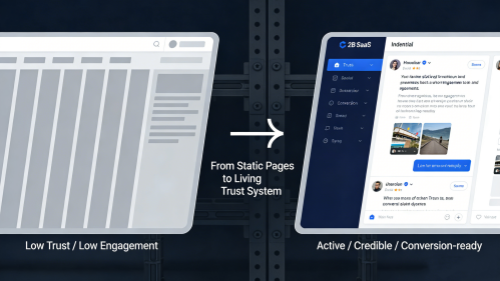
Yet in practice, many manufacturing websites suffer from a clear form of “static decay”:
🔹Content remains unchanged for long periods
🔹Average session duration is short
🔹Conversion performance consistently underperforms expectations
Based on Landelion’s project experience, the core issue is rarely design or traffic volume. Instead, it lies in the systemic disconnect between social media content and the website’s trust structure.
While LinkedIn publishes technical insights and YouTube showcases customer stories, the website often fails to absorb and validate these “living proofs.” As a result, overseas buyers encounter trust breakpoints at critical decision moments.
This article breaks down three practical, implementation-ready strategies to help manufacturing companies convert social media activity into durable website trust assets—and ultimately improve B2B inquiry quality.
I. A Deep Diagnosis: How Overseas Buyers Perceive Trust Gaps
At its core, B2B procurement is a high-risk avoidance process.
Multiple studies show that before contacting sales, B2B buyers independently research potential suppliers across websites, social media platforms, and third-party sources.
Buyers actively move across digital channels to validate product and supplier capability. When information across channels is inconsistent, cognitive load increases and trust weakens (Source: Digital Commerce 360).
What Buyers Verify First on a Website
During the initial website visit, buyers typically assess three dimensions within seconds:
✅ Operational activity
(Content update frequency and visible industry participation)
✅ Capability credibility
(Third-party social proof and real customer evidence)
✅ Technical relevance
(Depth of technical discussions and industry positioning)
If the website fails to respond clearly, trust erodes quickly.
Common Trust Breakpoints
🔹 Outdated content signals
Long-unupdated “News” or “Latest Updates” sections often raise concerns about operational continuity. In real cases, buyers questioned supplier stability simply because the latest website update referenced an event from years ago.
🔹 One-way information delivery
Product pages listing only specifications without testimonials or application context fail to meet engineers’ expectations. Overseas buyers care more about peer validation and real-world use than raw parameters.
🔹 Channel fragmentation
When buyers see active technical discussions on LinkedIn but find no corresponding depth on the website, professional credibility weakens. The need to cross-check platforms increases decision friction.
💡 Landelion Insight
Many overseas buyers explicitly treat “whether the website reflects social media activity and technical engagement” as a key signal of supplier reliability.
II. Three Strategies to Systematically Embed “Living Proof” into Your Website
Strategy 1: Embed LinkedIn Feeds to Build a “Real-Time Professional Presence”
How to Implement
Use LinkedIn’s official embed function to insert company page feeds into sections such as Industry Insights or News Center
Filter posts to prioritize technical keywords (e.g. #PrecisionEngineering, #IIoT)
Optimize layout while retaining the “Follow” entry to encourage long-term connection
Why It Works
🔹 Reduces perceived distance
Buyers see teams actively engaging in industry discussions, forming a “live partner” impression. Some companies report that conversations shifted from basic inquiries to technical discussions after embedding feeds.
🔹 Strengthens professional tagging
Frequent exposure to industry keywords improves relevance perception among target audiences.
🔹 Delivers long-term SEO value
Continuously updated content contributes to a stronger “freshness” signal for search engines.
Strategy 2: Build a YouTube Customer Testimonial Video Wall
How to Implement
Select high-quality customer videos featuring real people, application contexts, and outcomes (with formal authorization)
Categorize by industry or application (e.g. automotive, medical devices)
Add concise text summaries highlighting customer role and value delivered
Why It Works
🔹 Stronger evidence chains
Customers describing their own challenges and results carry far greater credibility than written claims.
🔹 Lower perceived risk
Seeing peer companies already using the solution significantly increases buyer confidence.
🔹 Cross-cultural resonance
Native-language interviews with accurate subtitles preserve authenticity while maintaining professionalism.
Strategy 3: Industry Topic Aggregation Sidebars to Signal Thought Leadership
How to Implement
Add an “Industry Discussions” module to the website resource center
Aggregate curated discussions from LinkedIn and other platforms using industry tags (e.g. #PredictiveMaintenance)
Include expert commentary from internal technical teams
Why It Works
🔹 Positions thought leadership
Shows the company actively participating in global technical discourse, not just selling products.
🔹 Attracts high-intent engineers
Search-driven visitors stay longer when encountering deep, relevant discussions.
🔹 Enables sales conversations
Provides sales teams with ready-made technical talking points and icebreakers.
III. Optimization Results and Long-Term Maintenance
Before vs. After Integration
Dimension | Before (Static Website) | After (Dynamic Integration) |
Homepage | Static visuals, rarely updated | Live social feeds and customer videos |
Case studies | Text-only descriptions | Industry-segmented testimonial videos |
Trust signals | Static certificates | Social proof + video evidence + discussions |
Buyer perception | “Thin information, needs verification” | “Active, professional, worth engaging” |
Clients report that after implementing these strategies, content engagement, trust perception, and lead quality all improved, with higher sales follow-up efficiency.
Three Principles for Sustainable Operation
🔹 Systematic updates
Define synchronization cadence (e.g. daily LinkedIn feeds, monthly video updates)
🔹 Performance tracking
Monitor engagement depth via analytics (video watch time, page dwell time)
🔹 Cross-team collaboration
Marketing embeds content, technical teams review accuracy, sales provide real-world feedback
IV. Frequently Asked Questions (Q&A)
Q1: Will embedding LinkedIn feeds slow down website performance?
A: Not if implemented correctly. Use official lightweight embed code, enable lazy loading, and limit display to 3–5 recent posts. Optimized implementations show negligible performance impact.
Q2: How do we ensure compliance when using customer videos?
A: Follow three steps:
① Obtain written authorization specifying scope and duration
② Avoid unauthorized sensitive information
③ Clearly label videos as “Used with client permission”
(Standard authorization templates are available from Landelion.)
Q3: How can smaller companies start with limited resources?
A: Focus on an MVP approach:
① Embed LinkedIn feeds first (low technical effort)
② Start with 1–2 authorized customer videos
③ Use free platform features (e.g. YouTube playlists) before scaling
Conclusion: Trust Is the Core Asset in Manufacturing Global Expansion
A website should not be a static content warehouse—it should function as a trust showroom.
Each precise integration of social media proof sends a clear message to overseas buyers:
“We are professional, active, and trustworthy.”
When technical discussions, customer evidence, and industry participation are naturally visible on the website, it transforms from an information container into a trust acceleration engine.
Breaking channel silos is ultimately about rebuilding trust logic—ensuring that at every step of the buyer journey, professional value is continuously verified.
Is Your Website Still “Sleeping”?
📩 Contact us | Explore marketing solutions
💬 Add us on WeChat for a tailored solution
📚Further Reading