


In July 2026, LinkedIn introduced a new feature: users can mark posts as “Looks like AI-generated spam” via the three-dot menu on any post. At the same time, LinkedIn has been stepping up its detection of AI slop and low-quality content. LinkedIn has stated that while AI can assist with language polishing, AI-generated content that lacks clear perspectives, authentic viewpoints, and substantive information is less likely to be distributed beyond a user's first-degree network.
As AI-generated content floods the platform, the platform's choice is no longer “encouraging volume” but “identifying quality”. For B2B companies, a fundamental shift is underway: the practice of maintaining account presence through templated content is losing its effectiveness.
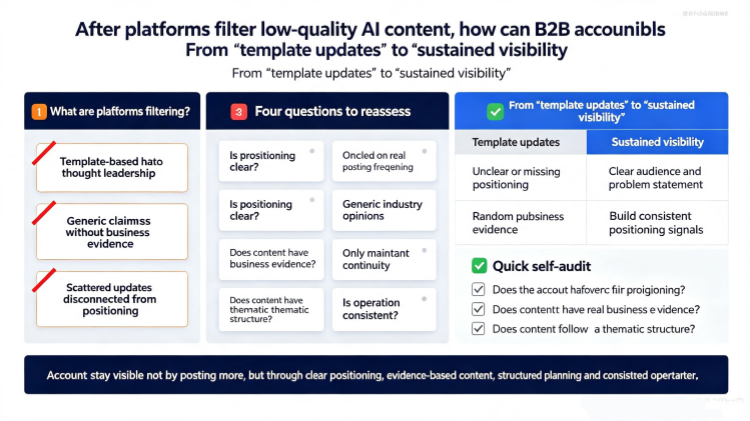
I. What is the platform filtering out?
Specifically, the following types of content are more likely to be flagged as low-quality and may see reduced exposure in recommendation feeds:
| Content type | Characteristics | The problem |
|---|---|---|
| Templated “thought leadership” | Well-structured, elegantly worded posts that lack original viewpoints | Rearrangements of common perspectives rather than genuine experience |
| Generic commentary without business grounding | “Industry insights” with no customer scenarios, specific data, or verifiable experience | Fails to answer what customers truly care about: what can you help me solve? |
| Scattered updates detached from business positioning | Random piles of company news, holiday greetings, and exhibition photos | No clear thematic signals, making it harder to be recommended to truly relevant target audiences |
The signal from the platform is: AI can assist, but it cannot replace business judgment.
II. Why can't B2B accounts rely solely on “consistent posting”?
Many B2B companies' social media operating logic is: maintain posting frequency, publish a few pieces per week, covering industry trends, company updates, and product information. When the platform starts identifying and filtering low-quality content, “consistent posting” alone is no longer an advantage.
As we mentioned earlier, content production in the AI era demands more professional judgment – clarity on what content is worth publishing and what information customers will trust. And now there is another question: how does the account itself get recognised by both the platform and customers?
A B2B customer clicking into an account will not trust the company just because “they posted five times last week”. What they need is: does this account clearly state who the company serves, what problems it solves, and what verifiable experience it has? Similarly, the platform's recommendation system needs sufficient signals to determine: who this account is, who it serves, and whether its content is worth recommending to relevant audiences.
As the platform begins filtering low-quality content, accounts that rely on “volume” to maintain presence will find: the more content they publish, the harder it becomes for target customers to see them. Because the system no longer only looks at “how much was posted”, but rather “whether the content is needed and whether the account has a clear identity”.
III. After platform changes, B2B accounts need to re‑examine four questions
Algorithm changes are not a one‑time rule adjustment; they represent a redefinition of the platform's content value standards. B2B accounts need to re‑examine their operating logic from the following four dimensions:
1. Is the positioning clear?
Does the account have a clear positioning – who it serves, what problems it solves, and what value it delivers? Is this positioning consistent across the bio, pinned content, recent posts, and business information? If the account's positioning is unclear, the system cannot accurately recommend content to target audiences, and customers cannot quickly determine “what this has to do with me” after landing on the page. Accounts with clear positioning are more likely to form stable thematic signals, helping both the platform and customers understand the domain in which the account consistently operates.
2. Is the content grounded in business reality?
Behind every piece of content, is there real business information to support it – customer scenarios, project experience, verifiable data? Or is it merely repeating generic industry viewpoints? As the platform begins filtering content that “feels generic or repetitive”, content without business grounding will find it harder to enter target customers' view. Content with business grounding is inherently differentiated and more easily recognised by the system as “content with informational value”.
3. Does the content have structure?
Does the content on the page have clear thematic planning – which content targets customers in the awareness stage, which targets those in the evaluation stage, and which are case studies and evidence? Or is it a pile of scattered posts? Structured content is easier for the system to identify and classify, and also helps customers complete their evaluation more effectively.
4. Is there operational consistency?
This is the most easily overlooked point. Once the account's positioning and content structure are defined, consistent operations are needed to build signals for the platform. These “signals” include: in what domain the account consistently produces content, whether content quality and professionalism are consistent, and how the target audience engages and responds. The platform's recommendation system needs sufficient historical content and engagement feedback to identify the account's thematic direction and content relevance. If operations are intermittent or topics jump frequently, the system cannot form a stable content profile, and recommendation accuracy will decline.
IV. Evolution from “template updates” to “sustained visibility”
| Dimension | Relying on “template updates” | Pursuing “sustained visibility” |
|---|---|---|
| Account positioning | Vague or missing, posting a bit of everything | Clearly articulates who is served and what problems are solved |
| Content source | Generic industry views and templated expressions | Based on real business information and verifiable experience |
| Content structure | Scattered posting, lacking thematic planning | Sustained, topic‑based output organised around customer evaluation needs |
| Operating logic | Maintaining posting frequency | Building positioning consistency and accumulating account recognition signals |
After platform changes, the core question B2B accounts need to answer is no longer “how much did we post”, but “when target customers and the platform's system both look at this account, is it clear, substantiated, and recognisable”. An account's visibility depends on the alignment of four dimensions: positioning, content, structure, and operations.
V. Can your account sustain visibility through these changes?
If you are unsure about your team's current state, use these quick self‑check questions:
⬜ Does the account have a clear positioning?
Without reading the bio, just looking at the last 10 posts – can a new visitor quickly determine “who this company serves and what problems it solves”? If not, account positioning has a break.
⬜ Is the content backed by real business evidence?
Randomly select three recent posts – does each one have traceable customer scenarios, project experience, or specific data to support it? If there are only opinions without evidence, the content source has a break.
⬜ Does the content have a thematic structure?
Do the posts from the past month follow a clear thematic thread, or are they a pile of scattered company news and industry viewpoints? Without thematic planning, both customers and the system will struggle to form a clear understanding of the account.
Conclusion: After low‑quality content is filtered, accounts need to build visibility signals even more
This round of algorithm adjustments sends the same underlying signal: content distribution is shifting from “encouraging volume” to “identifying quality”.
For B2B companies, this means that relying on templated updates to maintain presence is becoming ineffective. Accounts need sustained visibility – not through “posting more”, but through clear positioning, business‑grounded content, structured thematic planning, and consistent operations. These four elements together form an account's “visibility signals”, determining whether the account can still enter target customers' view after the platform filters out low‑quality content.
Target Audience Reach & Conversion addresses exactly this upgrade – from “template updates” to “sustained visibility”. Landelion can help B2B companies re‑examine their content strategies amid platform algorithm changes – from positioning review, content planning, to operational cadence – ensuring the account is not just “present”, but consistently visible to target customers.
Act now Does your overseas social account rely on template updates to maintain presence, or has it formed a content structure that can be consistently seen by target customers?Landelion can help B2B companies examine account visibility amid algorithm changes from the perspective of Target Audience Reach & Conversion – diagnosing whether the issue lies in account positioning, content grounding, thematic structure, or operational cadence. Explore Target Audience Reach & Conversion solution Book an account visibility diagnosis |
📚 Further reading
How to Turn Your B2B Social Media Page into a Trust-Building and Conversion Engine
Why B2B Social Media Needs Professional Judgment More Than AI‑Generated Content
Why B2B Companies Need Both Content and Advertising Before Launching Global Social Media