


Once an overseas project enters the collaboration phase, companies often need to communicate with multiple internal roles on the customer side simultaneously – technical teams, procurement, legal, management, local operations – each with different decision‑making logic and information needs. Yet most companies still communicate with “one set of content, one logic, for everyone”.
Communication is not absent, but the audience has not been accurately identified. |
A 2025 study by LinkedIn and Edelman defines these overlooked roles as “hidden buyers” – internal stakeholders who are often ignored by marketing and sales yet hold real influence in purchasing decisions. The study notes that over 40% of B2B deals stall because the buying group cannot reach internal consensus.
This means that even when the technical solution is approved and pricing is largely agreed, the project can still stall due to concerns from a stakeholder who has not been properly engaged.
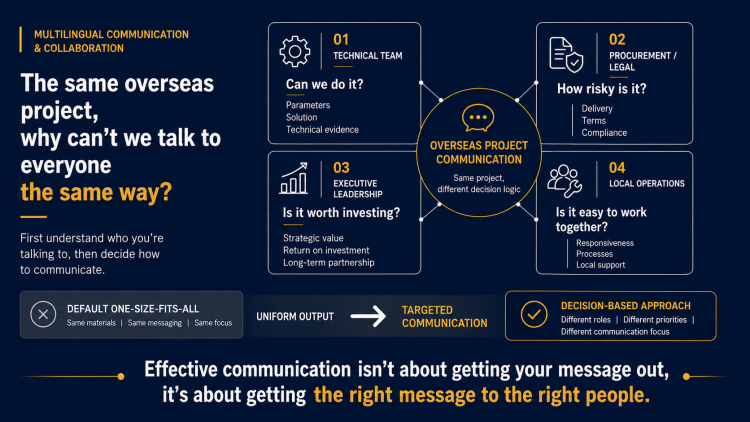
I. Why do communication audiences become more complex during project collaboration?
Before a project enters the collaboration phase, the company’s communication counterparts are relatively straightforward – typically the customer’s procurement contact or a technical interface during the initial screening stage. The content is also relatively fixed: product introductions, company capabilities, and preliminary proposals.
But once in the collaboration phase, the audience expands rapidly:
1. The customer’s technical team
They care about whether the product meets specific technical specs, whether parameters align, and whether customisation is possible. They don’t need to hear “we are strong” – they need to know “can this spec be achieved, and how?”
2. The customer’s procurement and legal teams
They focus on delivery timelines, payment terms, contract clauses, and risk allocation. They judge not technical capability, but the executability and risk control of the cooperation.
3. The customer’s management
They care about strategic value, long‑term cooperation potential, and return on resource investment. They need to know “what is the overall value of this collaboration to the company” – not project‑level details.
4. The customer’s local operations team
They care about implementation, local support, and after‑sales responsiveness. They need to know “will day‑to‑day collaboration run smoothly after the project moves forward?”
5. The company’s own internal teams
Technical, delivery, legal, and finance departments each need to convey different information and coordinate different content in communications.
Each communication counterpart has a different decision‑making logic and information need. Without advance identification, you risk “talking strategy to technical experts and specs to management” – communication happens, but the information does not reach the right people.
II. Different audiences focus on different decision priorities
The same project, the same company – different roles have very different decision‑making logic:
1. Technical decision‑makers: judging “can it be done”
They need to verify whether technical capabilities match, whether the solution is feasible, and whether similar experience exists. Communication should focus on specific technical parameters, process paths, case details, and verifiable technical evidence.
2. Procurement and legal: judging “how high is the risk”
They need to verify delivery reliability, reasonableness of terms, and risk control. Communication should focus on delivery processes, quality systems, compliance documentation, and precise contract wording.
3. Management: judging “is it worth investing”
They need to verify strategic value, long‑term cooperation potential, and return on resource investment. Communication should focus on the overall value to the customer’s business, the long‑term synergy space, and the match between resources and commitments.
4. Local operations teams: judging “is it easy to work with”
They need to verify whether daily communication is smooth, whether issues are responded to promptly, and whether cultural differences are managed effectively. Communication should focus on collaboration processes, communication mechanisms, and local support capabilities.
If you don’t identify your audience and use the same content and logic for all roles, information transfer efficiency drops significantly.
III. Communication in project collaboration requires first identifying the audience and scenario
Landelion’s Multilingual Communication & Coordination service, in project collaboration scenarios, focuses on pre‑meeting preparation, on‑site coordination, and post‑meeting follow‑up. Specifically, four things need to be done:
1. Identify the communication scenario
When identifying the communication scenario, also assess the participants’ roles, levels, decision authority, and core concerns. Every cross‑border meeting, negotiation, client visit, or factory tour requires decisions on language direction, staffing, equipment needs, and coordination methods. Technical reviews, commercial negotiations, and executive meetings have completely different communication priorities – if you misjudge the scenario, all subsequent preparations will be off track.
2. Prepare materials and terminology in advance
Prepare meeting materials, product content, background information, and professional terminology in advance to help interpreters and participants align on the same context. If the interpreter only starts understanding the meeting content on the day, on‑site communication efficiency drops significantly. Inconsistent terminology and unsynchronised materials are major causes of poor communication efficiency in project collaboration.
3. Assign language staff and equipment
Match interpreters, simultaneous interpretation equipment, online meeting tools, and on‑site support based on the meeting scenario, reducing execution risks from ad‑hoc arrangements. Temporary interpreter arrangements often increase quality and stability risks. Different scenarios require different language capabilities – technical reviews need interpreters familiar with industry terminology, commercial negotiations need interpreters who understand contract logic, and factory tours need escort interpreters who can handle live Q&A.
4. On‑site coordination and contingency support
During meetings or events, coordinate language staff, customer teams, equipment providers, and event workflows to handle ad‑hoc adjustments and communication risks. Interpretation, equipment, materials, and on‑site processes must not fall out of sync. Any temporary issue in any link – equipment failure, process changes, or last‑minute agenda additions – requires someone on site to coordinate, ensuring communication is not interrupted or derailed.
Problems in multilingual communication often occur before the meeting even starts. The quality of pre‑meeting preparation determines the effectiveness of on‑site communication.
IV. The way you communicate determines the outcome
| Communication stage | If “default one‑size‑fits‑all logic” | If “identify audience first” |
|---|---|---|
| Starting point | Starting from company introduction | Starting from the other party’s role and concerns |
| Content organisation | One set of materials for all scenarios | Adjust information structure based on audience and purpose |
| Pre‑meeting preparation | Interpreter arrives on the day and starts cold | Provide meeting materials, background, and glossaries in advance to get the interpreter up to speed |
| Language preparation | Generic translation, inconsistent terminology | Prepare professional glossaries to ensure core terms stay consistent across meetings and interpreters |
| Staffing | Temporary interpreters, unstable quality | Match professional interpreters to the meeting scenario, providing short‑term, project‑based, or on‑site support |
| Equipment support | Rented last minute, issues arise during setup | Prepare simultaneous interpretation equipment, online meeting tools, and on‑site support in advance |
| On‑site coordination | Interpreter works alone, no coordination on site | Coordinate language staff, customer teams, equipment providers, and event workflows to handle ad‑hoc adjustments |
| Communication outcome | Information is sent, but may not be received | Information is understood and advanced by the right people in the right way |
Communication in project collaboration is not about “sending a message” – it is about “making sure the other party receives and understands it”. And the prerequisite for “receiving and understanding” is to first identify who the other party is, what they care about, and what they need – and complete systematic preparation of materials, terminology, personnel, and equipment before the meeting.
V. Does your project communication identify the audience first?
If you are unsure about your team’s current state, use these quick self‑check questions:
⬜ Before each important communication, do you clarify the other party’s role and concerns?
Technical reviews, commercial negotiations, executive meetings – different scenarios involve different counterparts. Are you making advance judgments and preparations? If all communication uses the same logic, audience identification is broken.
⬜ Is the communication content adjusted based on the audience?
Are the materials sent to the technical team different in structure, language, and focus from those sent to management? If they are identical, content organisation is broken.
⬜ Does the interpreter receive materials and glossaries in advance?
Before important meetings, does the interpreter receive meeting materials, background information, and professional glossaries? If they only start learning on the day, pre‑meeting preparation is broken.
⬜ Have there been any breakdowns in equipment or processes during on‑site communication?
If online meetings drop, simultaneous interpretation equipment fails, or on‑site processes are chaotic – and these happen frequently – on‑site coordination is broken.
If any of the above issues exist, communication in project collaboration still needs more systematic preparation and coordination.
Conclusion: Enter project collaboration by identifying the communication audience first
Once an overseas project enters collaboration, communication is no longer “company to a single client” but “company to multiple roles” – technical teams, procurement, legal, management, local operations – each with different decision‑making logic and information needs.
Without identifying the audience, communication becomes an information broadcast – sent, but not necessarily received. True effective communication is: identify the audience first, then organise the content, then coordinate on‑site.
Landelion’s Multilingual Communication & Coordination service covers the full communication support chain in project collaboration – from scenario identification, material preparation and terminology alignment before meetings, to language staffing, equipment support, and process coordination on‑site, to post‑meeting documentation and result consolidation – ensuring every communication reaches the right people precisely.
Act now Does your overseas project communication use the same logic for all roles, or have you built a coordination mechanism that identifies the audience first and then organises communication?Landelion can help B2B companies examine coordination breaks in overseas project communication from the perspective of Multilingual Communication & Coordination – diagnosing whether the issue lies in scenario identification, pre‑meeting material and terminology preparation, language staffing, equipment support, or on‑site process coordination. Explore Multilingual Communication & Coordination solution Book a project communication coordination diagnosis |
📚 Further reading
Don't Let Language Gaps Undermine Your Expertise – Build a Multilingual Communication System
How to Structure B2B Sales Materials for Internal Customer Handover and Decision Advancement
From Patchwork to Professional: Content System Building for the B2B Evaluation Phase