


In many post‑exhibition reviews or sales feedback from overseas‑focused companies, a common refrain emerges: the English product brochure is ready, beautifully designed, and overseas buyers take it away during the show or initial conversation – yet when sales follows up, the other party hesitates to move forward.
This does not necessarily mean the customer has no interest. More often, the material is taken away but does not truly help the customer complete internal discussions, compare solutions, or reach a purchasing decision. The contact person may need to relay the information to the technical team, procurement team, or management – but if the brochure itself does not clearly explain application scenarios, differentiated value, trust evidence, and next steps, it will hardly serve as a basis for internal decision‑making.
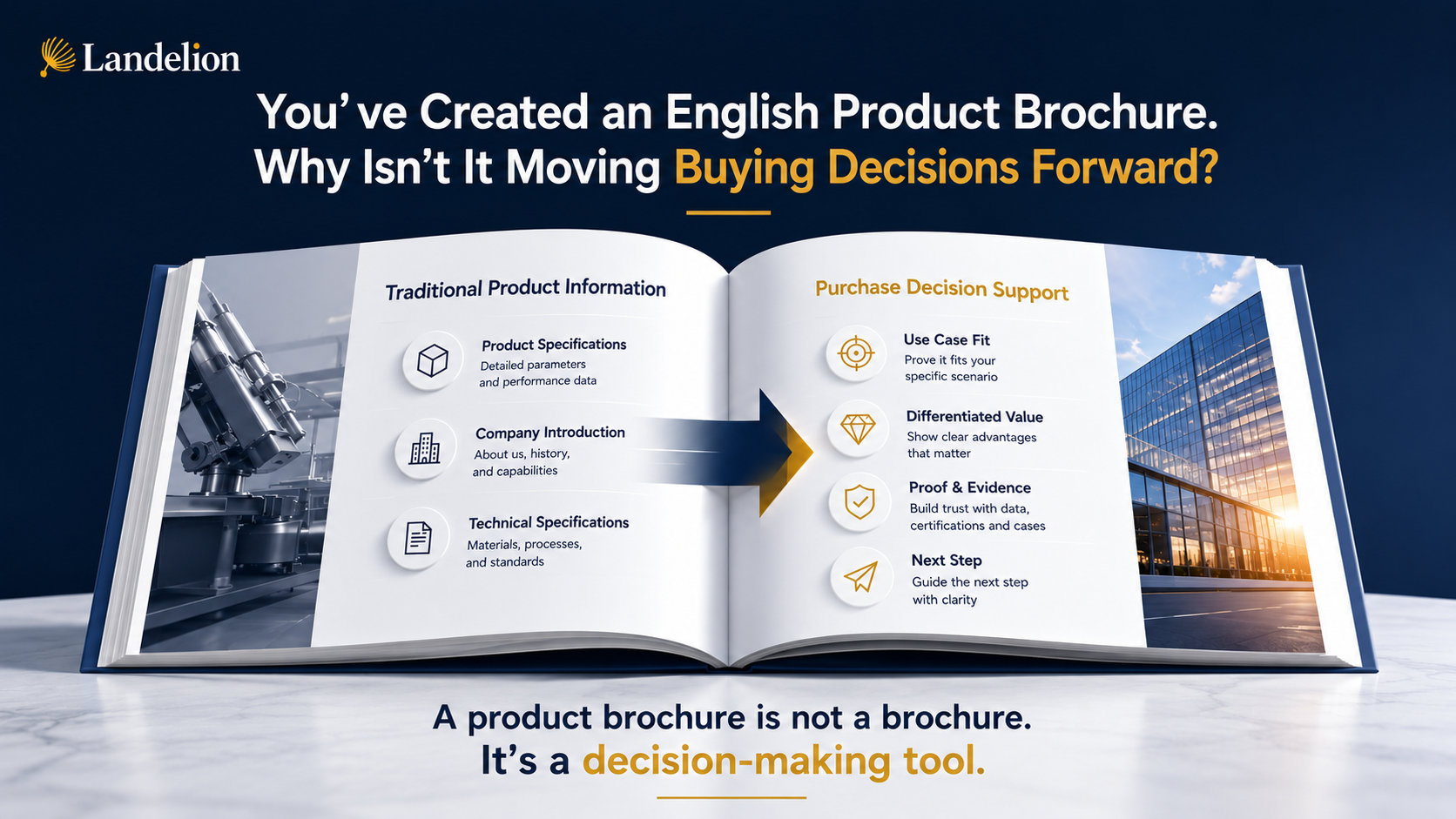
Therefore, the problem with English product brochures is often not just language accuracy or visual appeal. For B2B companies, an English product brochure should assume a clear sales‑support function: helping overseas customers understand who you are, what problem your product solves, why you are trustworthy, and how to continue the conversation.
This is precisely what content system building aims to solve. Product brochures, case studies, technical documentation, sales materials, and multilingual versions should not be created on a one‑off basis. Instead, they should form a content asset system that supports customer understanding, sales follow‑up, and purchasing decisions.
I. Why do English product brochures often fail to generate follow‑up?
In B2B purchasing processes, the on‑site contact is rarely the sole decision‑maker. Whether at a trade show, during an online inquiry, or after a sales visit, the contact person must still relay information and drive the decision internally. If the product brochure does not help them do this, subsequent communication often stalls at “we’ll take a look” or “let’s discuss internally”.
1. Information must be re‑transmitted
The contact person needs to extract key information from the brochure and turn it into internal slides or emails. If the brochure is overly technical or vague, they cannot extract effective information.
2. Risk must be shared
Purchasing decisions involve risk. If the brochure lacks compliance certifications, case studies, or other trust evidence, the contact person will be reluctant to recommend the solution.
3. Next steps must be clearly indicated
After internal discussion, the team needs to know “what to do next.” If the brochure lacks clear calls to action – such as how to request a quote, schedule a demo, or contact technical support – the conversation tends to stay at “we’ll think about it”.
💡 Landelion Insight: An English product brochure is not just material for customers to read – it should become a tool that helps customers explain, compare, and advance purchasing decisions internally.
II. What questions should an English product brochure answer to support purchasing decisions?
An effective B2B English product brochure should not be organised around what the company wants to say, but around how overseas customers make decisions. It needs to help customers move from “understanding the product” to “willing to proceed with evaluation”. Gartner’s discussions of the B2B buying journey consistently emphasize that buyers rely on multiple information sources to conduct independent research and evaluate alternatives. As a result, content should be organized around buyer decision-making rather than internal product descriptions.
1. Scenario fit (Scenarios)
🔹Content requirement: Not just “what the product is”, but “what problem it solves in which scenario”.
🔹Value: Helps the customer’s technical team quickly match their needs and reduces internal explanation costs.
2. Differentiation
🔹Content requirement: Clearly state our unique advantages over competitors (e.g., lower TCO, faster delivery, specific compliance certifications).
🔹Value: Provides the customer with “reasons” to convince their internal team, avoiding a price‑only competition.
3. Trust proof
🔹Content requirement: Embed industry case studies, customer testimonials, compliance certificates, and verified data reports.
🔹Value:Lowers decision risk, consistent with the “answer assets” logic (as discussed in “Before contacting you, customers have already judged through search and social media: why manufacturing urgently needs ‘answer assets’?”). The brochure is a concentrated vehicle for such assets.
4. Next steps
Content requirement: Clearly guide “how to get a quote”, “how to book a demo”, “how to contact technical support”.
Value: Shortens the path from “initial awareness” to “continued conversation”, preventing the brochure from being read and then abandoned.
💡 Landelion Insight: A good English product brochure should give the customer’s internal team something to discuss, evidence to check, and a clear way forward.
III. How to turn brochures into assets through content system building?
Fixing the brochure problem requires more than “optimising translation” – it must be managed within a content system. This means systematically addressing content structure, asset reuse, and version alignment.
| Dimension | Traditional translation model | Content system model | Core value |
|---|---|---|---|
| Content structure | Listed by product features, China‑centric logic | Organised around customer decision journey, scenario‑based logic | Lowers customer understanding cost, directly supports purchasing decisions. |
| Asset reuse | Redesigned for each show, cannot be reused | Modular design, content can be broken into PPTs, emails, one‑pagers | Reduces production cost, ensures consistency of sales tools. |
| Update coordination | Chinese version updated, English version lags | Version linkage mechanism, ensuring global information consistency | Prevents trust erosion caused by conflicting information. |
💡 Landelion Insight: An English product brochure is not a one‑time deliverable – it is a content asset that can be reused, updated, and continuously support customer decisions.
IV. Boundaries of content system building: avoid over‑engineering and over‑localisation
Building a content system does not mean the brochure must cover everything, nor does it mean creating completely different versions for each market. For B2B companies, the key is to establish clear boundaries between unified messaging and market adaptation.
1. Professional, not cluttered
Content should focus on core decision information, avoiding irrelevant parameters just to appear “rich”.
2. Unified, not rigid
Core information (e.g., specs, certifications) must be unified, but market‑specific case studies can be moderately localised.
3. Continuous, not one‑off
Brochures must be updated as the product evolves. Avoid abandoning maintenance after the show ends – ensure the ongoing effectiveness of the asset.
Conclusion: Let your English product brochure truly enter the customer’s purchasing process
What global‑bound companies need is not just a professionally designed English product brochure, but a sales content asset that helps overseas customers understand, compare, trust, and continue the conversation.
When a product brochure stays at the level of language translation and layout design, it may be taken away but will hardly drive the next step. Only when the brochure clearly answers application scenarios, differentiation, trust evidence, and action paths can it truly enter the customer’s internal discussion and purchasing process.
That is exactly what content system building solves: organising scattered product materials, case content, technical documentation, sales kits, and multilingual versions into a reusable, updatable, and coordinated content asset system – enabling the company to more clearly state who it is, what problem its product solves, and why it deserves to be trusted.
Act now Check whether your English product brochure truly supports overseas customers’ purchasing decisionsHas your English product brochure only completed language translation, or has it formed a complete decision‑support chain from scenario fit, differentiation, trust proof, to next steps? Landelion can help B2B companies identify decision‑support gaps in sales materials from the perspective of content system building – diagnosing whether the problem lies in content structure, trust signals, version management, or sales reuse mechanisms. Learn more about content system building Book a sales content asset readiness diagnosis |
📚 Further reading
Content System Development: Why More Language Versions Often Lead to Less Brand Consistency
Why Cross-Market Content Keeps Getting Reworked and Fails to Stay Consistent