


Many companies expanding overseas only realize the problem after an international meeting ends: the materials the client takes away are not aligned with what the sales team explained verbally. Delivery timelines, pricing, technical specifications — even a single inconsistency can become a reason for rejection during the client's internal discussions.
Across multiple projects we have reviewed, we found that clients in meetings and business visits rarely start with formalities. What they truly care about first are delivery schedules, costs, and risk. When the sales team verbally explains a solution, but the materials handed to the client contain inconsistent terminology or outdated versions, trust can erode instantly.
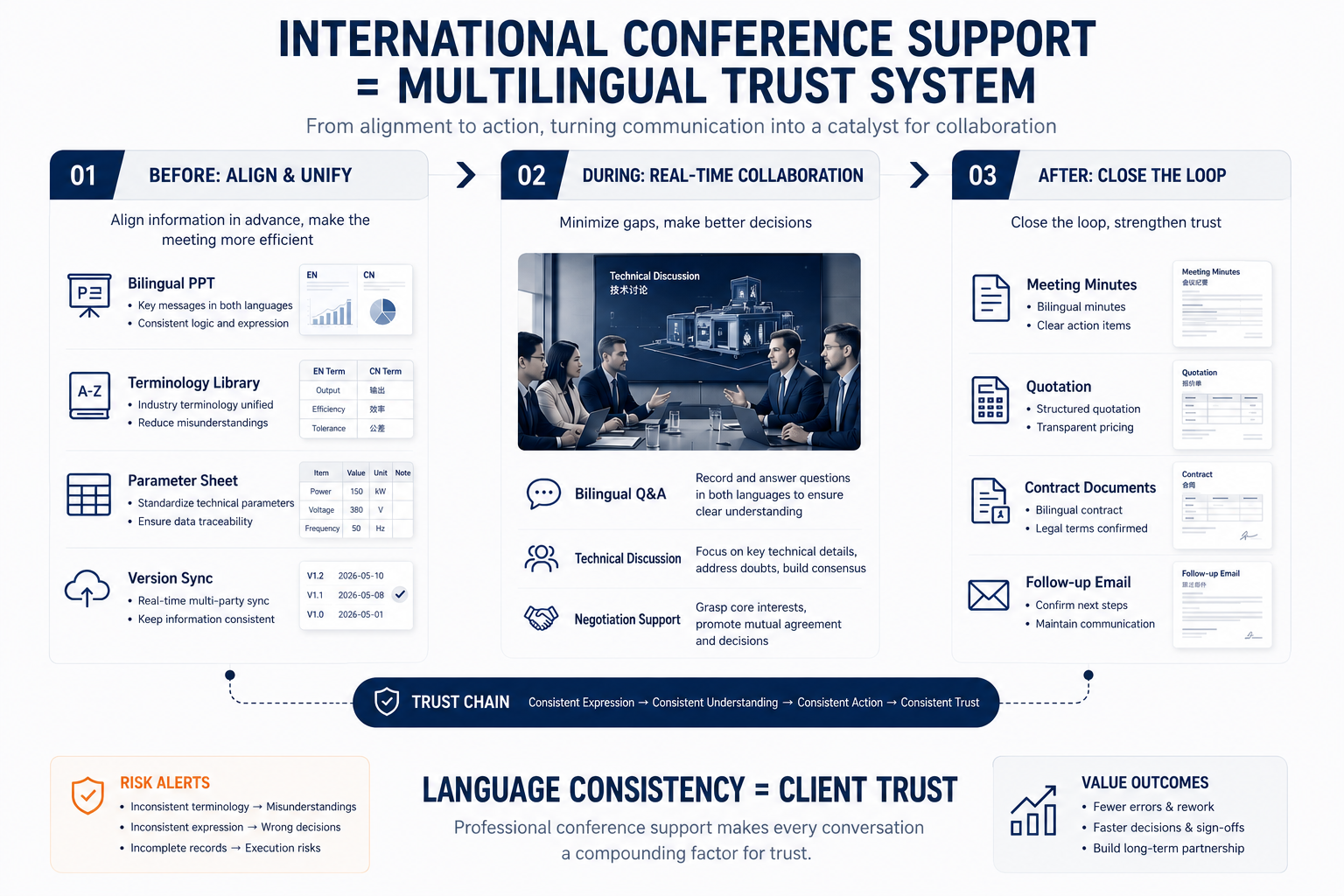
The essence of international meeting support is not live language conversion on-site. It is the construction of a multilingual communication system that supports the entire process before, during, and after the meeting.
For Chinese companies expanding globally, building this system is the core value of a multilingual communication and collaboration solution.
I. Spoken Communication Fades — Written Materials Become the Evidence
In B2B decision-making, meetings are often critical turning points. But verbal communication has natural limitations.
1. Information Is Temporary
Even highly accurate interpretation disappears the moment it is spoken. Clients still need written materials to bring back for internal discussions, reporting, and documentation.
2. Written Documents Define Accountability
Verbal promises are often interpreted as"discussion points,"while written specifications, delivery commitments, and commercial terms are treated as formal commitments.
If bilingual materials contain inconsistencies, clients will usually default to the version that best protects their own interests — creating potential compliance and contractual risks.
3. Materials Carry Trust
A professionally structured bilingual document with consistent terminology and natural business language is itself proof of a company's international capability. It sends a clear message: "We are prepared to serve global markets." Interpretation helps clients understand what was said. Documentation determines whether clients trust what was promised.
Discussions around brand consistency increasingly focus on the need for a “unified experience for target audiences” supported by cohesive communication across markets and teams. In multilingual business environments, inconsistent messaging often creates additional coordination and trust challenges. (Source: HubSpot)
II. International Meeting Support Is Not Translation — It Is a Multilingual Communication System
Many companies assume preparing materials simply means"translating a Chinese PPT into English."In practice, this often leads to content that is technically translated but operationally unusable.
Real international meeting support requires coordination across three dimensions.
1. Before the Meeting: Material Preparation and Terminology Alignment
Common Problems: Sales terminology differs from technical documentation. Chinese materials are updated while English versions remain outdated.
Solution: Build a centralized glossary to ensure sales, technical, and delivery teams all communicate within the same terminology framework. Materials should undergo expression restructuring — not just direct translation — to align with the reading habits and expectations of the target market. (Learn more: Common Challenges and Solutions in Cross-Market Content Consistency)
Value: This avoids conflicting internal messaging and ensures the company speaks externally with one consistent voice.
2. During the Meeting: Real-Time Support and Q&A Coordination
Common Problems: Sales teams struggle to answer highly technical questions. Interpreters cannot fully capture complex technical meanings in real time.
Solution: Prepare standardized bilingual Q&A documents. For high-frequency topics such as delivery timelines, compliance requirements, and after-sales service, prepare pre-approved bilingual responses that can be referenced instantly by sales teams and interpreters.
Value: This improves response speed, demonstrates professionalism, and reduces communication errors.
3. After the Meeting: Closing the Loop with Consistent Follow-Up Materials
Common Problems: Meeting summaries, quotations, and technical confirmation documents often use inconsistent wording compared to the materials presented earlier. As clients review more documents internally, uncertainty grows.
Solution: All follow-up documents — including meeting minutes, quotations, and technical confirmations — should remain version-aligned with pre-meeting materials and undergo multilingual quality review.
Value: This ensures consistency between commitments and execution while reducing future disputes.
💡 Landelion Insight: Multilingual communication is not a one-time task. It is a coordinated system.
III. Why Professional Multilingual Coordination Matters
If bilingual materials are so important, why do many companies still struggle even when preparing them internally?
Because the challenge often exceeds the capability boundaries of individual sales teams or temporary translation support.
1. Terminology Management Becomes Increasingly Complex
As product lines and international meeting scenarios expand, glossaries require continuous maintenance. Sales turnover, organizational restructuring, and market shifts can all disrupt messaging consistency. Professional coordination services ensure terminology assets remain institutionalized at the company level rather than dependent on individuals.
2. Version Control Is Difficult
Different markets, clients, and negotiation stages often require different document versions. Without clear version governance, companies frequently encounter:
Outdated files being sent
Inconsistent materials across teams
Verbal commitments conflicting with written documentation
3. Language Must Match Culture and Industry Context
Certain technical concepts carry market-specific conventions. Literal translation can easily create ambiguity. This requires professionals who understand not only language, but also industry context and business culture.
This is exactly what Landelion's Multilingual Communication & Collaboration Solution is designed to solve: transforming language from a communication aid into infrastructure for cross-functional and cross-market coordination. Professional coordination exists so sales teams can focus on winning business — rather than worrying about wording consistency.
IV. Which Scenarios Require Bilingual Negotiation Materials Most?
Not every meeting requires a full multilingual support system. But in the following high-risk scenarios, the investment becomes critical.
| Scenario | Core Materials | Language Coordination Requirements |
|---|---|---|
| Executive Meetings & Strategic Signings | Cooperation frameworks, NDAs, strategic intent agreements | Small wording deviations may affect the tone and direction of the partnership. Precision and professionalism are essential. |
| Technical Discussions & Solution Reviews | Technical specifications, compatibility explanations, implementation plans | High technical accuracy is required. Terminology must align fully with engineering documentation. |
| Tenders & Compliance Reviews | Legal clauses, compliance certifications, delivery standards | Requires both legal and linguistic review to reduce compliance and contractual risks. |
Conclusion: Let Language Become a Bridge — Not a Barrier
The next phase of globalization competition is no longer only about products. It is about collaboration efficiency.
When companies begin building multilingual communication systems, they stop relying on temporary translation support and start developing reusable, trustworthy communication assets.
What clients experience is not merely smoother language — but stronger professionalism and reliability.
Landelion focuses on helping companies integrate multilingual communication into a scalable, manageable, and reusable collaboration system, ensuring every important conversation actively supports sales progress and customer trust-building.
🚀 Take Action: Does Your International Meeting Support Truly Build Trust?
Is your international meeting support still based on temporary interpreters — or have you already established a reusable multilingual communication coordination system? Landelion provides multilingual communication and collaboration assessments for B2B companies, evaluating terminology management, material preparation, and post-meeting follow-up consistency. We help identify hidden language risks and coordination gaps in international business communication.
Book Meeting Support Assessment Explore Communication Solutions
📚 Further Reading
Professional Escort Interpretation for Manufacturing Overseas Visits