


In post‑exhibition reviews for B2B companies, a common question arises: the QR code brought traffic, the English landing page was opened, but the time on page, form submission rate, and subsequent inquiry volume did not improve accordingly. In many review meetings of global‑bound companies, a widespread phenomenon is that the QR code brings traffic, but engagement metrics fail to rise.
This is not merely a matter of design aesthetics, but a reflection of the mismatch between content asset structure and the purchasing decision path. Companies often treat landing pages as standalone “mini‑websites”, investing design resources to pile up information, while overlooking their core function in the exhibition context: to quickly build trust and capture leads as a key node in the content system.
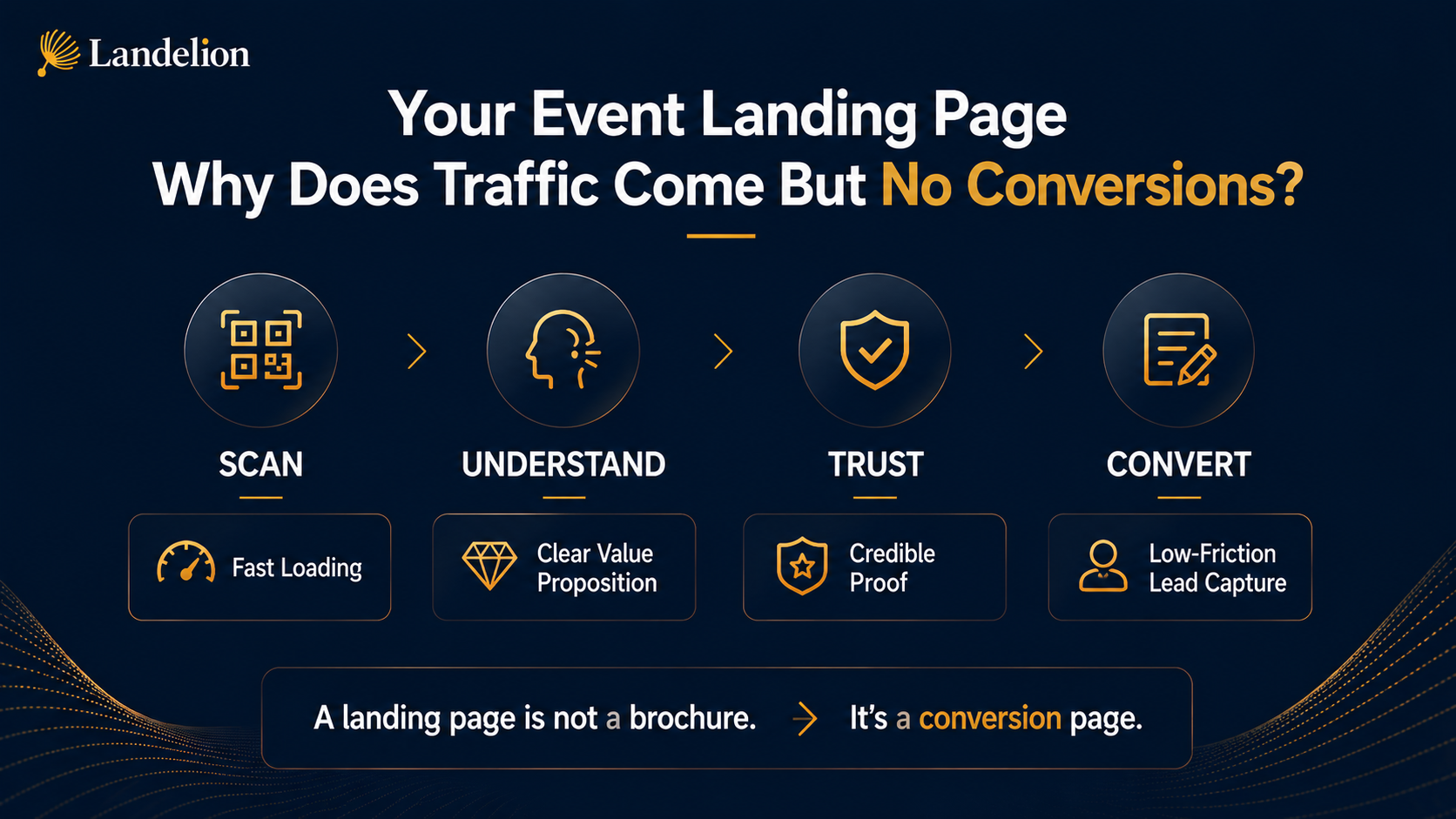
A landing page is not an information display page – it is an action‑conversion page. If the page structure is loose, lacks focus, or has no clear call‑to‑action, the valuable traffic from the exhibition will slip away. From the perspective of content system building, the value of a landing page lies not in how beautiful it looks, but in whether it can organise content assets into the most efficient conversion structure, ensuring every visit is effectively captured.
I. Misalignment between content structure and the decision path
In the noisy environment of an exhibition, buyer attention is extremely limited. If the content system lacks structured design, information overload becomes a conversion barrier. The fundamental reason for low conversion rates on many companies’ landing pages lies in the structural mismatch between content supply and the buyer’s decision logic.
First, content structure often follows internal company architecture rather than customer decision logic. Many pages fail to clearly state “who you are and what problem you solve” above the fold, forcing customers to scroll – increasing bounce rates. This self‑centric narrative raises the customer’s cognitive cost.
Second, trust signals are distributed without strategy. If the page lacks compliance certifications, customer cases, or other trust proof, visitors perceive “unprofessionalism” and leave. Trust signals should not be decoration – they are decision‑support tools.
Finally, vague calls‑to‑action break the conversion path. If the form is hidden at the bottom of the page, or requires multiple clicks to find contact information, customers lose patience. In the long B2B decision cycle, every friction point can cause lead loss.
II. Five architectural principles for conversion‑oriented content assets
To improve traffic‑capture efficiency, the landing page must be architected around “conversion”. This requires covering five key elements, which are the basic requirements for conversion‑oriented content assets in content system building.
1. Stable and accessible mobile experience
Technical stability of content delivery is the prerequisite for conversion. Images should be compressed, scripts streamlined, and the page must load stably on overseas networks and mobile devices. Companies can use basic page inspection tools to check mobile load speed and overseas accessibility. Technical experience directly influences the customer’s initial judgment of brand professionalism.
2. Clear value proposition above the fold
The headline should directly state “what solution for which industry”, not a generic company introduction. Let customers decide “is this relevant to me?” within 5 seconds, reducing bounce rate. Clarity of the value proposition determines whether the customer will invest further time.
3. Content structure oriented to purchasing decisions
Organise content according to the customer’s decision logic (e.g., pain point → solution → evidence → action), rather than listing internal company structure. Help customers complete initial evaluation quickly, reducing cognitive cost. This embodies the “customer‑centric” principle in content system building.
4. Verifiable trust signals
Showcase well‑known client logos, compliance certifications (ISO/CE), exhibition photos or videos. Build endorsement quickly and lower the psychological barrier for leaving information. This aligns with the “brand consistency” logic we mentioned earlier, ensuring trust signals are consistent across channels.
5. Low‑friction form and clear next‑step guidance
Form fields should not exceed 4 items (name, company, email, needs). After submission, show a “thank you” page explaining next steps (e.g., “you will receive an email within 24 hours”). Lower resistance to leaving information, boost lead capture rates. This is a key metric emphasised in HubSpot’s landing page best practices, ensuring the shortest decision path. Clear next‑step guidance manages customer expectations and prevents confusion after submission.
III. Asset management and system coordination for landing pages
To solve conversion leakage, simply “beautifying the design” is not enough – the landing page must be managed within a content system. This requires operating across three dimensions: structure, reuse, and coordination, ensuring the landing page becomes an iterative content asset rather than a one‑time piece.
| Dimension | Traditional single‑page model | Content system model | Core value |
|---|---|---|---|
| Content structure | Redesigned for each show, inconsistent styles | Modular design, following a unified content architecture standard | Reduces production cost, ensures consistent customer experience. |
| Asset reuse | Content is isolated, cannot be linked with other materials | Reuse trust signals, case studies across brochures and social content | Ensures cross‑channel information consistency. Refer to the asset reuse logic in “Why B2B English product brochures cannot be just translations”. |
| Version governance | No updates after the show, information becomes outdated | Version linkage mechanism, ensuring global information is up‑to‑date | Prevents trust erosion caused by conflicting information, ensures asset longevity. |
A landing page is not a one‑off piece – it is a reusable, iterable content asset. Through systematic management, companies can ensure that every exhibition investment yields long‑term content assets.
IV. Evaluation criteria for content asset efficiency
Companies can self‑diagnose whether their exhibition landing page meets content system standards by answering three key questions. This is not just a technical check, but an assessment of content asset efficiency.
☐ Is the content structure clear?
Ask a non‑internal person to browse the above‑the‑fold content for 5 seconds – can they tell what you do? If not, information delivery is broken.
☐ Are trust signals consistent?
Check whether certifications and cases on the landing page match those in the product brochure and on the corporate website. If not, the content system has a break.
☐ Is the version current?
Check whether the page parameters and contact information are up‑to‑date. If outdated, version governance is broken.
If any of the above links are broken, the leads generated from the exhibition are likely lost the moment they scan.
Conclusion: Build cumulative content conversion assets
In the second half of going global, competition is not just about traffic, but about the conversion efficiency of content assets.
When a company starts building its content system, it no longer creates pages on the fly – it owns trusted conversion entry points. Customers feel not just product professionalism, but also a highly efficient service experience.
For global‑bound companies, landing pages are not merely traffic‑capture pages – they are a reflection of content asset efficiency. Landelion is committed to helping companies truly integrate landing pages into a runnable, collaborative content system. Through professional content system building, we ensure every visit can become a potential business opportunity. For B2B companies, exhibition landing pages should not be one‑time pages, but content assets that support overseas buyers’ judgments, information‑leaving, and subsequent communication. Content system building solves this: organising value propositions, product materials, case evidence, form entries, and next‑step guidance into a reusable, updatable, and collaborative page structure – so that exhibition traffic does not remain just in access data, but enters the sales follow‑up and lead nurturing process.
Act now Check whether your exhibition landing page truly has capture capabilityDoes your exhibition landing page only display information, or does it already have the complete conversion elements from loading speed, value communication, to form capture? Landelion can help B2B companies identify content‑structure breaks in landing pages from the perspective of content system building – diagnosing whether the problem lies in value proposition, trust signals, form design, or version management. Explore content system building solution Book a landing page content asset diagnosis |
Note: If on‑site exhibition communication, bilingual materials, terminology consistency, or post‑show follow‑up are involved, you can also combine this with an assessment of multilingual communication & coordination.