


For many companies, content management starts with “standardising the format” – using the same PPT templates, the same brochure layouts, and the same website design guidelines. All of this is necessary – but what comes next?
The marketing team produces a new product introduction using the standard template. The sales team takes it, only to find that the value propositions it highlights are not what customers actually care about. Sales rewrites it, but the revised version no longer aligns with what is stated on the website. In the next round of updates, regional teams each produce their own versions – all are compliant in format, but the core messaging has already diverged.
To the customer, this is not a matter of different teams’ communication styles – it is the same company saying different things across touchpoints: one message on the website, another in sales materials, and yet a third from regional teams.
Formats are unified, but content has become even more chaotic.
The issue lies in a more subtle but more critical place: as content volume grows, what is most needed is not unified formatting, but unified judgment criteria – which expressions represent the brand, which value points cannot be changed arbitrarily, which assets can be reused across channels, and which content must be synchronised with version updates.
I. Formats are unified – so why does content still speak with different voices?
When companies realise their content is chaotic, their first instinct is often to “create a set of templates”. Templates do make things look visually consistent – but they don’t solve the underlying content problems.
Inconsistent messaging is not constrained.
For the same product’s core selling point, Team A writes “improves production efficiency”, Team B writes “reduces total cost of ownership”, and Team C writes “shortens delivery cycles”. All three are technically correct – but from the customer’s perspective, the brand is “shifting its story”.
Value proposition delivery lacks a baseline logic.
Sales teams adjust their messaging based on what customers respond to in conversations. The adjusted version may open more dialogues, but it no longer aligns with what is stated on the website. When customers browse the website and then talk to sales, they feel a disconnect.
Asset reuse is far lower than expected.
Regional teams each create their own case studies, landing pages, and product narratives. New assets are constantly being produced, but very few are reusable across teams.
Many companies are not short of brand guidelines or template files. Yet in actual content production, teams still rewrite core messages based on their own interpretations. The problem is rarely about willingness – it is more about the lack of a set of content standards that can be executed, judged, and reused.
II. As content grows, three “judgment criteria” become essential
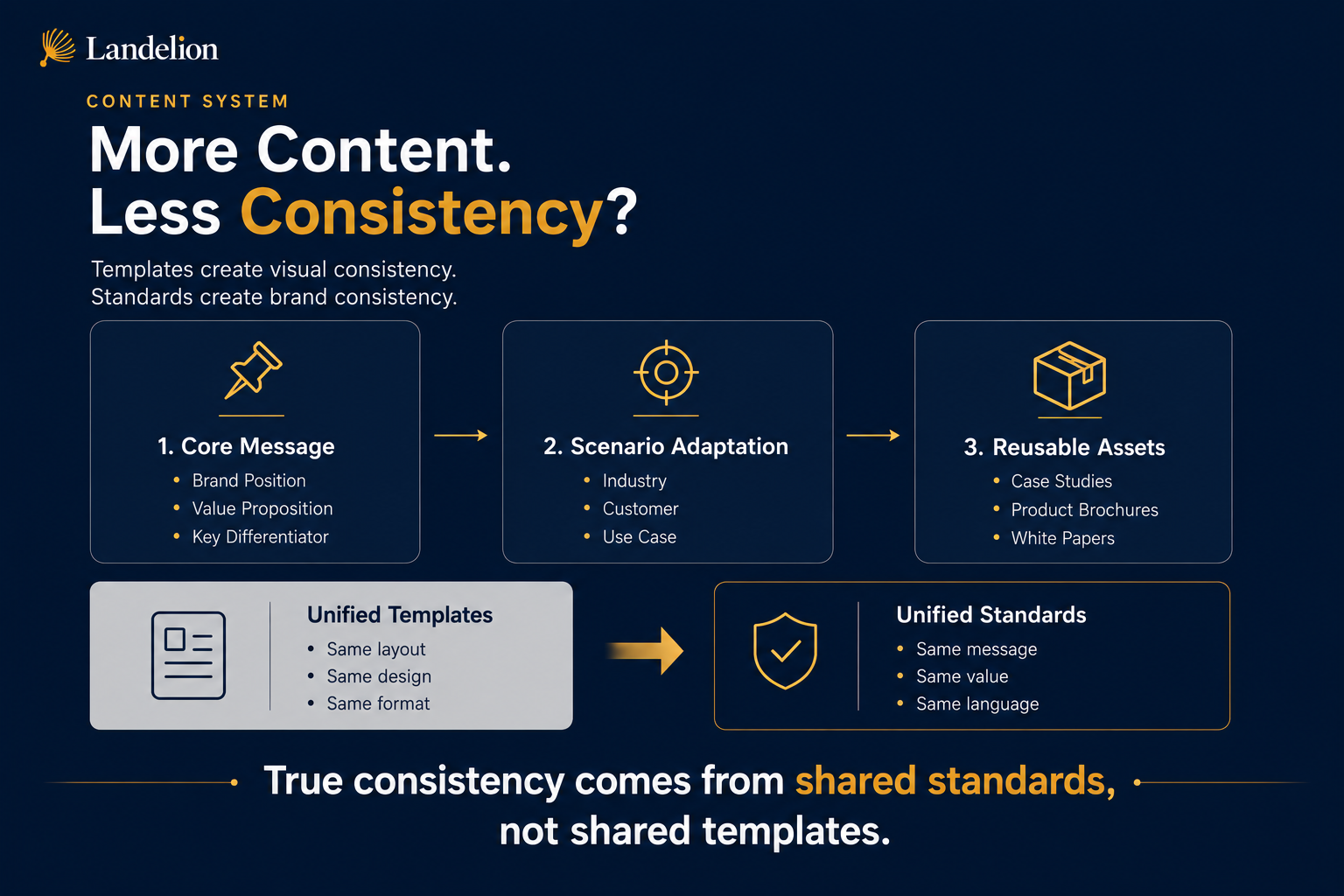
Unified formatting solves “visual consistency”. What Content System Building truly aims to solve is “message consistency”.
After the content sources are gradually consolidated, companies still need to address one more issue: whether different teams follow the same set of judgment criteria when using the same content assets.
Specifically, three criteria are needed:
Criterion 1: Which core expressions must remain consistent?
Every brand has a core set of value propositions, positioning statements, and differentiators. These are the “expression bottom line” – no matter who writes them, which channel they are used for, or which customer they target, the core statements cannot be arbitrarily changed. For example, a precision equipment company’s core proposition might be “helping customers reduce error risk in high‑precision inspection scenarios”. Different teams can adjust the wording based on industry and application scenarios, but they cannot rewrite the core capability into something completely different.
Criterion 2: Which value points can be adjusted by scenario, but cannot deviate from the main thread?
Core statements cannot be changed, but the way they are elaborated can vary by scenario. For automotive customers, you can emphasise stability in continuous production environments. For electronics customers, you can highlight defect detection and quality consistency. Content for different scenarios may have different entry points, but they should all revolve around the same main thread – not redefine the brand value independently.
Criterion 3: Which content can be reused, and which is suitable for single use only?
Core product specs, standard case studies, foundational white papers – these are reusable “content components”. Content created for specific events or specific customers is “one‑time content”. Distinguishing between the two is the only way to avoid “saving everything and confusing everything”. Truly reusable assets should be integrated into a unified content system, rather than scattered across individual team folders.
| Judgment criteria | Core question | Applicable to | Management approach | Typical actions |
|---|---|---|---|---|
| Criterion 1: Expression bottom line | What can never be changed? | Brand value propositions, positioning, differentiators | Centrally defined, mandatorily enforced | Audit core information assets, create a “red line” list |
| Criterion 2: Scenario‑based value points | What can be reframed, but the main thread stays? | Value narratives for different industries, regions, customer segments | Set the framework, authorise adaptation | Define adjustment boundaries, provide a scenario‑specific example library |
| Criterion 3: Asset reuse boundaries | What is worth reusing, and what is disposable? | White papers, case libraries, product specs vs. campaign content, custom proposals | Component‑based management, periodic pruning | Build a core content library, set update cycles and archiving rules |
III. Three principles behind the judgment criteria
The three criteria correspond to three principles of Content System Building.
Principle 1: More content is not better – more consistent content is better.
If content between teams is inconsistent and value points conflict, volume actually dilutes the brand. The first step in Content System Building is not adding more content – it is making existing content “speak the same language”.
Principle 2: Content management needs clear lines of authority over “who says what”.
Marketing writes the website, sales creates presentations, regional teams produce local content – every team is producing content, but without a unified standard for “how core value propositions are articulated”, clear lines of authority are lacking. No amount of templates can solve content governance issues without clear accountability.
Principle 3: Asset reuse capability determines the efficiency of the content system.
Efficiency is not about how much new content is produced each year, but about how many times a high‑quality asset can be reused. A product white paper can be broken down into website pages, social content, and sales collateral. A customer case study can be repurposed into industry‑specific solutions and scenario content. Higher reuse rates mean less pressure on content teams and easier brand consistency. Industry data shows that over 70% of enterprise digital assets are never reused after their first use.
IV. Where does your content judgment system stand?
If you are unsure of your team’s current state, use these quick self‑check questions:
⬜ Are the core selling points on the website, sales presentations, and regional materials consistent?
Randomly pull descriptions of the same product from the website, a sales deck, and a product brochure – do the core claims align? If there are multiple versions, the expression bottom line has not been clearly defined.
⬜ When creating new content, does the team know what can and cannot be changed?
When teams produce new content, is there a clear standard to judge “is this wording acceptable?” If it’s always based on intuition, judgment criteria are missing.
⬜ Are core assets being reused, or do they sink after one use?
Of the core content produced in the past year, how much has been reused or adapted by other teams? If the reuse rate is extremely low, the component‑based content management system is broken.
If any of the above issues exist, the content system’s foundational infrastructure is still incomplete.
Conclusion: What needs to be unified is not formats, but judgment standards
Once content reaches a certain scale, the choice is not “should we keep doing content?”, but “how do we ensure that the growing number of people producing content all say the same thing?”
Unified formats and templates are the first step. What truly sustains a content system over the long term is a clear set of judgment standards: which messages cannot be changed, which content needs to be maintained centrally, and which assets can be freely adapted.
Unified formatting solves “looking the same”. Unified judgment standards solve “saying the same thing”. Landelion can help companies build these judgment standards – from auditing core value propositions, to defining content tiers and boundaries, to assigning roles and responsibilities across teams – bringing decentralised content production into a governable, consistent, and reusable content system.
Act now Is your content production endlessly adding new assets, or have you already established unified expression boundaries and judgment standards?Landelion can help B2B companies audit core brand expressions, define content tiers and boundaries, and establish cross‑team content judgment standards from the perspective of Content System Building – diagnosing whether the problem lies in fuzzy expression baselines, scattered value propositions, or missing asset reuse mechanisms. Understand Content System Building solution Book a content asset governance diagnosis |