


On July 1, 2026, LinkedIn launched a suite of AI-powered creative tools within Campaign Manager for advertisers. The five features cover the entire creative production chain – from brand specification setting, AI copy generation, ad personalisation, multi‑variant creative production, to flexible asset combination.
Advertising creative is moving from “manual production” to “AI‑assisted production”, and the efficiency of creative generation and variant testing is improving. But tools are only amplifiers – they help you generate copy faster, produce variants, and personalise delivery, but they cannot answer a more fundamental question: what exactly does your brand want to say, to whom, and where should customers go after they click?
If these questions remain unanswered before launch, the more ads AI generates, the more budget is wasted. That is why, after the release of AI ad tools, B2B companies need to focus less on “whether we can generate ads ourselves” and more on whether their pre‑launch judgment is clear enough. How to define brand expression, how to segment customer profiles, how to organise creatives, and how to handle post‑click engagement – none of these are settings that tools complete automatically. They require upfront design aligned with business goals, target markets, and sales paths.
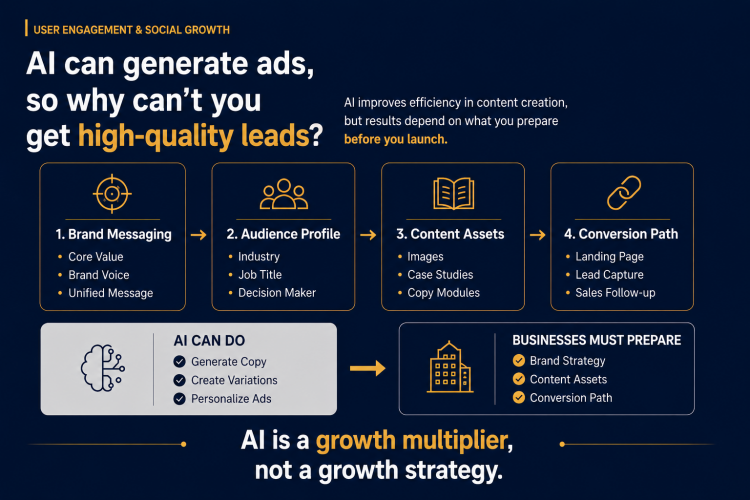
I. What tools can do, and what they cannot
Let’s look at the core features LinkedIn announced:
1. Brand Kit
Advertisers can set brand colours, fonts, and brand voice to help maintain more consistent brand expression across subsequent ad content.
2. Draft with AI
By entering a product URL, ad objective, and optional high‑performing historical creatives, the system can generate a first draft of ad copy.
3. Ads Personalization
Automatically adjusts ad messaging based on the audience’s professional attributes such as job title, company, and industry.
4. AI Ad Variants
Automatically generates multiple versions based on existing ads to test different headlines and intros.
5. Flexible Ad Creation
Advertisers provide an asset pool of images, videos, and copy, and the system automatically combines them to generate more creative variants.
At their core, these tools solve “production efficiency” and “testing efficiency” – faster output, more variants, and more targeted audience matching.
AI can help you make ads faster, but it cannot help you make ads better.
II. Four things you need to clarify before AI ad campaigns
These four items may seem like basic pre‑campaign preparation, but they actually span branding, content, advertising, and sales handover.
1. Is your brand expression clear?
Brand Kit lets companies set brand colours, fonts, and brand voice. But if the company itself is unclear about what its “brand tone” is – professional and rigorous, or innovative and bold; technology‑driven, or customer‑centric – then the brand guidelines set up are just formalities.
AI‑generated content will follow the rules you set, but the rules themselves must be defined by people. If brand expression is vague to begin with, AI‑generated ads will struggle to form a stable, consistent brand impression.
2. Is your target customer specific enough?
Ads Personalisation adjusts messaging based on the user’s job title, company, and industry. But the degree of personalisation AI can achieve depends on the granularity of the customer profile you provide.
If your customer profile is simply “manufacturing business owner” or “HR head”, AI can do very little. But if you refine it to “quality lead at an electronics manufacturer with overseas plants, focused on quality management and production stability”, the more specific the profile, the more likely AI personalisation will create effective matches.
3. Is your content library sufficient?
Flexible Ad Creation requires companies to provide an asset pool of images, videos, and copy – only then can the system combine them to generate more variants. AI can do combination and optimisation, but effective creative still relies on the materials, sources, and expression boundaries that the company has prepared in advance.
If the company only has one set of product photos and a single product description, the variations AI can generate are very limited. But if you have multi‑angle product shots, application photos for different scenarios, visual assets from customer cases, and multiple versions of core selling‑point copy – the more complete and structured the library, the greater the room for AI to generate effective creative.
4. Is the handover chain ready?
This is the most overlooked point. AI can help improve creative testing efficiency, but if after clicking an ad the customer lands on an outdated page, a website that offers no way to leave contact details, or a sluggish sales process – all clicks just burn budget, not generate revenue.
Advertising is only the first link in the acquisition chain. Content, landing pages, forms, and sales follow‑up must form a complete handover path before the campaign starts.
III. From “launch first, check later” to “prepare first, then scale”
| Evolution dimension | Starting from “launch first, check later” | Gradually moving to “prepare first, then scale” |
|---|---|---|
| Brand expression | Test and adjust on the fly, based on gut feeling | Clarify brand tone, core messages, and expression boundaries in advance |
| Target customers | Broad targeting, relying on AI to auto‑match | Define clear customer profiles and segmentation strategy upfront |
| Content assets | Shoot and write on demand | Build a reusable asset library and copy modules |
| Handover chain | Direct clicks to the homepage | Dedicated landing pages, clear lead‑capture forms, and fast sales response |
The value of AI ad tools is not just about testing different creatives faster – it is about scaling what is already clear: your expression, assets, and handover chain. The prerequisite is that the company already knows what it wants to scale.
IV. Where does your LinkedIn ad content readiness stand?
If you are unsure of your team’s current state, use these quick self‑check questions:
⬜ Has the brand’s core expression been clearly documented and unified?
Are brand positioning and core selling points consistent across teams and channels? If different teams say different things, AI‑generated ads will perpetuate that inconsistency.
⬜ Is the target customer profile specific enough?
Is the profile refined to industry, company size, job level, and decision‑making role? If it is just “B2B customers”, AI personalisation has nothing to work with.
⬜ Are your ad‑ready content assets sufficient and reusable?
Do you have enough product shots, scenario images, case study visuals, and core copy modules for AI to combine and draw from? If you have to shoot and write from scratch every time, AI’s efficiency advantage cannot be realised.
⬜ Is the post‑click handover path already in place?
Are the landing pages, lead‑capture methods, and sales follow‑up processes ready for when customers click? If the chain has breaks, even the highest CTR will not translate into quality leads and opportunities.
Conclusion: With AI ad tools, companies need to get themselves ready first
LinkedIn’s AI ad tools have improved creative production and multi‑variant testing, allowing B2B companies to generate copy faster, produce variants, and test different angles. But the tools themselves do not solve strategy.
Brand expression, target customers, content assets, and the handover chain are not replaced by AI – they become even more important. Because AI is only an amplifier; it amplifies not the tool itself, but the company’s existing foundation of expression, assets, and conversion readiness.
Therefore, before launching LinkedIn AI ad campaigns, B2B companies need to complete a readiness check: Is brand expression unified? Are target customers clear? Are assets structured enough? Are landing pages and sales handover connected? Landelion can help companies complete this preparation before the campaign, so that AI tools truly serve target audience reach and social growth – rather than amplifying the waste of insufficient preparation.
Act now Is your LinkedIn ad content ready to be amplified by AI, or are there still breaks in brand expression, target customers, content assets, and the handover chain?Landelion can help B2B companies, from a target audience reach and social growth perspective, audit brand expression, customer profiles, ad creatives, landing pages, and the sales handover chain before launching LinkedIn campaigns – identifying what content is suitable for AI amplification and what foundational issues need to be fixed first. Explore Target Audience Reach & Conversion solution Book a social ad conversion diagnosis |