


During post-project reviews with many globalizing companies, sales teams often raise the same sharp question:
"We've been running our website and global social media for a year. Why do I still have to explain basic specifications, company capabilities, and compliance qualifications from scratch every time I meet a customer?"
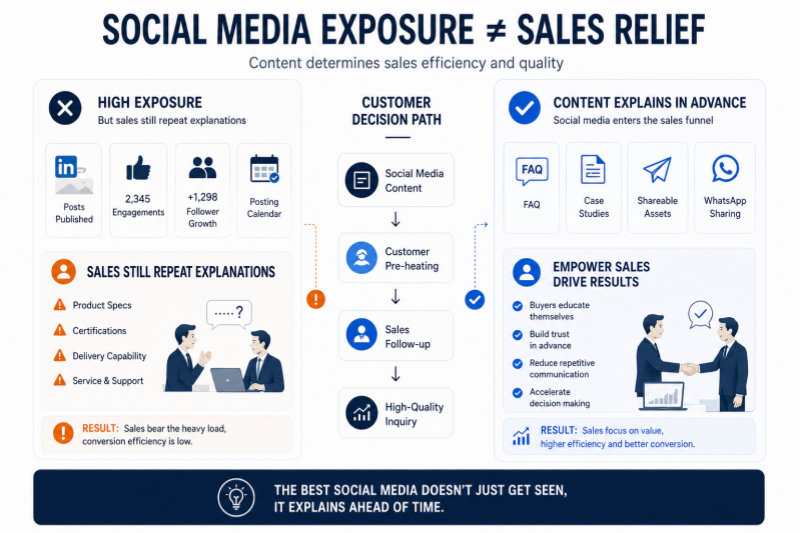
This problem is far more common than most companies realize. Businesses invest heavily in global social media marketing, accumulate followers and impressions, yet the content never becomes reusable sales support material. Customers may have already seen the company's content, but still enter negotiations with the same fundamental questions. As a result, sales teams repeat the same explanations over and over, while conversion cycles grow longer.
The real value of global social media is not simply exposure — it is reducing the amount of explanation sales teams need to do later.
If content cannot lower communication costs for sales, it remains promotional material rather than a functional part of the lead generation process. In most cases, the root problem lies in a disconnect between global social media operations, customer decision-making, and sales follow-up workflows.
I. Three Major Disconnects in Global Social Media Operations
Many companies appear highly active on global social media, yet their content becomes practically unusable in real sales conversations. This usually stems from three structural disconnects inside the operational process.
1. Operational Goals vs. Customer Evaluation
What happens: Global social media KPIs focus on posting frequency, follower growth, and engagement metrics.
The problem: To hit these KPIs, teams produce large volumes of industry news, generic updates, and holiday greetings. Customers may conclude that the company is"active,"but still have no idea what problems the company actually solves.
The result: Customers cannot make preliminary judgments based on the content itself, so all clarification work falls back onto sales. Sales teams must once again explain how technical specifications relate to real business pain points.
Insight: If content does not help customers self-qualify, sales teams end up qualifying them manually.
2. Posting Logic vs. Decision Logic
What happens: Content is organized around publishing schedules rather than customer questions.
The problem: When customers want to understand something specific — such as after-sales support — they must dig through months of old posts. Social media feeds operate chronologically, while customers search based on needs and decisions.
The result: Customers cannot easily find answers and assume no answers exist. Sales teams then spend time reorganizing fragmented information.
Insight: Fragmented posts do not create structured answers. The search cost becomes too high for buyers.
3. Public Content vs. Sales Usability
What happens: Content is designed for public visibility rather than sales enablement.
The problem: There are no concise, reusable formats suitable for WhatsApp sharing, email follow-ups, or direct customer communication. Social media posts are often too long, visually unsuitable, or difficult to reuse during conversations.
The result: Sales teams abandon official content and resort to manually retyping explanations.
Insight: If content cannot become a sales tool, it eventually becomes archived clutter.
💡 Landelion Insight: The number of times sales teams repeat the same explanations often reflects how disconnected global social media still is from customer evaluation and sales follow-up workflows.
II. Global Social Media Should Be Designed Around Customer Decisions and Sales Workflows
Fixing this problem requires more than asking sales teams to"communicate better."Companies need to redesign the operational logic behind global social media. Social media should not function merely as a publishing channel — it should become a pre-sales support layer.
1. Shift Content Planning from"Industry Topics"to"Sales Questions"
New approach: Marketing teams should regularly collect the Top 10 questions sales teams hear most often and transform those into global social media content themes.
Business value: Customers encounter on global social media the exact topics sales teams repeatedly explain during negotiations. Social media begins handling early-stage market education, allowing sales teams to focus on complex or personalized discussions instead of repeating foundational information.
2. Shift Content Structure from"Timeline"to"Decision Journey"
New approach: On platforms like LinkedIn, Featured sections and pinned content should follow customer decision logic — such as qualifications → case studies → services → contact pathways — rather than simply displaying the latest posts.
Business value: Customers can quickly find the information they need to evaluate the company, reducing bounce rates and shortening the path toward meaningful conversations.
3. Shift Delivery Formats from"Long Posts"to"Sales Enablement Assets"
New approach: Break long-form content into reusable formats such as summary cards, visual snippets, short links, or quick-reference assets that sales teams can directly forward to customers.
Business value: Sales teams can immediately reuse official content during conversations, ensuring consistent messaging while improving response speed.
💡 Landelion Insight: The best global social media operations make sales teams feel,"This saved me time."
III. How to Evaluate Whether Global Social Media Truly Supports Sales
The success of global social media should not be measured solely by impressions or engagement. It should also be evaluated based on how effectively it supports sales execution.
1. Usage Rate
Key question: Do sales teams actively share global social media content with customers?
Evaluation focus: The real indicator is whether sales teams voluntarily use official content during conversations instead of relying on improvised explanations.
2. Repetition Rate
Key question: Are frequently repeated customer questions already addressed clearly on the company website or global social media?
Evaluation focus: Over time, repetitive foundational questions should gradually decrease, allowing sales teams to focus more on real purchasing needs and solution discussions.
3. Lead Warmth
Key question: Have customers already understood key information before contacting sales?
Evaluation focus: The issue is not whether customers viewed content, but whether their questions become more specific and closer to real procurement scenarios. Strong leads typically arrive with informed, industry-specific questions rather than generic inquiries. The ultimate goal is not simply increasing inquiry volume, but improving the proportion of qualified inquiries.
If these indicators remain weak, it suggests that global social media content has not yet become part of the customer evaluation and sales follow-up process. This is precisely the problem that audience engagement and social media growth services are designed to solve: ensuring that content is not only visible, but also reusable, actionable, and operationally valuable for sales teams.
💡 Landelion Insight: Content is not only for customers to read — it is also for sales teams to use. Social media is not just an exposure channel; it is a sales efficiency tool.
Conclusion: Social Media and Sales Should Work Together
The true efficiency of global social media marketing is reflected in how much it reduces communication friction for sales teams.
When global social media operations are redesigned around customer decision-making and sales workflows, sales teams stop acting like repetitive explainers and start acting like consultants. That level of alignment is a clear sign that a company's global lead generation system is becoming mature.
🚀 Take Action: Evaluate Whether Your Global Social Media Truly Supports Sales
Is your global social media creating visibility — or helping sales teams reduce repetitive explanations and improve lead conversion efficiency? Landelion provides global social media diagnostics tailored for B2B companies. From content planning and structural design to sales reuse pathways, we help identify operational disconnects and ensure social media content truly supports customer evaluation and sales follow-up.
📚 Further Reading
How Social Media Builds Trust for Global Manufacturers
Manufacturing Social Media Marketing: How Answer Assets Drive Leads