


As the exhibition booth was nearing completion, the marketing director noticed a small but critical detail:
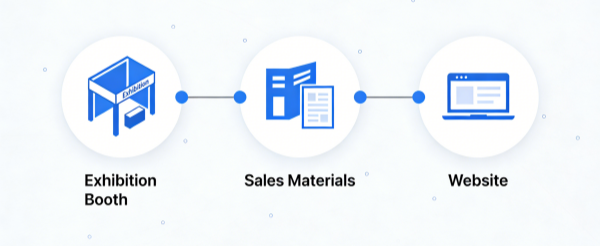
The main slogan on the booth read: “Leading Advanced Packaging”
The latest product brochure in the sales team’s hands said: “High-Precision Packaging Solutions”
Meanwhile, the homepage headline on the English website read: “Semiconductor Equipment Manufacturer”
None of these statements were wrong. But for overseas customers, their coexistence signals one thing: There is no single source of truth inside your organization.
In industries like semiconductors—where deal sizes are large and decision cycles are long—confusion is the enemy of trust.
As highlighted by years of data from the Edelman Trust Barometer, trust has become a core currency in business decisions. Any inconsistency in messaging can directly erode that trust. Many companies invest heavily in booth design and visual branding, yet overlook a more critical risk: Inconsistency across channels and languages.
💡 Landelion Insight: In high-end global markets, content consistency is not about copy alignment—it is about enterprise-level content governance.
I. The Hidden Risk: Why Visual Consistency Cannot Fix Content Fragmentation
Exhibition teams are often assembled temporarily from marketing, sales, and technical departments.
Marketing focuses on brand positioning
Sales focuses on conversion messaging
Engineering focuses on technical accuracy
Without a centralized content system, each team produces materials based on its own priorities. The result:
The booth attracts brand-oriented visitors
Sales engages price-sensitive prospects
The website speaks to technical researchers
For semiconductor buyers—especially engineers—this fragmentation signals operational instability. If even minor discrepancies exist between exhibition materials and website data, the conclusion is rarely: “You made a mistake.” Instead, it becomes: “Your supply chain or quality control may not be reliable.”
💡 Landelion Insight:
Visual consistency makes you look professional. Content consistency makes you trustworthy.
II. The Framework: 4 Critical Content Types That Must Be Aligned
To reduce risk and build trust, companies must align four key categories of external content before any major exhibition. These elements form the core of how customers understand your brand.
1. Value Proposition Alignment
This is the highest-level message—whether on booth walls, website headlines (H1), or sales email signatures. Your description of who you are and what problem you solve must remain consistent.
Avoid mixed messaging: booth = “innovation”, website = “manufacturing”, sales = “cost efficiency”.
2. Technical Parameter Version Control
In semiconductors, specs evolve quickly. Booth parameters must match the latest downloadable datasheets.
Risk: Present next-gen specs at the booth, but QR code links to outdated documents → raises doubts about product authenticity.
Solution: Establish a Single Source of Truth (SSOT) for technical data.
3. Customer Case Narrative Consistency
Case studies are the foundation of trust. The story told via booth videos, website pages, and sales decks must be identical.
Example discrepancy: Booth: “Yield improved by 50%” vs. Website: “Efficiency improved by 30%” → undermines credibility.
4. Closed-Loop Conversion Path
All entry points—QR codes, contact forms, business cards—must lead to the same response system.
Friction example: QR scan → English landing page → Chinese-only follow-up → immediate drop-off.
Content consistency is logical alignment, not copy-paste.
| Content Dimension | Common Issue | Alignment Strategy |
|---|---|---|
| Value Proposition | Booth says “innovation,” website says “manufacturer,” sales says “low cost” | Define one core positioning statement for all external channels |
| Technical Data | Booth shows next-gen specs; QR links to outdated datasheet | Maintain a Single Source of Truth (SSOT) for all specs |
| Customer Cases | Booth: “+50% yield”; Website: “+30% efficiency” | Lock core metrics; use identical narratives across touchpoints |
| Conversion Path | QR leads to English page; follow-up only in Chinese | Test full journey across languages; unify lead capture system |
At global events like SEMICON, content consistency reflects operational maturity. When customers see rigor in your messaging, they assume the same rigor exists in your product quality.
III. Implementation: Pre-Event Content Consistency Audit
Achieving alignment does not require rebuilding everything—it requires a structured audit. Start this process two weeks before the exhibition.
Step 1: Build a Central Content Repository
Collect all external-facing materials: booth copy, website pages, sales decks, brochures. Assign a content owner with final authority over all external messaging.
Step 2: Cross-Channel Validation
Simulate the customer journey: See a pre-event post → visit website → scan QR → receive email. Check for inconsistencies—especially between English and local language versions.
Step 3: Establish an Update Control Mechanism
If data changes during the event:
– All channels must update simultaneously
– If the website can’t update, remove conflicting booth content
💡 Landelion Insight:
In high-stakes communication, the cost of incorrect information is far greater than the cost of incomplete information.
Conclusion: Consistency Is Not the Goal—Trust Is
Visual consistency creates a short-term impression of professionalism.
Content consistency builds long-term trust.
As manufacturing companies move into higher-value global markets, the website is no longer just a digital brochure.
It becomes a verification point of organizational maturity.
Only when every touchpoint communicates the same truth can a stable global trust system be built.
Take Action: Pre-Event Content Self-Check
If you’re preparing for SEMICON or any international exhibition, ask:
Is your core value proposition consistent across website, booth, and email?
Are technical specifications synchronized across demos and downloadable materials?
Are there translation inconsistencies between languages?
Is your lead capture journey seamless across platforms and languages?
📩 Contact Us | Explore Our Services
💬 Add WeChat to book a 15-minute consultation
We provide support in:
Terminology consistency
Version control
External communication risk management
Multilingual communication support
You can reply “CONSISTENCY” to receive:
✔ One-page content template
✔ 30-second pre-event content checklist