


In post-project reviews with many globalizing companies, marketing leaders often raise the same concern:
"We now have websites in five languages and more than a dozen translated product manuals. Why do customers still feel our brand messaging is inconsistent?"
This is a common challenge of content inconsistency. Companies invest heavily in multilingual localization, expanding the number of language versions they support, yet their brand message becomes increasingly fragmented. Customers encounter different versions of the company across channels, languages, and business interactions.
More language versions do not automatically make content clearer.
What often breaks down first is not translation quality itself, but consistency in messaging standards, version management, and brand expression. Without a structured content system, multilingual content stops being a market expansion asset and starts becoming a source of noise.
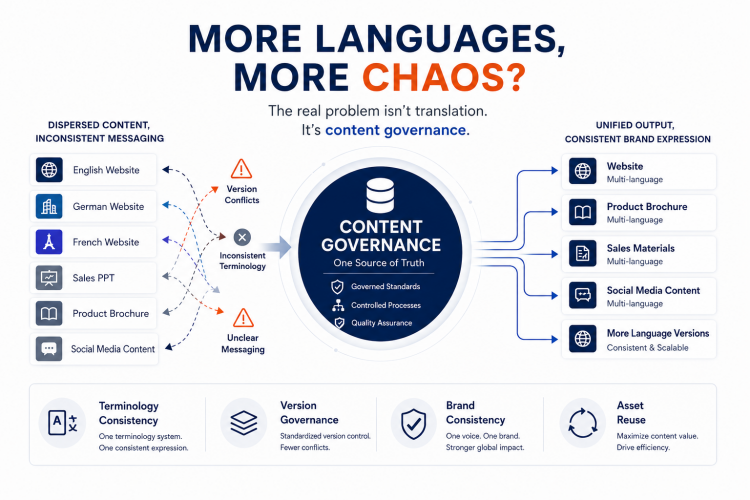
I. Why Does Adding More Language Versions Lead to Brand Messaging Drift?
Many companies assume multilingual content simply means translating Chinese content into other languages. In reality, multilingual production without a content system often results in fragmented communication.
1. Lack of Terminology Standards
Different projects and vendors may translate the same technical term differently. For example, "Controller" may be translated one way in certain documents and another way elsewhere.
Impact: Customers perceive the company as less professional and may even question whether product specifications are consistent.
2. Unsynchronized Version Updates
The Chinese product information has been updated, while the English version still contains outdated specifications. The website reflects the latest information, but product brochures still reference old data.
Impact: Customers receive conflicting information across touchpoints, significantly reducing trust.
3. Inconsistent Messaging Across Channels
Website content feels formal and professional, social media content feels casual, and sales presentations use yet another tone. There is no consistent management of brand messaging across channels and markets.
Impact: Brand identity becomes blurred, making it difficult for customers to form a clear and consistent perception.
💡 Landelion Insight: Multilingual content is not a copy-and-paste exercise. It is a matter of cross-market content governance.
II. Three Major Risks of Operating Without a Cross-Market Content System
The root cause of inconsistent brand communication is rarely translator capability. More often, it stems from structural weaknesses in content system management.
| Risk Area | Situation | Challenge | Impact |
|---|---|---|---|
| Messaging Standards Risk: No Unified Terminology Management | Terminology is retranslated for every new project, relying on individual translators’ interpretations. | As product portfolios grow, terminology assets remain unmanaged and historical content becomes difficult to reuse. | The same product may be described differently across languages and documents, increasing customer confusion. |
| Version Governance Risk: No Coordinated Update Process | Source-language content is updated, but multilingual teams are not notified. | Without version logs and update rules, multilingual content becomes outdated or inaccurate. | Customers inquire using outdated materials, forcing sales teams to spend time correcting information. |
| Brand Consistency Risk: No Cross-Channel Tone Management | Websites, brochures, and sales materials are created by different teams. | Without a unified Style Guide, each team develops its own communication approach. | Customers encounter different brand personalities across touchpoints, making trust harder to establish. |
💡 Landelion Insight: The real issue is not language—it is the system used to manage content.
III. How Content System Development Creates Unified Multilingual Content Management
Solving fragmented communication requires more than finding better translators. Companies need a structured content system that brings headquarters messaging, local-market communication, sales materials, website content, and multilingual assets into a unified framework.
This governance framework should focus on terminology, version control, and brand consistency.
1. Terminology Alignment: From Ad Hoc Translation to Reusable Assets
Approach: Build a centralized glossary as foundational infrastructure for all multilingual content projects. Regularly review terminology to ensure consistency across technical, sales, and marketing teams.
Value: Consistent terminology across documents and languages reduces customer confusion and strengthens professional credibility.
This aligns directly with the messaging alignment principle discussed in Cross-Market Content System Development and serves as the foundation of effective content governance.
2. Version Governance: From Isolated Updates to Coordinated Workflows
Approach: Establish a version management system. Whenever source-language content is updated, multilingual update workflows are automatically triggered. Clearly define which content requires immediate synchronization and which can be updated later.
Value: Ensures customers worldwide receive accurate and current information, reducing trust erosion caused by outdated content.
3. Brand Consistency: From Fragmented Communication to Unified Standards
Approach: Develop a comprehensive Style Guide covering websites, product documentation, sales materials, meeting collateral, and multilingual content. Standardize key messages, terminology, and brand tone across all customer-facing assets.
Value: Creates a recognizable and consistent brand identity across markets.
💡 Landelion Insight: The goal of content system development is not to make every language identical. It is to ensure customers in every market understand the same brand value.
IV. Content System Boundaries: Avoiding Over-Standardization
Building a content system does not mean forcing every market to communicate in exactly the same way. Companies must balance consistency with localization.
1. Consistent, Not Rigid
Terminology should remain standardized, while marketing language should allow appropriate localization. Consistency should not come at the expense of local relevance.
2. Collaborative, Not Dependent
Internal teams should participate in terminology validation, but should not become responsible for translation execution. Professional processes should handle production, while internal stakeholders focus on accuracy and business alignment.
3. Continuous, Not One-Time
Glossaries and version-management systems require ongoing maintenance. Content assets should continue generating value long after individual projects are completed.
Conclusion: Turn Your Content System Into a Bridge of Cross-Market Trust
In the next phase of globalization, companies compete not only through products, but through their ability to communicate consistently across markets.
When organizations build a cross-market content system, they move beyond ad hoc translation and begin creating reusable, trustworthy content assets. Customers experience not only linguistic clarity, but also professionalism and reliability.
For globalizing companies, success is no longer defined by delivering multilingual content alone. The real challenge is creating alignment between headquarters messaging, local-market communication, sales materials, website content, and multilingual assets.
Content system development provides the governance framework that makes this possible—bringing scattered content into a unified, manageable, and reusable structure so customers in every market clearly understand who you are, what problems you solve, and why you are worth trusting.
🚀 Take Action: Evaluate the Maturity of Your Cross-Market Content System
Are your multilingual assets functioning as a unified brand resource—or merely a collection of disconnected translations? Landelion provides Cross-Market Content System Assessments for B2B companies, helping identify management risks and operational gaps across terminology management, version governance, and brand consistency.
Get Content System AssessmentExplore Content System Solutions Add WeCom for Consulting
📚 Further Reading
Why Cross-Market Content Keeps Getting Reworked and Fails to Stay Consistent
Multilingual Content Governance: Why Translation Must Evolve into Global Expression Governance