


A technology‑focused B2B company launched an advanced predictive maintenance platform. The technical lead spent forty minutes explaining the model and algorithm framework, and the launch event received an enthusiastic response. But when sales visited customers with the materials, the question was surprisingly consistent: “The technology sounds impressive, but what does it have to do with the equipment on our shop floor?”
This is not a technology problem – it is a value translation problem.
According to manufacturing content marketing research, 66% of manufacturers report that their content struggles to convert customers, and 64% struggle to prove ROI.
The stronger the technology and the more it is showcased, the less customers understand the application value – this is becoming the most hidden growth bottleneck for technology‑driven B2B companies.
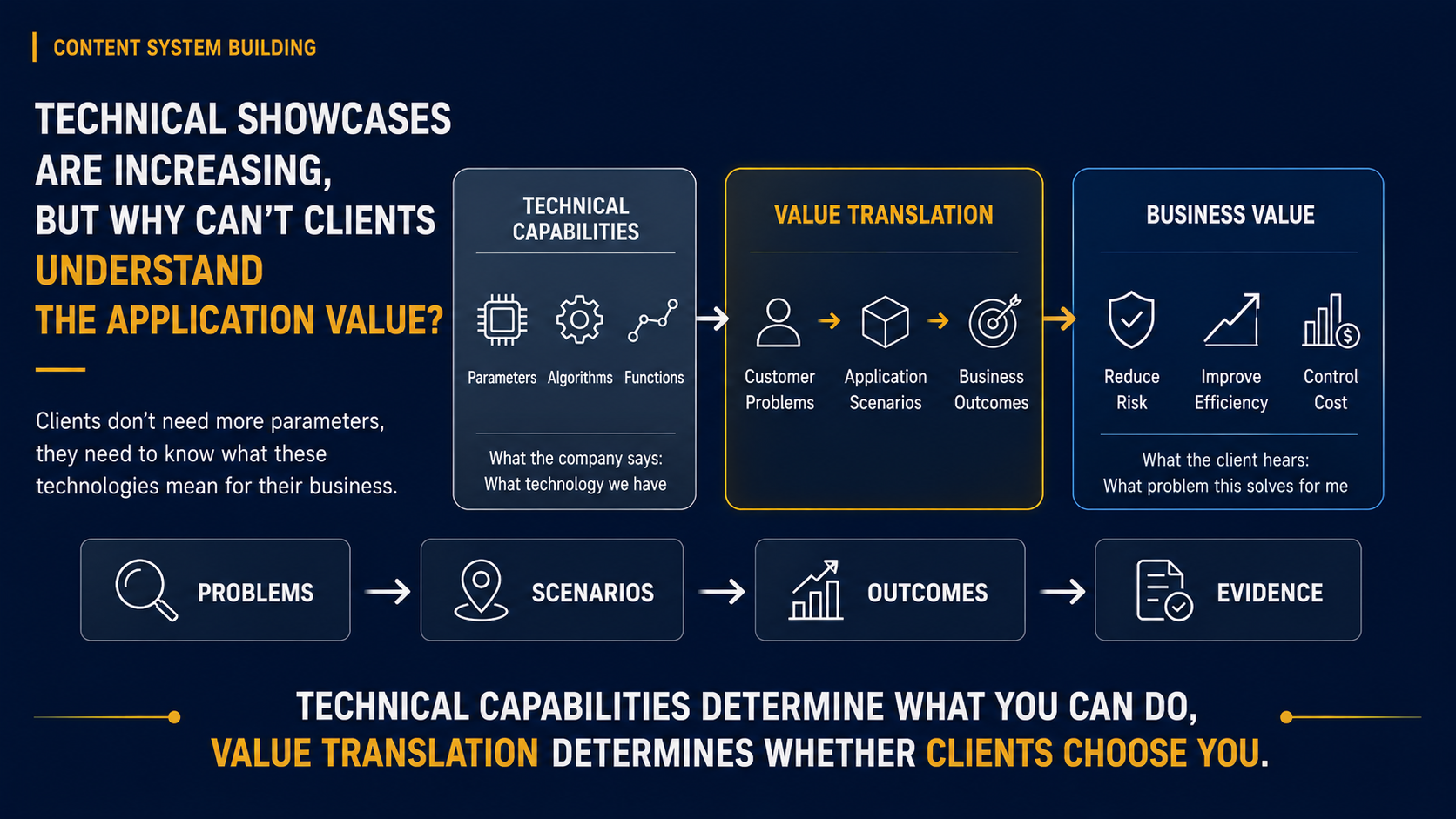
I. Why do customers understand less the more technology is showcased?
Many technology companies operate on the logic that if they write clear specifications, create impressive demos, and explain technical details thoroughly, customers will naturally understand the value. But the reality is quite the opposite.
1. The “curse of knowledge” is at work
The more immersed a company is in the complexity and sophistication of its own technology, the more disconnected it becomes from customers’ actual cognitive frameworks. Product teams work with their technology every day – this deep familiarity leads them to unconsciously use technical language, without realising that the audience does not share the same background knowledge. When companies speak “technical language” to customers who think in “business language”, communication inevitably fails.
2. Stacking specifications is not the same as delivering value
Excessive technical specifications exceed decision‑makers’ cognitive load limits – the more information, the slower the decision. Customers see dozens of similar product pages every day; your spec sheet is just one of them. If content only covers equipment parameters without addressing application scenarios, customers are left to figure out for themselves whether “this parameter can solve my problem” – and that mental translation process often leads them to give up.
3. Companies have an internal “complexity bias”
Many technology brands worry that simplifying information will make their products seem less sophisticated or less differentiated. So they tend to retain all technical details, fearing they might miss a key advantage. The result: content becomes more complex, and customers understand less.
4. Homogeneity makes it harder to differentiate
The complexity of technology and the specificity of application scenarios turn sophisticated technical details into obscure parameters in brochures, and unique technical approaches are reduced to vague marketing slogans – ultimately, in the customer’s eyes, they become indistinguishable from competitors’ “homogeneous solutions”.
II. What do customers really need?
B2B purchasing decisions involve a high rational threshold and risk‑aversion psychology. Customers are not unwilling to understand technology – they need to make judgments within limited time. What they truly need are three things:
First, they need to know “what problem does this solve”.
Customers face specific business pains – such as “low yield rates” or “delivery delays” – not abstract “high‑performance equipment”. They don’t care about “99.5% algorithm accuracy”; they care about whether you can reduce unplanned downtime, lower maintenance costs, and stabilise delivery cycles. Business language must be concrete, direct, and tied to their daily pressures.
Second, they need to know “what this has to do with me”.
Customers need a one‑sentence summary of “who this product is for and what it does”. If customers have to figure out for themselves whether a specification can solve their problem, most will choose to walk away.
Third, they need to know “why they should believe it”.
As more B2B purchasing research is conducted online, customers validate supplier capabilities through search, short‑form video, peer reviews, case studies, and other channels.
III. Four key actions to move from “showcasing technology” to “translating value”
To solve the “customers don’t understand” problem, companies need to complete a translation from “technical language” to “business language”. This is not about polishing copy or training sales scripts – it is a systematic restructuring of the content system.
Action 1: Define the problem in the customer’s language
Companies first need to answer: how do customers actually understand their own problems? What everyday language do they use to describe these pain points? For example, customers may not call it “predictive maintenance” – they are more likely to think of it as “emergency repairs”, “reactive fixes”, or “uncontrollable equipment risk”. Companies need to incorporate this everyday language into their content system so customers can recognise at first glance that “this is talking about my problem”.
Action 2: Translate specifications into business outcomes
This is the most critical step. Don’t say “equipped with high‑precision sensors” – say “in practical applications, this technology translates into more stable process control, lower rework risk, and more controllable scrap costs.” Don’t say “power output reaches 5kW” – explain that this helps customers improve structural stability and reduce cargo damage risk in multi‑layer stacking or long‑haul transportation scenarios. The meaning of a specification to the customer is not the number itself, but the business outcome behind it – reduction in defect rates, cost savings, shorter delivery cycles.
Action 3: Use scenario‑based content to lower the understanding barrier
Technology companies’ content cannot stop at “what we have” – it needs to show “what problem this solves in which scenario”. For example, the precision advantage of servo welding can be demonstrated through visual comparisons – such as yield improvement on thin‑walled materials. Energy efficiency advantages can be shown through split‑screen video comparisons of pneumatic welding’s fluctuating curves versus servo welding’s stable curves. Scenario‑based content helps customers connect to their own working conditions – the lower the imagination cost, the stronger the trust.
Action 4: Build trust with verifiable evidence
Customers need to see that “someone like me has used this and gotten results”. Case studies are among the most influential information sources in B2B purchasing – Gartner research shows that 41% of buyers rank case studies as the most valuable content type in their decision process. Companies need to classify successful case studies by industry and application scenario, enabling customers to self‑identify and see how “companies similar to mine have benefited”.
IV. “Value translation” through the lens of content system building
| Dimension | Just showcasing technology | Translating business value |
|---|---|---|
| Content starting point | Product specifications and technical parameters | Customer pain points and business scenarios |
| Core language | Technical terminology and functional descriptions | Business outcomes and scenario‑based expression |
| Customer perception | “Sounds impressive, but what does it have to do with me?” | “This is talking about my problem” |
| Basis of judgment | How high the specs are, how comprehensive the features are | What problems it solves, what outcomes it delivers |
| Trust building | Relies on self‑statements | Relies on verifiable case studies and scenario evidence |
No matter how much technology is showcased, if it cannot be translated into business value that customers can understand, judge, and verify, the technology advantage remains “the company’s own affair”. One of the core functions of content system building is to complete the translation from “technical language” to “business language” – enabling customers to understand “what this capability can do for me” without needing a technical background.
V. Where does your technology value translation stand?
If you are unsure about your team’s current state, use these quick self‑check questions:
⬜ Can customers quickly understand “what problem this solves” after engaging with your content?
Pick a product brochure or technical document at random – can a new customer say “what specific problem this product helps me solve” after reading it? If customers can only repeat technical specifications without describing business value, value translation is broken.
⬜ Is the language in your content “technical language” or “business language”?
Open a product introduction and randomly circle three core statements – do they describe technical specifications, or do they explain business outcomes and customer benefits? If technical specifications dominate, language translation is broken.
⬜ Do you have case content categorised by scenario and industry?
Can customers find reference cases in their own industry and application scenario? If all cases are mixed together and customers cannot self‑identify, scenario‑based content is broken.
Conclusion: If technology cannot be understood, it cannot be chosen
Technical capability determines whether a company can enter a customer’s field of view. But whether it gets chosen depends on whether that technical capability can be translated into business value that customers can understand, judge, and verify. If a company only showcases technological sophistication without answering “what problem this solves, what scenario it fits, and what outcomes it delivers”, customers cannot complete the judgment from “understanding the technology” to “believing in the value”.
Content System Building addresses precisely this break – from “showcasing technology” to “translating value”. Landelion can help technology‑driven B2B companies reorganise product specifications, technical capabilities, and demo presentations into business language that customers can understand – starting from customer pain points, presented through scenario‑based content, and supported by verifiable evidence – so that technical capabilities are truly understood, recognised, and chosen by target market customers.
Act now Does your technical content leave customers more confused, or has it been translated into business value they can understand?Landelion can help technology‑driven B2B companies assess their technology value translation capability from the perspective of Content System Building – diagnosing whether the issue lies in customer insights, language conversion, scenario presentation, or evidence support. Explore Content System Building solution Book a technology value expression diagnosis |
📚 Further reading
From Patchwork to Professional: Content System Building for the B2B Evaluation Phase
Why Can't Customers Quickly Decide If Your Company Is Right for Them?
B2B English Product Brochures: Why Overseas Buyers Still Struggle to Make Purchasing Decisions