


A B2B manufacturing company entered the Southeast Asian market several years ago, expanded its product lines, and its overseas customer base gradually shifted from small and medium‑sized buyers to multinational corporations. Yet the company introduction on its website still remains an early version: it includes the founding year, business scope, and sales coverage, but fails to state who the company now serves, what problems it solves, or what new delivery capabilities it has.
Business continues to expand, but the foundational external messaging has not been updated accordingly. Company introductions, website about pages, sales PPTs, exhibition materials, LinkedIn summaries, and distributor descriptions – these seemingly basic pieces of content are often the very first entry points for customers, partners, and channels to learn about a company. When these materials become disconnected from the current state of the business, the first crack appears in the message the company sends to the outside world.
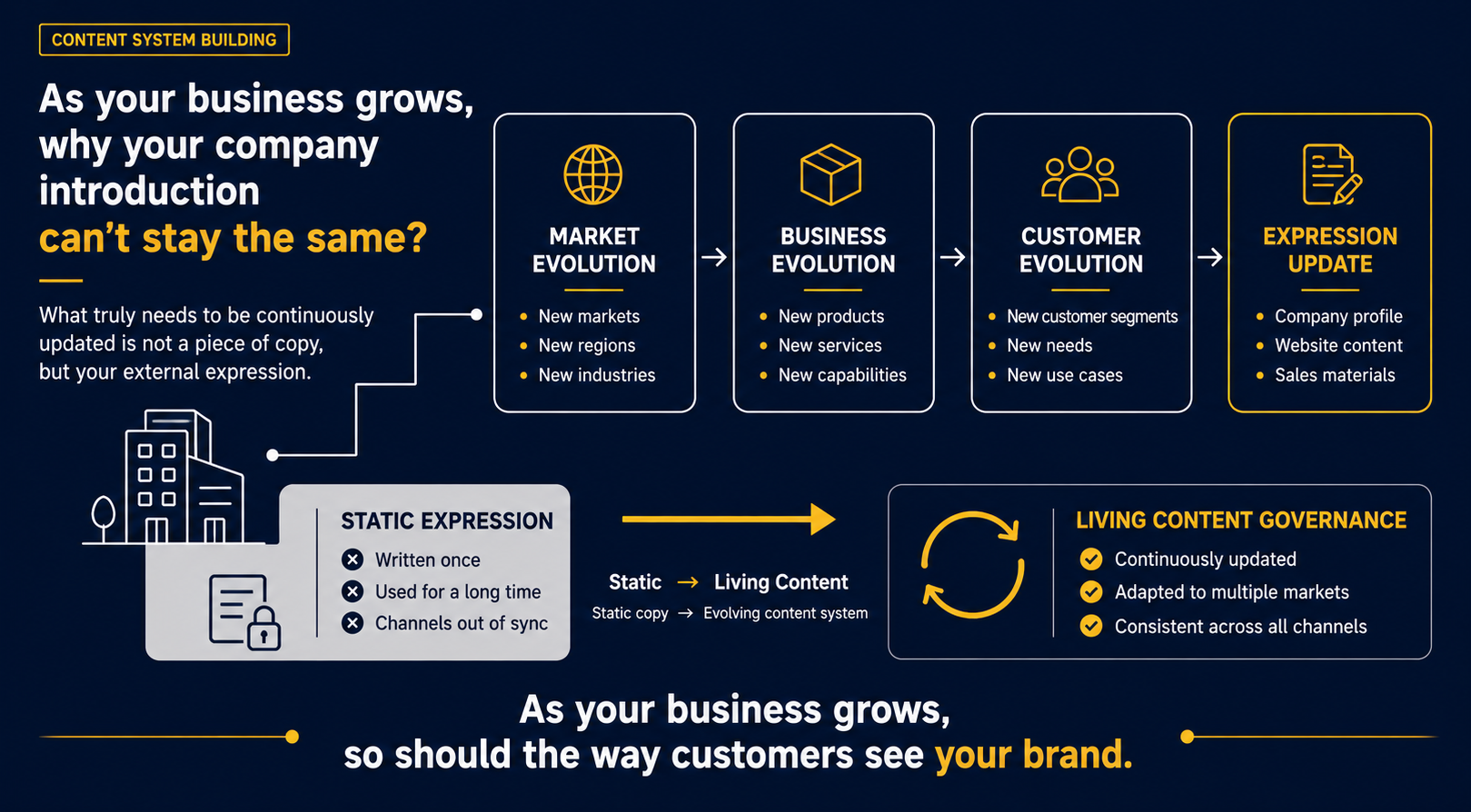
I. Business is changing, but external messaging has not kept pace
Global business expansion for B2B companies is rarely linear; it happens across multiple dimensions simultaneously:
Markets are changing. Moving from a single market to multiple markets, from emerging to mature markets – customers in different markets have different criteria for evaluating suppliers. The messaging logic that works for Southeast Asian SMEs often does not apply to European multinationals.
Products and services are changing. Product lines are expanding, service capabilities are upgrading, and solutions are moving from point‑based to integrated offerings – what was once a core product may now be just one part of the business portfolio.
Customers are changing. From serving SMEs to serving industry leaders, from a single industry to multiple industries – shifts in customer profiles mean the answer to “who we serve” needs to be rewritten.
Competitive positioning is changing. From market follower to industry leader, from regional player to global contender – changes in competitive positioning require adjustments to how “who we are” is articulated.
After these changes occur, the company’s foundational external messaging often remains static. The result: the company customers see on the website feels different from the one they actually encounter. LinkedIn Manufacturing Buyer Research 2025 shows that 55% of manufacturing buyers find it difficult to differentiate between potential suppliers. When the brand image conveyed across channels is inconsistent, customers tend to pause their evaluation and continue comparing other suppliers.
II. A company introduction is not a one‑time effort
Many companies treat their company introduction as a one‑off project – written at founding, updated at IPO, and then left untouched. But B2B business evolution is continuous, and external messaging must be rebuilt continuously as well.
The core question a company introduction answers is not “who we are”, but “can we solve your problem”. There is no single answer to this. Across different markets, industries, and customer sizes, the criteria for “can solve” vary. A fixed set of introduction content cannot address the diverse judgment needs of multiple markets and customer groups.
A common challenge for B2B companies expanding globally is: how to maintain brand consistency while making customers in different markets feel that “this company understands my problem”. This requires a content management system to support it, not a team “finding time to revise it” occasionally.
When the business scope expands from one region to multiple regions, and from a single product line to multiple product lines, the original introduction may not be wrong, but it can no longer accurately reflect the company’s current business scope, target audience, and capability boundaries.
III. After business expansion, foundational external messaging needs to answer four questions anew
After business changes, foundational external messaging should be systematically rebuilt around the following four dimensions:
Dimension 1: Who do you serve – is the customer profile still accurate?
Does the original target customer description still cover the current core customer base? In newly entered markets, does the customer profile need to be redefined? If the original introduction said “serving small and medium‑sized manufacturers” but the business has now expanded to serve multinational groups, then the fundamental “who we serve” needs to be rewritten.
Dimension 2: What problem do you solve – is the value proposition still valid?
Does the original core value proposition still describe the main problems the current business solves? After product line expansion, has the problem set changed? If the original value proposition was “helping companies reduce procurement costs” but the current core value is now “providing end‑to‑end supply chain solutions”, then the value proposition needs to be upgraded.
Dimension 3: Which markets and scenarios do you serve – is the target market expression clear?
After entering new markets, industries, and customer segments, does the external messaging allow target customers to self‑identify? When customers read the introduction, can they quickly determine whether “this company is suitable for my market, industry, or business scenario”?
Dimension 4: Why should they trust you – have trust signals kept pace with business growth?
Certifications, industry cases, customer scale, delivery capabilities – have these trust‑building materials been updated alongside business growth? If certifications are still from three years ago, cases are still the earliest ones, and delivery capability descriptions are still old versions, the trust signals customers see will be disconnected from current business capabilities.
IV. Foundational external messaging needs a mechanism for continuous rebuilding
| Evolution dimension | Typical state after business expansion | Characteristics of a mature content system |
|---|---|---|
| Update awareness | No active review after creation | Proactively assess whether external messaging needs adjustment after business changes |
| Content structure | One set of content for all scenarios | Unified core messaging, with tailored versions for different markets and scenarios |
| Maintenance mechanism | Updated only when a department happens to remember | Fixed content update cadence and version management |
| Consistency management | Each channel operates independently | Website, sales materials, social media profiles, and distributor materials stay synchronised |
| Version management | Different channels use different historical versions | Establish a single source of truth to ensure website, sales PPTs, social bios, and distributor materials are updated in sync |
Company introductions, website about pages, sales PPTs, exhibition materials, LinkedIn summaries, and distributor descriptions are not static documents that can be written once and used forever. They are foundational tools for communicating with customers across different markets and scenarios, and they need to evolve with business growth.
V. Where does your foundational external messaging stand?
If you are unsure about your team’s current state, use these questions for a quick self‑check:
⬜ When was the company introduction on the website last systematically updated?
If it has been a long time and the business has changed significantly in the interim, the external messaging is behind.
⬜ Is the company introduction consistent across different channels?
Randomly compare the company introduction on the website, in sales PPTs, and on LinkedIn – are the core messages consistent? If they differ, content consistency management is broken.
⬜ Has the introduction been tailored for different markets?
Have the materials for Southeast Asian customers and European customers been adapted while maintaining core consistency? If they are identical, multi‑market adaptation is broken.
⬜ After business changes, is there a mechanism to trigger a re‑evaluation of external messaging?
When new products launch, new markets are entered, or new customer segments emerge, is there a defined process to assess whether foundational messaging needs updating? If not, the content update mechanism is missing.
If any of the above issues exist, foundational external messaging has not kept pace with business growth.
Conclusion: Let foundational external messaging keep up with business change
After global business expansion, what changes is not just the market scope, but also customer structure, product capabilities, service models, and competitive positioning. If the company introduction, website about page, sales materials, and channel materials remain on old versions, customers will see a brand image that lags behind the company’s true current capabilities.
Foundational external messaging is not a one‑off copywriting task; it is the underlying content asset through which the company continuously builds awareness with customers, partners, and channels. It needs to be rebuilt continuously as new markets are entered, product lines expand, customer structures evolve, and trust signals are updated.
Content System Building addresses precisely this transition – from “write once, use forever” to “continuously updated with business growth”. Landelion can help B2B companies restructure their company introductions, website about pages, sales PPTs, social media bios, and distributor materials, ensuring that foundational messaging across different markets and channels remains accurate, consistent, and verifiable.
Act now Is your foundational external messaging written once and used forever, or has it been continuously rebuilt with business growth?Landelion can help B2B companies assess whether foundational external messaging has kept up with business expansion – diagnosing whether the issue lies in update mechanisms, multi‑market adaptation, content consistency, or trust‑signal synchronisation. Explore Content System Building solution Book a foundational messaging diagnosis |