


A common sticking point in B2B sales is: the materials have been sent, but the customer hasn't moved forward.
Sales believes the materials are comprehensive – product introductions, technical specifications, case studies, quotations – everything is there. But the point of contact is slow to respond. After a few follow‑ups, they say they are “still in internal discussions”.
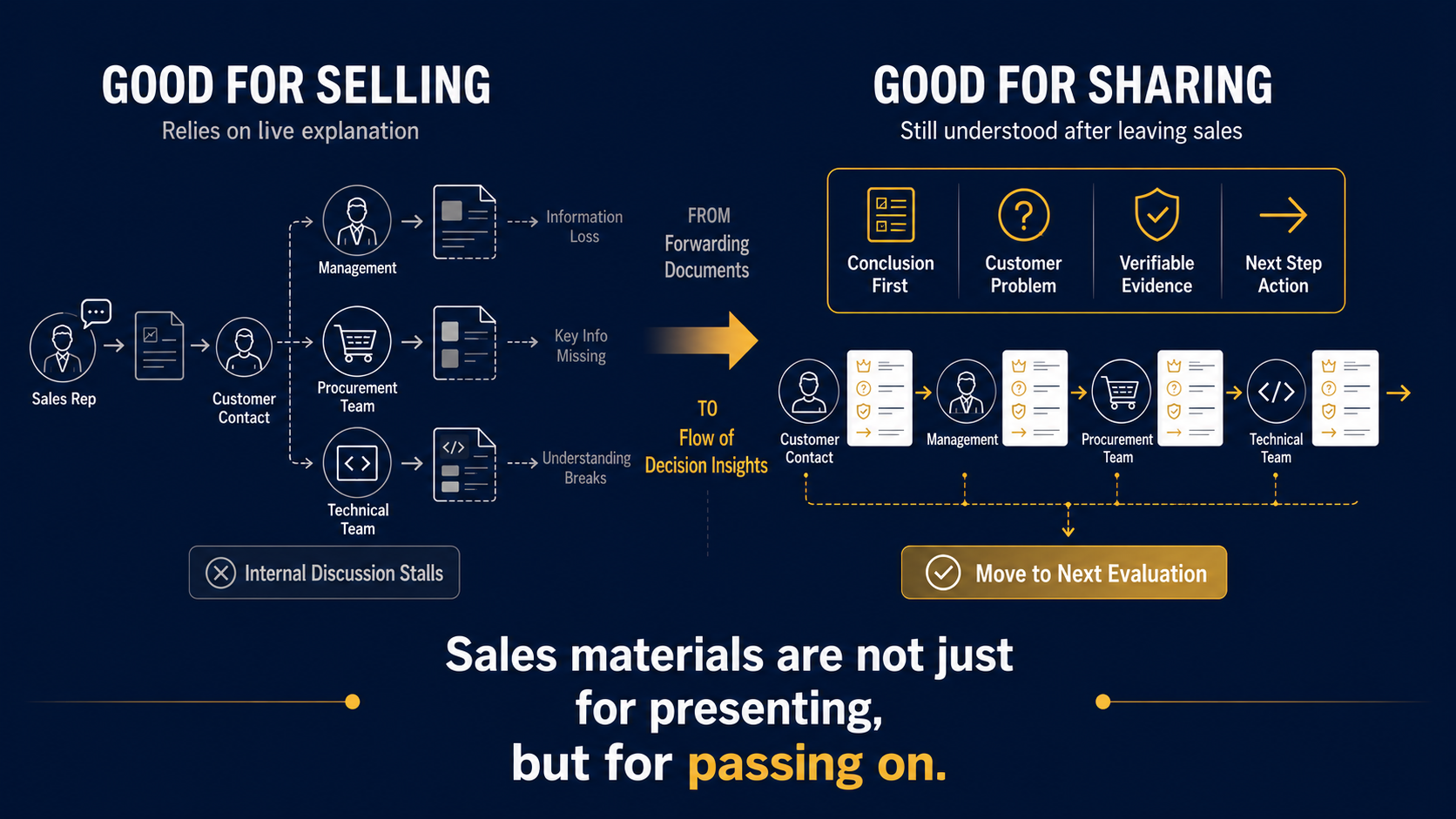
The issue may not be whether the materials are “complete”, but whether the contact person can smoothly pass them on to other internal decision‑makers while maintaining the integrity and persuasiveness of the information during the handover.
Publicly available Gartner insights indicate that B2B purchasing is rarely carried out by a single decision‑maker; buying groups often involve multiple roles. For sales and marketing teams, the key is not just sending materials to a single contact, but providing easily accessible, shareable information that helps the buyer’s organisation internally understand, compare, and build consensus.
In other words, the point of contact is merely the receiver of information. The real decision usually passes through the boss, procurement, technical teams, regional teams, and even headquarters. Sending materials to the contact is just the first step – it also needs to be understood, endorsed, and re‑transmitted.
If the materials are designed only for “sales to explain face‑to‑face to the customer” and neglect the scenario of “the contact passing them internally”, the efficiency of information transfer drops significantly once the materials are sent out.
I. Why are materials still “not moving” even when they are “complete”?
Many companies believe that the core of material preparation is “completeness of content” – putting all relevant information into one document, the more complete the better. However, during internal circulation, “completeness” does not equal “transmissibility”.
A typical feature of B2B purchasing is multi‑role participation in decision‑making. After receiving materials, the customer’s contact person usually needs to sync with the boss, procurement, technical teams, regional teams, or headquarters colleagues. Each role has different concerns: the boss cares about ROI, procurement cares about costs and terms, technical teams care about feasibility, and regional teams care about local adaptation and delivery support. Each layer has different priorities, and each handover risks information loss or distortion.
Gartner research shows that a typical B2B purchasing decision involves 6 to 10 stakeholders. Industry data also indicates that in enterprise SaaS deals, this number averages 11 people.
With loosely structured technical materials, the contact person finds it difficult to grasp the core value quickly, let alone explain it internally in their own words. During a conversation, sales can fill in background, emphasise key points, and answer questions. But once the material leaves the salesperson’s hands, the contact must independently absorb, reorganise, and re‑transmit the information. If the material lacks a clear background explanation, problem definition, solution value, and supporting evidence, the handover becomes a simple “forwarding of files” rather than a driver of internal discussion.
II. What circulates internally is not files, but judgment basis
The customer’s contact person is willing to forward a set of materials to internal decision‑makers not because the document is “good looking” or “professional”, but because it helps them answer a core question: why should we push this forward?
The contact person is a relay station of information, not the decision‑maker. What they need to convey internally is not “what documents this company sent”, but “what problem this company can help us solve and why it’s worth continuing to talk”. If the material does not provide such judgment basis, the contact lacks sufficient information to persuade internal colleagues.
Specifically, the contact person typically needs the material to answer the following questions when passing it on:
Question 1: What is the background?
Why is the customer considering this supplier, and why does it need to move forward now? If the material jumps straight into solution details without providing context, the contact cannot explain to internal colleagues why this discussion is meaningful.
Question 2: What is the conclusion?
The contact person often needs the “conclusion” first to judge the necessity of the matter. If the material starts with “background introduction” or “company overview” without placing the core conclusion upfront, it becomes difficult for them to explain why this matter is worth further attention.
Question 3: Why you?
Internal decision‑makers will ask: why choose this supplier? What differentiates it from other options? Is there verifiable evidence? If the material is only self‑referential and lacks third‑party evidence or specific data, the contact will struggle to answer these follow‑up questions during handover.
Question 4: What happens next?
Internal decision‑makers will care about: if we proceed, what are the next steps, what is the timeline, and what resources are needed? If the material does not set clear expectations, the contact will find it hard to convince decision‑makers to move to the next stage.
When the material cannot help the contact answer these questions, the handover becomes “forwarding files” rather than “transmitting judgment basis”.
III. What kind of materials support internal handover?
To ensure smooth internal handover, content design needs to be adjusted – not by writing more, but by organising the information to be more suitable for re‑transmission.
1. Structure: put the conclusion first
The key to internal handover is helping the recipient quickly understand “this material is worth reading”. If it starts with company background, history, and product specifications, the recipient must read several pages to find the core message – the handover barrier is high.
An effective structure should be: state the conclusion first – “what problem we solve and what value we bring” – then support it with evidence, followed by details and appendices. This allows the contact to directly tell internal decision‑makers: “this is the core conclusion, and here is the supporting material”.
2. Language: shift from “we” to “you”
The value of materials lies in enabling internal decision‑makers to draw conclusions through reading, rather than relying on sales’ verbal explanation.
Effective material language should revolve around the customer’s specific problems, avoiding internal jargon and buzzwords. Every capability description should be translated into business value for the customer, so that the handover person can directly quote or copy the material’s wording when communicating internally.
3. Evidence: be specific and verifiable
Internal decision‑makers are usually more cautious than frontline contacts and have a lower tolerance for vague statements. Claims like “significantly improved efficiency” or “received unanimous customer praise” carry almost no weight with decision‑makers.
Effective materials should support assertions with publicly shareable client types, specific data, timelines, and traceable outcomes. Every “we can do this” should correspond to a “we have actually done this”.
4. Action: clarify the next steps
After internal discussion, the customer often needs to return to the supplier to move things forward. If the material lacks clear guidance on next steps – what the customer needs to do, who the contact needs to coordinate, the expected timeline – the conversation after the handover tends to stall at “we’ll keep it in mind internally”.
Effective materials should conclude with clear action recommendations, enabling the contact to tell their internal team: “after reviewing this, we can decide whether to schedule the next technical exchange.”
IV. Evolution from “suitable for sales to present” to “suitable for customers to forward”
| Dimension | If materials are “suitable for sales to present” | If materials are “suitable for customers to forward” |
|---|---|---|
| Structure | Laid out progressively from company background and product parameters | Conclusion first, core value immediately visible |
| Language | “We”‑centric, listing capabilities and parameters | “You”‑centric, addressing the customer’s specific scenarios and problems |
| Evidence | Vague statements, lacking specific data | Quantifiable, traceable, verifiable |
| Call to action | Ends with “contact us” | Clearly tells the customer what to do next and how to proceed |
| Use case | Relies on sales to explain on‑site | Can be understood and forwarded internally even without sales |
V. Do your materials support internal handover?
If you are unsure about your team’s current state, use these quick self‑check questions:
⬜ Does the first page of the material directly answer “why it’s worth discussing”?
Pick a recent proposal or document sent to a customer at random – does the first page help the reader quickly understand “what problem this company can solve”? If it still starts with company background, the structure has a break.
⬜ Can the wording in the material be directly quoted by the forwarder?
Open a sales document and randomly circle three core statements – can these be directly copied by the contact to explain to internal colleagues? If they need to be rephrased by the forwarder, language has a break.
⬜ Does the material include verifiable evidence to support its claims?
Are the “effects”, “improvements”, or “optimisations” mentioned supported by specific, checkable data? If there are only conclusions without evidence, credibility has a break.
Conclusion: Make sales materials a tool for internal customer advancement
After B2B sales materials are sent, the real test is not whether the customer received them, but whether they can continue to be understood, forwarded, and discussed internally.
If materials can only rely on sales to explain on‑site, once they leave the salesperson, they easily lose context, emphasis, and persuasion. The customer contact needs not just a document, but a set of judgment rationale that can be explained internally: why this matter is worth discussing, why this supplier is worth continuing to evaluate, and how to proceed next.
Content System Building addresses the break from “suitable for sales to present” to “suitable for customers to forward”. Landelion can help B2B companies restructure proposals, case studies, product introductions, and sales materials so that they maintain clear structure, credible evidence, and clear action guidance even as they circulate within the customer’s organisation.
Act now Are your sales materials only reliant on on‑site sales explanations, or can they already support your customer contacts to forward and advance internally?Landelion can help B2B companies examine breaks in the internal circulation of sales materials from the perspective of Content System Building – diagnosing whether the issue lies in structure, language, evidence, or next‑step guidance. Explore Content System Building solution Book a sales material circulation diagnosis |
📚 Further reading
From Patchwork to Professional: Content System Building for the B2B Evaluation Phase
Why Can't Customers Quickly Decide If Your Company Is Right for Them?
B2B English Product Brochures: Why Overseas Buyers Still Struggle to Make Purchasing Decisions