


Many global‑bound companies are technologically strong – competitive product specifications, extensive delivery experience, and full industry certifications. Yet overseas customers often respond: “Your technical capabilities sound impressive, but after meeting you, we are still not entirely sure you are truly reliable.” The 2026 Edelman Trust Barometer shows that 70% of global respondents are unwilling to trust people whose values, backgrounds, or information sources differ from their own. For overseas customers, an unfamiliar supplier from a different country and cultural background naturally starts from a position of “trust deficit”. Any information gap in cross‑language communication further amplifies this distrust.
An overseas client made a special trip to attend a cross‑border meeting. The company arranged for its technical director and sales director to attend, and also provided interpretation support. The meeting lasted two hours – technical details were covered, case studies were presented – but the client left with an expression that said: “I heard a lot, but didn’t really get the key points.” The post‑meeting review revealed that the interpreter was unfamiliar with industry terminology, the technical director’s remarks were oversimplified, and the client’s follow‑up questions were not accurately conveyed. Although both sides sat in the same conference room, the critical information never fully aligned.
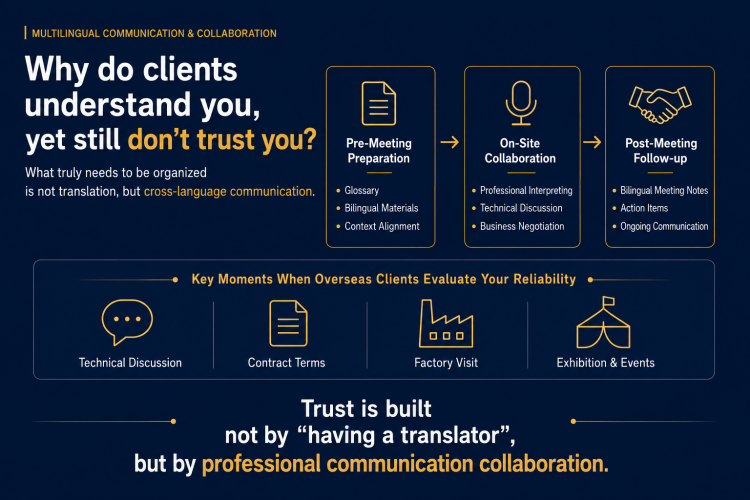
Truly effective cross‑language communication requires systematic support – from pre‑meeting preparation, to on‑site coordination, to post‑meeting follow‑up.
I. Capability is “present”, but communication is “offline”
Many companies believe that as long as an interpreter is arranged, cross‑language communication will proceed smoothly. The reality is that having an interpreter on site is only the minimum requirement – the effectiveness of communication depends on systematic preparation before, during, and after the meeting.
In one important business negotiation, both teams had prepared thoroughly, but the on‑site interpreter was unfamiliar with the industry’s technical terminology – translating “tolerance range” as “error margin” and “batch delivery capability” as “large‑scale production capacity”. The meaning was close, but the professional precision was off. The client did not point it out at the table, but later commented: “Your technical expressions were not precise enough. We are not sure whether your technical team truly understands our requirements.”
The core issue is this: professional capability must be accurately conveyed at the communication moment to be validated by the customer. And the prerequisite for accurate conveyance is not “having an interpreter”, but “communication that is professionally organised and coordinated”.
II. Four critical moments when overseas customers validate reliability through cross‑language communication
Overseas customers validate an unfamiliar supplier’s capability not on paper, but in face‑to‑face communication. The following four moments are critical windows for the customer to judge “is this company reliable”:
1. Technical discussions in meetings
Customers assess a company’s professional depth through technical exchange meetings. If the technical director’s responses are simplified, omitted, or distorted during interpretation, the customer will perceive the company as “technologically weak” or “not answering the question”.
2. Contract terms communication during negotiations
Communication on contract terms, delivery standards, and quality requirements demands extremely high linguistic precision. A single mistranslated term can lead the customer to reassess the risk of cooperation.
3. Client visits and factory tours
Customers verify a company’s production capacity and management level through on‑site inspections. The quality of the on‑site explanation and the smoothness of the Q&A session directly influence the customer’s trust.
4. Exhibition exchanges and client training
At exhibitions, customers decide whether to engage further based on brief conversations. In training scenarios, customers evaluate a company’s professionalism through the quality of the training content delivered.
III. Three things you must get right to accurately convey professional capability in communication
1. Pre‑meeting preparation – bring all parties into the same context
Low communication efficiency and on‑site misunderstandings are often not the interpreter’s fault, but the result of insufficient preparation on terminology and background before the meeting.
Three things must be done before the meeting: first, assess the type and complexity of the communication scenario – whether it is technical exchange, business negotiation, or factory visit, as different scenarios require different language support; second, translate and compile meeting materials, product introductions, and key technical parameters into a glossary and provide it to the interpreter well in advance; third, brief the interpreter on the meeting’s background, objectives, and key discussion points – ensuring they are not “understanding the context as they walk in”.
2. On‑site coordination – keep communication flowing and on track
During a meeting or negotiation, interpretation is only one part of on‑site coordination. Whether equipment is functioning, remote participants are smoothly connected, terminology disagreements are resolved on the spot, and the customer’s follow‑up questions are accurately conveyed – all of these require someone to coordinate on site.
On‑site coordination is not just the interpreter’s job – it also involves information alignment across sales, the technical lead, logistical support, and the customer’s participants. Who answers technical questions, who confirms commercial boundaries, who records action items – these need to be clarified before the meeting.
3. Post‑meeting follow‑up – capture and continue the communication outcomes
Communication does not end when the meeting concludes. Bilingual meeting minutes, accurate handover of action items, and preparation for the next meeting – these follow‑up actions determine whether the previous discussion translates into sustained cooperation.
IV. Evolution from “having interpretation” to “communication professionally coordinated”
| Evolution dimension | Starting from “having interpretation” | Gradually moving to “communication professionally coordinated” |
|---|---|---|
| Interpreter matching | Hired on short notice, inconsistent quality and reliability | Professional interpreters matched to the meeting scenario and industry domain |
| Pre‑meeting preparation | Interpreter arrives on the day and starts cold | Materials, glossaries, and background shared in advance for the interpreter to get up to speed |
| On‑site coordination | Interpreter works alone, no one coordinates on site | Interpretation, equipment, and event workflows coordinated together to handle ad‑hoc adjustments |
| Equipment support | Rented last minute, issues arise during setup | Simultaneous interpretation equipment and virtual meeting tools tested in advance to reduce execution risk |
| Post‑meeting follow‑up | Communication ends when the meeting ends | Bilingual minutes, action‑item tracking, and communication outcomes captured |
V. Where does your cross‑language communication coordination stand?
If you are unsure of your team’s current state, use these quick self‑check questions:
⬜ Before important meetings, does the interpreter receive materials and glossaries in advance?
If the interpreter only starts familiarising themselves with the meeting content on the day, pre‑meeting preparation is broken.
⬜ In technical discussions, are professional terms accurately conveyed?
Review the last cross‑border technical meeting – were the customer’s follow‑up questions accurately conveyed? If the customer repeatedly asks “are you sure that’s what they meant?”, terminology preparation is insufficient.
⬜ After meetings, are communication outcomes accurately recorded and followed up?
Are bilingual minutes issued promptly? Are action items accurately handed over? If every meeting is “just a chat”, post‑meeting follow‑up is broken.
If any of the above issues exist, your cross‑language communication still needs more professional coordination.
Conclusion: Let professional capability be accurately conveyed in every communication
It is not “having interpretation is enough” – what is needed is a complete communication framework from pre‑meeting preparation, to on‑site coordination, to post‑meeting follow‑up. Landelion can help companies across scenarios such as cross‑border meetings, business negotiations, client receptions, factory visits, exhibitions, and training – providing end‑to‑end multilingual communication support covering interpreter matching, terminology preparation, equipment support, and on‑site coordination – so that your company’s professional capability is more accurately conveyed in critical cross‑language communication scenarios, and more easily understood and validated by customers.
Act now Is your cross‑language communication just “finding an interpreter on short notice”, or have you built a complete system from pre‑meeting preparation to on‑site coordination to post‑meeting follow‑up?Landelion can help B2B companies identify coordination breaks in cross‑language communication from the perspective of Multilingual Communication & Coordination – diagnosing whether the problem lies in interpreter matching, pre‑meeting preparation, on‑site coordination, equipment support, or post‑meeting follow‑up. Explore Multilingual Communication & Coordination solution Book a multilingual communication assessment |