


At a recent quarterly review with a global‑bound company, the marketing team presented an impressive dashboard: steady LinkedIn follower growth, rising Facebook engagement, and significant increases in video views. But the sales director asked just one question: “How many of these views turned into qualified inquiries?”
The marketing lead explained that brand exposure had indeed increased, but the number of actionable leads for sales remained low.
This scenario of “bustling exposure but quiet conversion” is recurring across many companies that have expanded into overseas social media. Teams invest significant effort in deciding “which platform to use,” “how many posts per platform,” and “whether to run ads,” yet overlook what truly drives results: who the target customers are, whether the path from content to lead capture is clear, and whether social content can integrate with the website, materials, forms, and sales follow‑up.
Overseas social media is not about synchronising updates across multiple platforms – it is about building a path for reach, understanding, trust, and lead capture around your target customers. If the path is broken, having more platforms only adds maintenance costs, not acquisition channels.
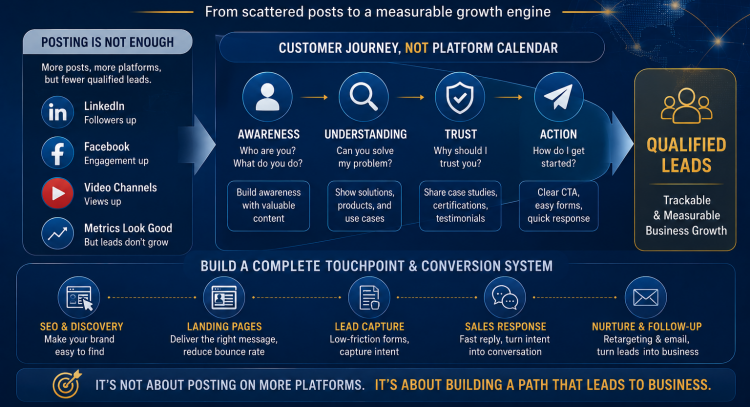
I. Why does “posting by platform” easily cause operations to lose focus?
For many companies, the first steps in overseas social media are “registering accounts” and “creating a posting schedule” – what to post on LinkedIn, what on Facebook, what on video channels, all laid out in a content calendar and executed accordingly.
This approach itself is not wrong. However, if the operating logic is “cover every platform”, three problems often arise:
1. Fragmented content, lack of a clear narrative.
To fill the publishing schedules of each platform, teams produce a large volume of content, but these pieces lack a unified customer‑path logic. LinkedIn gets an industry insight, Facebook gets a company news update, video channels get a product demo – customers see fragmented information across platforms and cannot form a coherent brand perception.
2. Unclear objectives, difficult to measure.
When content is organised by platform, KPIs naturally follow suit: LinkedIn tracks follower growth, Facebook tracks engagement rates, video channels track views. But these metrics combined do not equal acquisition results. Teams work hard and report that “all platform metrics are rising,” yet they cannot explain the relationship between these increases and sales.
3. Broken handover, wasted traffic.
Content generates exposure and clicks, but where do the clicks go? Are leads captured? Who follows up? If these questions are not answered clearly, even more traffic only consumes budget, not generates revenue.
The root of these problems is not that content is insufficient, but that content is organised by “platform” rather than by “customer”.
II. Customers don’t decide by platform – they decide by path
B2B purchase decisions have long cycles and involve multiple stakeholders. No customer decides to partner with you just by browsing LinkedIn, nor does any customer place an order after watching a single video. The customer decision path can be roughly divided into four stages: Awareness → Understanding → Trust → Action.
The value of social content lies in providing the right information at each stage and guiding the customer to the next.
| Customer stage | What the customer is thinking | Social content task | Handover action |
|---|---|---|---|
| Awareness | “Who are you? What do you do?” | Build presence with professional content, make your brand known | Guide to website or case page |
| Understanding | “What problem can you solve for me?” | Demonstrate capabilities with product demos and use‑case content | Offer in‑depth materials (white papers, brochures) |
| Trust | “Is what you say true? Who has used it?” | Build credibility with customer cases and industry endorsements | Open form submission, book a consultation |
| Action | “I’m ready – how do I contact you?” | Drive conversion with clear calls‑to‑action | Quick DM response, sales follow‑up |
This means social media operations should no longer be about “scheduling by platform”, but about building a content layout around the customer journey. The team must know where each post sits in the customer path – whether it is to make new customers aware of you, help those already aware understand your capabilities, or push existing prospects to trust and take action.
Platforms are just tools for reach – the path is the logic for conversion.
III. After reaching, how do you build a closed‑loop handover?
Traffic from social media can only turn into opportunities if it is properly handed over. From the moment a customer clicks on content, to viewing materials, leaving information, sales follow‑up, and entering the opportunity nurturing process – every step must be designed in advance. Otherwise, traffic is just numbers, not revenue. As emphasised in the Emplifi Social Selling Guide, every link from content to conversion needs to be mapped.
Concretely, the closed‑loop handover can be implemented across the following dimensions:
1. Alignment between landing pages and the website
After clicking a social link, customers should land on a dedicated page, not a generic homepage. The landing page content must be highly relevant to the post – what customers see should match the message they just read, reducing cognitive friction.
2. Low‑threshold design for materials and forms
Offer white papers, case studies, or brochures as lead magnets, but keep form fields minimal. Customers are reluctant to fill out lengthy forms – lowering the barrier improves capture rates. Use download gates for valuable content, but limit fields to essential information. See HubSpot Forms for best practices on form optimisation.
3. Rapid response via DMs and sales
Social DMs are high‑intent signals. When a customer reaches out via DM, they are already deep in the decision path. Establish a rapid‑response mechanism to ensure sales follow‑up within 24 hours, preventing leads from going cold.
4. Retargeting and lead nurturing
Not all customers will convert immediately. Use retargeting ads, email sequences, and other tactics to keep in touch with those who have visited but not yet converted, maintaining brand presence until they are ready to buy.
IV. Evolution from “platform operation” to “path growth”
To break free from ineffective busywork, companies must shift social media operations from being “platform‑centric” to “customer‑path‑centric”. This requires evolution across three dimensions: objectives, content, and collaboration.
| Evolution dimension | Starting from “platform operation” | Gradually moving to “path growth” |
|---|---|---|
| Core objective | Chasing follower count, likes, and posting frequency | Chasing lead volume, conversion‑path clarity, and sales satisfaction |
| Content strategy | Distributing the same content across all platforms | Tailoring content to each platform based on the customer‑path stage |
| Handover collaboration | Social team operates independently, sales receives passively | Social and sales collaborate, with rapid response and nurturing mechanisms |
Social media management is not a one‑off project – it is a continuously optimisable growth path. Through systematic management, companies can ensure that every social investment yields trackable leads, rather than disappearing as fleeting impressions.
V. Where does your social media operation stand?
If you are unsure where your team currently stands, use these questions for a quick self‑check:
⬜ Is content scheduled by platform or by customer path?
If the operating logic is “what to post on LinkedIn, what on Facebook”, your content strategy has a break. The right starting point should be “what customers need at the awareness stage, what they need at the understanding stage”.
⬜ Is the handover path clear?
After clicking a social link, can customers find a lead‑capture entry within a short path? If the path is too long, conversion design has a break.
⬜ Is sales response timely?
If a customer leaves an inquiry, is it followed up within 24 hours? If not, the collaboration mechanism has a break.
Any of the above issues affects not only acquisition efficiency, but also the ROI of your social media budget.
Conclusion: Make social media a trackable growth engine
In the second half of going global, competition is not just about exposure – it is about conversion paths.
When a company starts building a customer‑reach system, it no longer posts blindly – it owns a predictable, optimisable acquisition channel. Customers feel not just brand presence, but professional service that is always within reach.
For global‑bound companies, overseas social media is not only a channel for voice, but a critical touchpoint for growth. Landelion can help companies integrate social operations into a runnable, collaborative acquisition system through its target market reach & social growth services – ensuring every touchpoint has the opportunity to enter a trackable, follow‑up‑ready, and optimisable lead‑nurturing chain.
Act now Is your overseas social media only bringing exposure, or has it built a complete reach chain from search, engagement, DM conversations, form submissions, to sales follow‑up?Landelion can help B2B companies identify breaks in social media operations from the perspective of target market reach & social growth – diagnosing whether the issue lies in profile optimisation, engagement strategy, DM handover, or the conversion path. Explore target audience reach & conversion Book an overseas social reach chain diagnosis |