


A marketing team at an industrial equipment company ran an experiment: they fed all their product documentation, customer case studies, and technical materials into an AI tool. Within a week, the tool generated several white paper summaries, dozens of LinkedIn posts, and numerous email drafts. The volume was impressive, but the team lead ultimately selected fewer than five pieces for publication.
This dilemma is becoming the norm for a growing number of B2B companies. AI tools have dramatically lowered the barrier to content production, but the gap between “being able to produce” and “being worth publishing” has not narrowed because of AI.
Analysis by Graphite of publicly available web articles shows that the volume of AI‑generated articles has approached and even briefly surpassed that of human‑written articles. Content production capacity is expanding, but content value and relevance do not automatically improve in tandem.
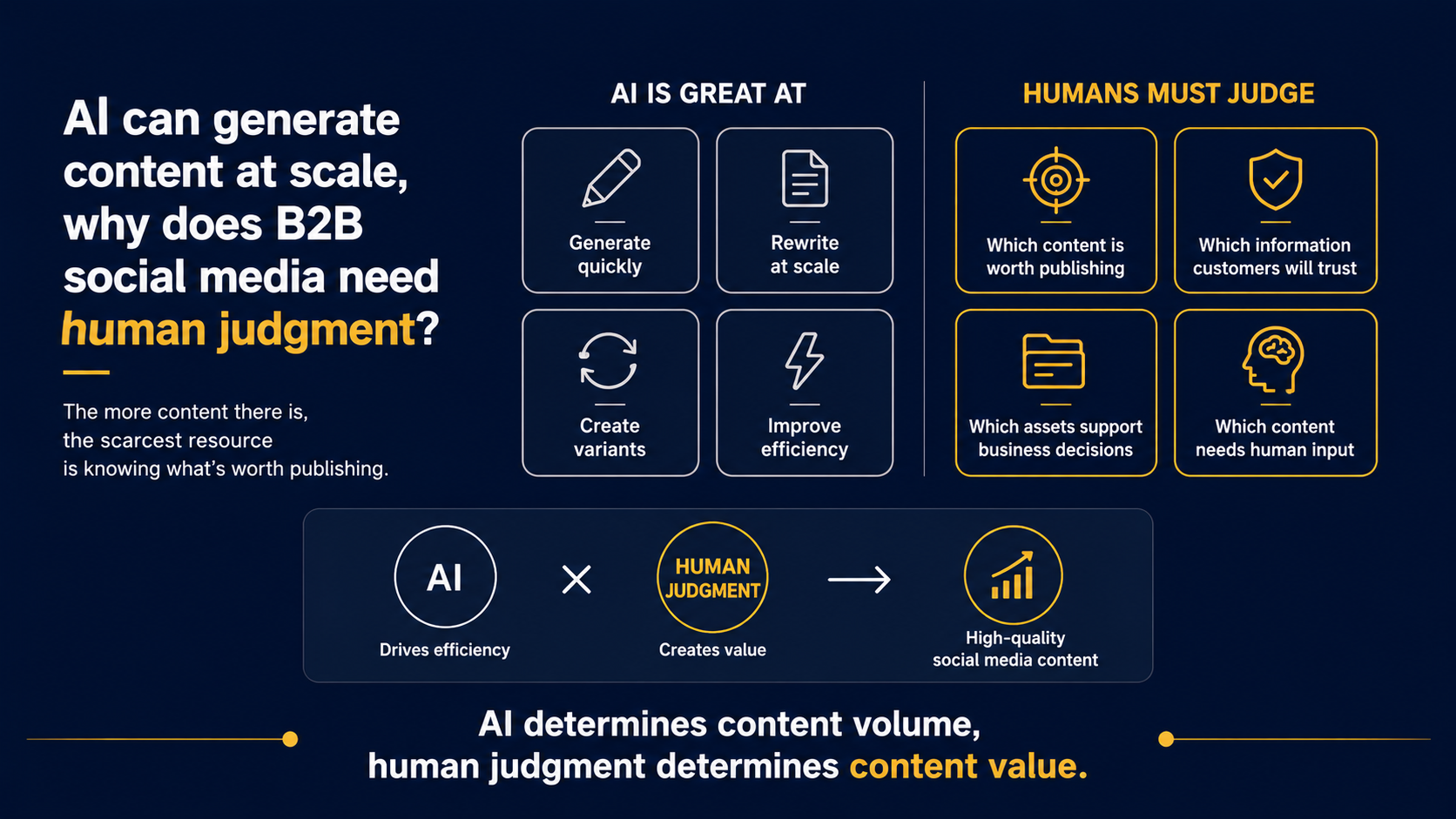
What is truly scarce in B2B overseas social media is not content volume, but professional judgment: which content is worth publishing, what information customers will trust, and which materials can genuinely support business decisions.
I. AI lowers the production barrier, but not the judgment barrier
AI tools address the “how to write” question, but the upfront judgments of “what to write, for whom, and to what depth” still require human input. Mass‑generated content often suffers from three common problems:
Insufficient information density.
AI‑generated content is good at “elaborating on a topic,” but B2B customers need evidence, not exposition. They want to see: who have you served, what problems have you solved, and what verifiable results have you delivered.
Such content cannot rely solely on AI; it must be built on the company’s own real materials. If a company has not organised its case studies, data, and delivery records, AI‑generated content becomes “opinionated but unsupported.”
Homogeneous expression.
AI models are trained on similar data, so their outputs naturally converge in structure and wording. When multiple peers use AI to generate social content, customers will see a flood of “look‑alike” posts. B2B marketing already faces homogeneity, and AI amplifies this risk.
Lack of judgment support.
AI can tell you “this topic is trending,” but it cannot judge whether that topic is important to your target customers. It can generate “three ways to improve efficiency,” but it cannot assess whether your customers currently care more about efficiency or risk. Such judgments require an understanding of customers, industries, and business contexts – information that typically comes from a company’s own market observations, sales feedback, and project experience.
II. Customers are moving from “consuming content” to “validating content”
Another consequence of the AI content deluge is that customers’ trust thresholds are rising. Forrester’s Buyers' Journey Survey 2025 found that 19% of buyers using AI applications feel less confident in their purchasing decisions because of inaccurate or unreliable information provided by AI.
At the same time, customers are turning to more trustworthy sources. A July 2025 LinkedIn study revealed that 77% of B2B marketing leaders say their target audiences no longer rely solely on a company’s owned channels to evaluate the brand; they use social networks to verify it. Globally, 43% of professionals consider their professional network as the primary channel for work‑related advice.
For B2B social media operations, this means customers are shifting from passive reception to active verification. They are not just looking at what the company posts; they also examine whether the content is backed by real business operations, whether claims can be validated by case studies, and whether materials stem from actual delivery experience.
III. In the AI era, B2B social media requires four types of professional judgment
In an age of mass content production, the core competency of B2B social media operations is shifting from content production to content judgment. The following four judgments cannot be fully automated by AI.
Judgment 1: What content is worth publishing – not everything that can be written should be published
AI can generate 20 post ideas in an hour. But which ideas address your target customers’ real concerns? Which topics move customers from “interested” to “want to learn more”? These judgments rely on a deep understanding of the customer decision path.
B2B purchasing involves multiple roles and extended evaluation cycles. Customers at different stages need different information – the awareness stage requires problem definition, the evaluation stage demands solution comparisons and case validation, and the decision stage needs risk control and delivery assurances. If you merely publish a stream of “industry insights” without staging, your content becomes “exposure without progression.”
Judgment 2: What information will customers trust – trust is not built by “saying it”
AI‑generated content is usually grammatically and logically sound, but when B2B customers judge whether information is credible, they don't ask “is it correct?” – they ask “is it substantiated?”
Customers ask: who made this claim? What is the data source? Are there similar cases? What do peers say? These trust factors must be organised based on real business experience. The credibility of social content does not depend on “who posted it,” but on whether the content is backed by verifiable professional judgment.
Judgment 3: Which materials can support business decisions – content must answer specific customer questions
B2B customers consume social content with one ultimate goal: to decide whether this company can solve their problem. If content stays at the level of “industry trends” and “best practices,” customers cannot draw any conclusion about “whether you can help me.”
Content that supports business decisions typically has three characteristics: specific customer scenarios, traceable solution processes, and verifiable result evidence. Accumulating and distilling such materials requires ongoing observation of customer needs and deep understanding of business delivery – which again demands human judgment and refinement.
Judgment 4: Which content needs human intervention – AI for efficiency, humans for judgment
This is not a debate about “whether AI can replace humans” – it is about division of labour.
AI is better suited for standardised, repetitive, low‑risk content production – such as generating multiple post variations from existing materials or quickly producing copy drafts from different angles. However, content involving core brand messaging, specific customer scenarios, or sensitive information requires human judgment and review.
IV. Evolution from “production‑centric” to “judgment‑driven”
| Evolution dimension | Production‑centric | Judgment‑driven |
|---|---|---|
| Content source | Rely on AI to generate generic content in bulk | Organise content based on customer insights and business data |
| Topic selection logic | Chase trends and hot topics | Based on customer decision stage and validation needs |
| Credibility building | Rely on the brand’s own channels | Build verifiable information through cases, data, and third‑party endorsements |
| Human‑AI collaboration | AI produces, humans fine‑tune | AI handles efficiency, humans handle judgment – clear division |
AI makes content production easy, but B2B social media competition has never been about “who posts more” – it is about “whose content better drives customer decisions.” When everyone can produce content at scale, the real differentiator is: who knows more clearly what content is worth publishing, what information customers will trust, and which materials genuinely support business decisions.
V. Where does your social content judgment stand?
If you are unsure of your team’s current state, use these quick self‑check questions:
⬜ Is content topic selection based on customer insights or on “what’s trending now”?
If the logic is “what others are writing about” rather than “what our customers need right now,” topic judgment is broken.
⬜ Does your social content include verifiable business evidence?
Randomly sample the last five posts – do they contain traceable cases, checkable data, or verifiable customer scenarios? If there are only opinions without evidence, credibility building is broken.
⬜ Can your team clearly distinguish what AI can do from what requires human judgment?
In content production, is there a clear standard for which steps are handled by AI and which require human review and judgment? If not, the human‑AI collaboration mechanism is broken.
⬜ Is social content aligned with customer needs at different sales stages?
Is content differentiated by customer stage? If all content targets only the “awareness” stage, the alignment between content and business judgment is broken.
If any of the above issues exist, your social content strategy still needs stronger judgment.
Conclusion: In an era of content abundance, judgment is the new competitive advantage
AI has made content production easier than ever. But precisely because of that, “being able to produce” is no longer a core strength in B2B overseas social media.
When customers are surrounded by homogeneous content, what they truly need is not more information, but more trustworthy evidence. The value of B2B overseas social media lies not in how many posts a company can publish, but in whether each post helps customers judge: does this company understand my problem, does it have real experience, and is it worth exploring further?
Target Audience Reach & Conversion is not just about posting frequency – it is about whether content can achieve effective reach, credible expression, and seamless handover. Landelion can help B2B companies, before launching or optimising overseas social media, clarify customer insights, topic selection logic, asset organisation, and human‑AI collaboration – turning social content into a validation tool for customers to evaluate supplier capabilities, rather than just another piece of noise in the information flood.
Act now Is your overseas social content just AI‑generated generic information, or is it trustworthy content based on customer insights and business judgment?Landelion can help B2B companies examine judgment breaks in their social content strategy from the perspective of Target Audience Reach & Conversion – diagnosing whether the issue lies in customer insights, topic selection, asset organisation, or human‑AI collaboration. Explore Target Audience Reach & Conversion solution Book a social content diagnosis |
📚 Further reading
B2B Social Media Lead Conversion: Why Marketing Leads Fail to Convert into Sales Opportunities
Global Manufacturing Brands: How to Evolve from Website Presence to AI Discoverability