


At many overseas trade shows or international exhibitions held in China, many B2B companies place QR codes at their booths, hoping that visitors will scan them to learn more about products, download materials, or connect with sales.
In practice, however, many QR codes still point only to WeChat official accounts, Chinese‑language pages, or content that requires a specific app to access. For overseas buyers, this is often not a smooth follow‑up path.
Visitors may have already shown interest at the booth and be willing to learn more, but if they encounter language, access, login, or communication barriers after scanning, the follow‑up is easily broken.
Exhibition QR codes should not be just a display item, nor should they be understood merely as “getting customers to follow an account”. They should serve as the entry point for overseas buyers to continue learning about the company, downloading materials, establishing contact, and entering the sales follow‑up process after they leave the booth.
From the perspective of target market reach & social growth, the core value of exhibition QR codes lies not in the number of scans, but in whether they can help the company build a continuous path from offline scanning to online reach, and from content browsing to lead capture.
1. Why do QR codes pointing only to WeChat official accounts lead to loss of overseas leads?
WeChat official accounts can be an important channel for communicating with Chinese customers and for content accumulation. However, in exhibition scenarios targeting overseas buyers, if the QR code only points to a WeChat official account, it can create handover barriers.
1. Different usage habits
Overseas buyers primarily use Email, LinkedIn, WhatsApp, website forms, or meeting booking tools for business communication. WeChat can serve as a communication supplement, but it is not necessarily the default channel for overseas customers to access materials and stay informed about a company.
2. Access and login barriers
If scanning requires redirecting to a specific app, logging in before viewing, or loading unstably under overseas network conditions, customers are likely to drop off at the very first step.
3. Language and content barriers
If the content after scanning is in Chinese, or if the customer must follow the account before viewing materials, they are likely to leave at the first step.
💡 Landelion Insight: The first second of the experience after scanning determines whether the customer continues or leaves immediately.
2. What follow‑up actions do overseas buyers need, and how should you handle them?
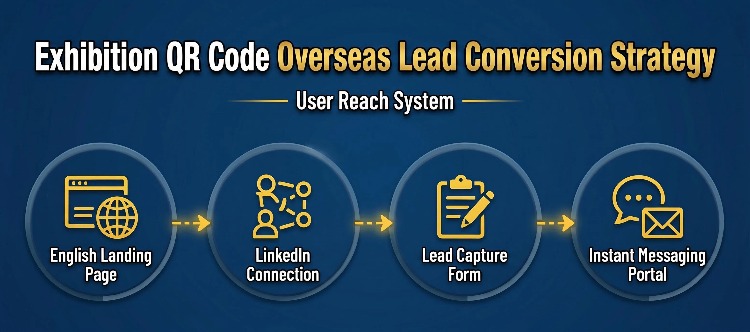
To ensure exhibition leads are not lost, the QR code should point to a “reach system” that aligns with overseas customers’ habits. This requires covering the following four key links, which are the areas we focus on optimising in our target market reach & social growth services.
1. English landing page
Action: Opens directly to an English webpage without requiring login.
Key content: Show‑exclusive offers, core product specs, downloadable brochure.
Value: Lowers access barriers, ensures information is instantly available without downloading extra apps.
2. LinkedIn and sales profile connection
Action: Guides visitors to follow the company’s LinkedIn page or sales team’s personal profiles.
Key content: Latest company updates, industry cases, team introductions.
Value: Builds a long‑term reach channel – customers can keep up with company progress through social feeds. See LinkedIn Business for advice on building a professional presence.
3. Lead capture form
Action: Embeds a simple form on the page (name, company, email, needs).
Key content: Exchange for a white paper, book a demo, request a quote.
Value: Converts anonymous scans into named leads for easier email follow‑up.
4. Direct contact channel
Action: Provides Click‑to‑Email or WhatsApp links.
Key content: “Contact the show specialist”, “Book a post‑show meeting”.
Value: Meets urgent inquiry needs, shortens response time.
💡 Landelion Insight: Effective handover means letting customers leave the most essential information in the way they are most comfortable with.
3. How to build an exhibition handover chain through target market reach & social growth?
Fixing handover breaks requires more than “changing the QR code” – you need a systematic post‑show reach strategy. This involves operating across three dimensions: channels, content, and follow‑up.
| Dimension | Traditional WeChat account model | Target market reach & social growth model | Core value |
|---|---|---|---|
| Channel selection | Closed loop within WeChat ecosystem | Global channels (Web/LinkedIn/Email) | Ensures overseas customers can access without barriers, reducing drop‑off. |
| Content presentation | Chinese images and text, requiring account follow | English landing page, viewable without login | Respects customer habits, improves information access efficiency. |
| Lead follow‑up | Waiting for customers to initiate contact | Proactive email sequences + social connections + sales DMs | Shifts from passive to active, ensuring leads are activated within the golden 24 hours. |
💡 Landelion Insight: The essence of systematic operation is to enable every exhibition lead to enter a trackable reach chain.
4. How to check whether your exhibition QR code truly builds a follow‑up reach chain?
Companies can self‑diagnose the reach system behind their exhibition QR codes by answering three key questions.
1. Can visitors browse without logging in?
Try scanning the QR code in an overseas network environment without logging into WeChat. If content cannot be viewed, there is an access barrier.
2. Is the interface entirely in English?
Check that the landing page, forms, and buttons are all in English. If any Chinese appears, there is a localisation break.
3. Are leads automatically captured?
After a customer submits a form, does it automatically enter the CRM or email marketing system? If manual export‑import is required, follow‑up efficiency is broken.
If any of the above links are broken, the leads generated from the exhibition are likely to become invalid within a week after the show ends.
Conclusion: Turn the QR code into the starting point of your acquisition chain
For B2B companies, exhibition QR codes should not be a passive scanning entry. They should become the starting point for overseas buyers to continue learning about the company, downloading materials, building social connections, and entering sales follow‑up.
Target market reach & social growth solves the handover breaks that occur after exhibitions: helping companies integrate offline booth conversations, English landing pages, LinkedIn connections, form submissions, and sales follow‑up into a trackable, reviewable, and continuously optimisable reach chain.
When overseas buyers can browse smoothly, understand quickly, leave information conveniently, and receive timely follow‑up after scanning, the exhibition leads will not remain as just an on‑site conversation – they will have the opportunity to continue into the subsequent opportunity nurturing process.
Act now Check whether your exhibition QR code truly builds a follow‑up reach chainDoes your exhibition QR code only complete the scan action, or has it formed a complete handover path from English landing page, LinkedIn connection, form submission, to sales follow‑up? Landelion can help B2B companies identify handover breaks in exhibition lead capture – diagnosing whether the problem lies in access entry, language content, form setup, social connections, or the follow‑up process. Explore target audience reach & conversionn Book an exhibition lead handover chain diagnosis |
Note: If on‑site exhibition communication, bilingual materials, terminology consistency, or post‑show follow‑up are involved, you can also combine this with an assessment of multilingual communication & collaboration.