


How can Chinese exhibitors at SNEC help overseas buyers understand, remember, and follow up? A practical guide on content, channels, and on‑site conversion.
At the 19th SNEC Shanghai, we saw a common pattern. Many Chinese solar firms had great booths and proactive sales. Yet the gap in “international readiness” was obvious when overseas visitors walked in. Some had English materials, global social accounts, English websites, and tailored scripts. Follow‑ups were smooth. But others showed clear gaps:
English materials are literal translations with China‑centric logic.
Brochures don’t help buyers grasp value or differentiation.
Sales speak English, but no overseas channels for follow‑up.
WeChat and cards only – no LinkedIn, English sites, or digital toolkits.
For Chinese firms, exhibiting in China with overseas buyers is a global comms moment. The booth is not the end – it’s the entrance.
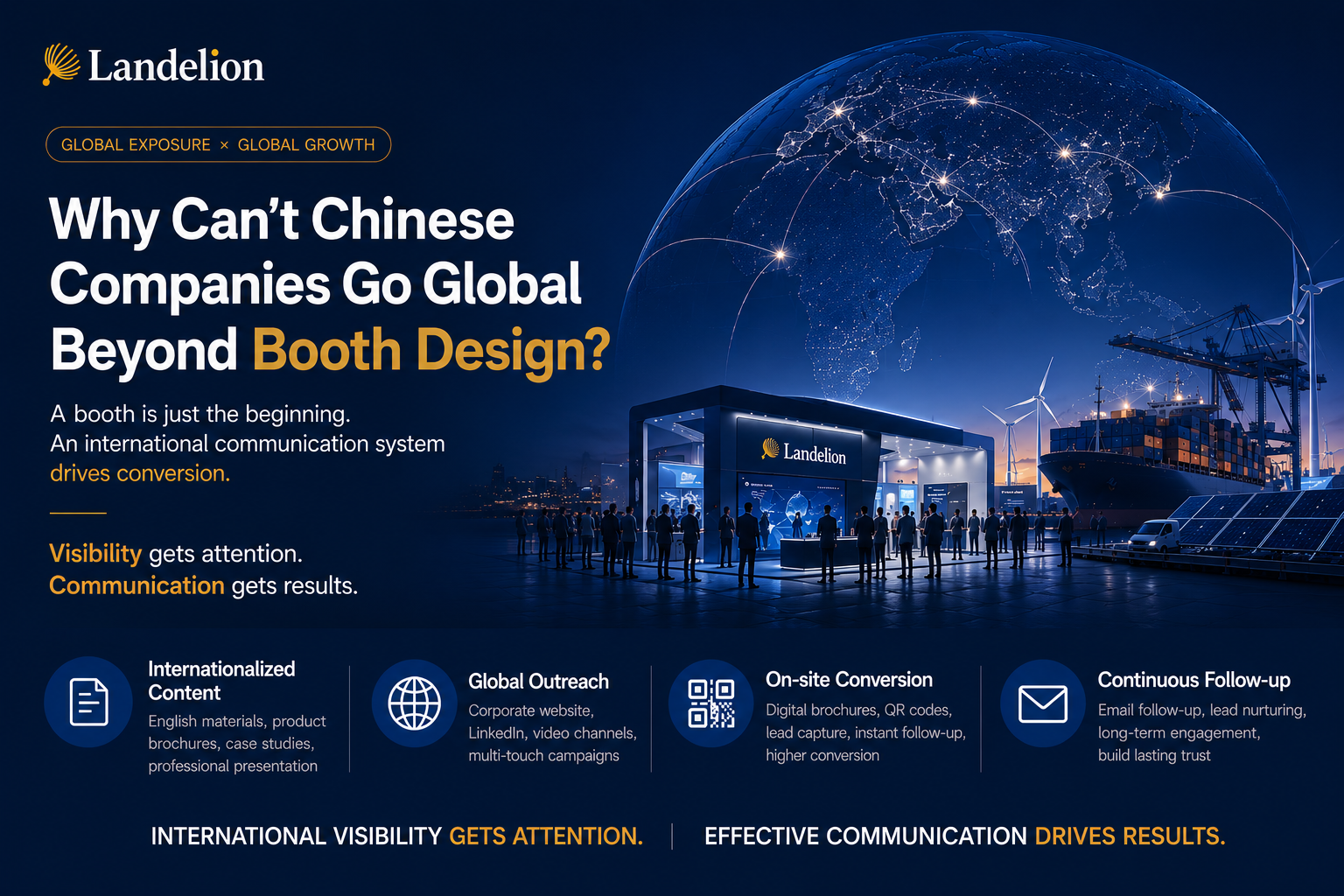
I. Many focus on booth presentation but underestimate international comms readiness
Big booth budgets decide if visitors stop. But real engagement depends on answering three questions quickly:
Who are you? – background, scope, positioning.
What problem do you solve? – value, use cases, benefits.
Why keep learning? – differentiation and decision‑ready info.
International content is not translation. It restructures information for overseas buyers’ logic.
Chinese firms often highlight scale, capacity, specs. Overseas buyers care more about:
Target markets & scenarios
Certifications
Delivery stability
Overseas project experience
After‑sales & local support
Difference from current suppliers
Literal translations bury the key points. That’s the first gap: content exists but isn’t truly internationalised.
II. Facing overseas buyers? You need more than English‑speaking sales
English sales are only the first step. A show interaction is a full acquisition chain.
Overseas buyer journey: see booth → stop → talk → scan QR → post‑show research → internal discussion → meeting request.
Without follow‑up content and overseas reach, conversations stay at “we talked once”.
We recommend three types of preparation:
● Three pillars of a show content & conversion kit
A show is an acquisition system. The real question: can buyers re‑find, re‑understand, and trust you afterwards?
III. Product brochures: not translation, but helping buyers decide
Many English brochures are direct translations – same logic, just different words. Buyers see words but can’t judge fit.
For solar, manufacturing, B2B tech, international materials should:
Explain value behind specs.
Specify scenarios where “efficient/reliable” applies.
Help buyers understand selection logic.
Turn strengths into buyer benefits.
Provide downloadable, shareable digital assets.
A good brochure helps buyers answer: Is this supplier professional? Suitable for my market? Can they deliver long‑term? Should I take it back?
International content is about speed of understanding and trust.
IV. WeChat and cards are not enough – prepare overseas‑preferred connections
Chinese firms rely on WeChat and business cards – great for local customers. Overseas buyers prefer:
LinkedIn
English website
Email
YouTube
PDF toolkits
Online meeting links
Press releases & Google presence
If they can only find you via a card or WeChat, the connection is fragile.
Better: an “international connection kit” – English landing page QR, LinkedIn on cards, digital toolkit, post‑show email templates, social media to carry show traffic.
That’s moving from “handing out cards” to “building a reach system”.
V. The real competition: not products, but communication systems
Chinese companies have strong products, supply chains, and cost control. But at shows, what matters is whether you can articulate value and build trust.
B2B buyers don’t order on the spot. The show’s real value: getting into their supplier consideration set.
Three layers of preparation:
● Three layers: booth → content → conversion
| Layer 01 Booth presentation Design, samples, flow – decides if visitors stop.Will they stop? |
| Layer 02 Content readiness English materials, use cases, FAQ – decides if buyers truly understand you.Do they understand? |
| Layer 03 Conversion readiness QR codes, landing pages, tagging, post‑show emails – decides if they keep finding you.Will they continue? |
View the show as a system test.
🔹If overseas buyers come but can’t understand your value;
🔹If they talk but can’t find a way to keep learning;
🔹If they take materials but can’t articulate your difference internally;
Then most of the show’s traffic is wasted.
VI. Pre‑show checklist for international readiness
Before an international show, review these 10 questions:
10 questions to check before the show A quick audit for overseas buyer readiness.
□ English company profile for overseas buyers? | □ English product brochure with overseas buying logic? |
□ English website or show landing page? | □ Scannable digital toolkit (PDFs)? |
□ LinkedIn company page & sales profiles? | □ Post‑show email template in English? |
□ English case studies / solution guides? | □ Clear articulation of target markets & use cases? |
□ On‑site lead capture & interest tagging? | □ Overseas social / video content to carry show traffic? |
Without these, you’ve done reception – not conversion.
Conclusion: Internationalisation starts when an overseas buyer walks into your booth in China
Many think going global means exhibiting overseas. But the moment an overseas buyer steps into your China booth, global communication has begun.
They judge your professionalism, content, responsiveness, and understanding of overseas markets.
Don’t just ask: Is the booth beautiful? Products complete? English clear?
Also ask: Can overseas buyers quickly understand us? Can they find us afterwards? Does our content support internal reporting? Can we turn one chat into an ongoing relationship?
Going global today is about exporting content, communication, and trust systems. The show is just the entrance. Success depends on your ability to be seen, understood, trusted, and chosen – consistently.
Next step Exhibiting at an international show with overseas buyers?If you're preparing English materials, landing pages, digital toolkits, or post‑show follow‑up, start with a readiness assessment. Request a custom plan Add WeChat for business | ||
| Content system building Organise English materials, brochures, website content, and digital toolkits for the show. Learn more → | Multilingual communication & coordination Support for on‑site, meetings, and post‑show multilingual communication. Learn more → | Target audience reach & conversion Leverage LinkedIn, English sites, social media, and toolkits to capture show traffic. Learn more → |