


For the past two decades, Chinese manufacturing has integrated deeply into global supply chains through scale, efficiency, and cost competitiveness. Yet this achievement has also shaped an unavoidable stereotype: low price, no brand, easily replaceable.
Today, many Chinese manufacturers operate with world-class automation, lean production, and globally certified quality systems. Their products often match or exceed international benchmarks. And yet—when they enter overseas markets—they still find themselves stuck in price wars. Not because their technology is inferior, but because global buyers are unaware of their true capabilities and long-term value.
The core issue is not product performance—it is communication.
When a European or Middle Eastern buyer searches for a Chinese supplier on LinkedIn and finds only a three-year-old company introduction, blurry trade-show photos, or factory footage without context, they struggle to believe this vendor deserves a price premium. The real barrier is not competence, but a trust deficit in the global branding journey of Chinese manufacturing.
I. Overseas Social Media: The New Trust Infrastructure for Chinese Manufacturing
Unlike traditional export channels—trade shows, cold emails, or intermediaries—overseas social media provides a decentralized, high-transparency communication environment. Here, the flow of information has fundamentally shifted: It is no longer the company “pushing” messages. It is global buyers actively verifying credibility.
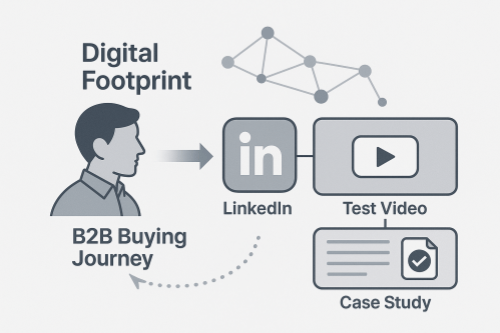
Recent B2B research shows: Most B2B buyers (88%) want to hear from vendors when researching and evaluating their options; and 44% of B2B professionals ranked it the most important social media platform. Engineers replay test videos to evaluate durability. Procurement directors read expert posts to judge delivery reliability. End customers follow sustainability stories to evaluate alignment. These touchpoints collectively reveal an industry truth: B2B purchasing decisions increasingly rely on visible and verifiable digital footprints.
Social media is not a game of likes—it is a system for accumulating trust assets. One video documenting an actual line-commissioning process conveys more credibility than a ten-page spec sheet. One technical essay written by a chief engineer builds more authority than thousands of dollars in display ads.
Overseas social media transforms abstract technical capability into concrete trust signals, enabling Chinese manufacturers to justify brand premium in global markets.
II. From Content to Systems: Building a Repeatable Global Brand Narrative
To unlock this value, manufacturers must move beyond sporadic posting toward a structured, repeatable, and sustainable content system.
1. Move beyond "translated marketing" to true localization
Literal translations often produce awkward messaging—such as “high-quality, low-price”—that contradicts premium positioning.
True localization means reframing value based on the industrial logic of each target market:
🔹Europe: compliance, certifications, carbon footprint
🔹Middle East: high-temperature reliability, grid stability
🔹Latin America: ROI cycle, uptime improvement, serviceability
Localization is not translation—it is contextual transformation.
2. Focus on solving customer problems, not listing parameters
Overseas buyers do not care how many patents you have. They care: “Can your equipment improve my OEE by 20%?”
High-performing content centers on real operational scenarios:
🔹Full visibility into certification processes (CE, UL, TÜV)
🔹Before/after comparisons of production-line efficiency
🔹On-site commissioning diaries and troubleshooting logs
🔹Real customer ROI data and factory interviews
These materials do more than prove competence—they communicate confidence: “We are transparent because our technology withstands scrutiny.”
3. Activate the “human dimension” to build expert authority
On LinkedIn and YouTube, people trust experts, not logos. The most influential voices are CTOs, chief engineers, and solution architects. Technical leaders are encouraged to: share insights on industry trends, comment on regulatory changes, participate in expert discussions, helps position the company as a credible, conversational, and technically authoritative partner—not a faceless supplier. B2B social media is fundamentally about long-term relationship building, not short-term exposure.
4. Build a closed-loop system connecting content → leads → conversion
A powerful video or article should never fall into a one-off content graveyard. It must be embedded into a conversion-oriented ecosystem:
🔹Add white-paper download links to YouTube descriptions
🔹Include “Book a technical consultation” CTAs in LinkedIn posts
🔹Route inbound leads directly into CRM
🔹Ensure 24–48h follow-up by regional sales teams
Only with this closed loop can social media evolve from a cost center into a growth engine for overseas business.
III. How Landelion Helps Chinese Manufacturers Build Global Brand Equity
Landelion supports high-end equipment, industrial automation, and advanced materials companies in navigating the shift from OEM mindsets to global brand-building systems. We provide an end-to-end framework that integrates strategy, content, and growth operations:
🔹Value Proposition Localization
Through executive interviews and competitor benchmarking, we extract differentiated value messages tailored to the U.S., Europe, Middle East, and Southeast Asia.
🔹Multi-language Content Engine
Professional English, German, Spanish, Arabic, and more—ensuring locally fluent and industry-correct communication.
🔹Full-funnel LinkedIn & YouTube Management
Content calendars, expert interviews, visual production, analytics, and campaign optimization.
🔹Executive Branding
Developing the thought-leadership voice of CEOs and CTOs in global markets.
🔹Lead Conversion Framework
Designing workflows that link content performance to real commercial outcomes.
We have helped numerous Chinese manufacturers significantly grow overseas organic traffic, increase high-quality LinkedIn inquiries, and shorten decision cycles across key B2B markets.
Conclusion: Brand Premium Begins with Visible Professionalism
Chinese manufacturing has long moved beyond low-cost OEM. But for the world to recognize this shift, slogans are not enough. Continuous, professional, transparent digital presence is the new competitive advantage.
When your engineering stories appear in the feeds of overseas decision-makers, when your solutions are cited by industry media, when your experts shape technical conversations—brand premium becomes not an aspiration, but an inevitability.
📩 Ready to elevate your global brand beyond “OEM identity”?
Contact Landelion to build a scalable, credible, and globally recognized brand system—from strategy to content to execution.
📚 Further Reading
Why Localization Must Come Before Ads | Manufacturing SEO Guide