


The criteria overseas customers use to evaluate suppliers are changing. In the past, sufficient production capacity, stable delivery, and comprehensive certifications were the basic thresholds for entering a customer's consideration. Today, these remain necessary conditions – but they are no longer sufficient.
B2B purchasing decisions are becoming more complex and more front-loaded. According to the 2026 LinkedIn Ads Benchmark Report released by Dreamdata, which analysed thousands of B2B companies, the B2B customer journey has extended from 211 days to 272 days. AI tools and third-party information channels are also influencing how overseas B2B buyers discover, research, and validate suppliers. Customers now complete most of their evaluation and screening before ever contacting sales. If company content still stops at showcasing production capacity, delivery, and certifications, it risks being filtered out during the customer's first round of screening.
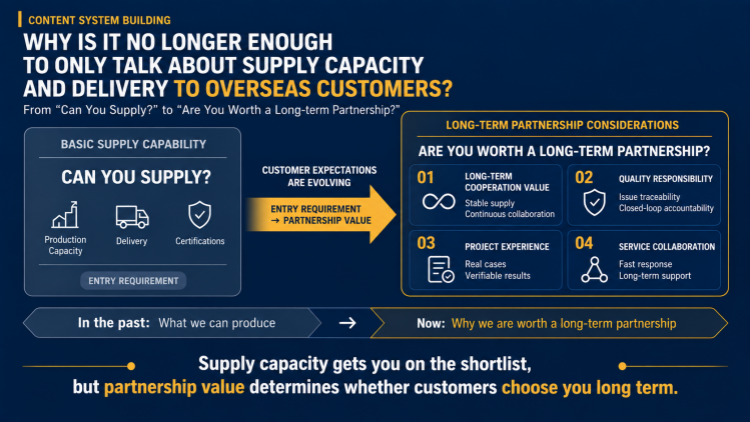
I. What are customers evaluating? More than just “can you do it”
As procurement cycles lengthen and decision-making groups expand, the dimensions customers use to evaluate suppliers have undergone structural change.
1. Quality accountability
Customers care less about “do you have a quality inspection report” and more about “who takes responsibility when something goes wrong, and how is it resolved.” The full chain of quality accountability includes: how quality anomalies are detected in time, how problematic batches are precisely traced, how responsibility is assigned, and how corrective actions are implemented and closed. Customers need to see a traceable, accountable quality management system – not just a test report.
2. Project experience
Customers need to see whether the company has relevant project experience, what types of clients it has served, and whether project outcomes are verifiable. Brands validated by professional communities or peers are more likely to be considered by younger buyers. Verifiable project experience is becoming a key credential for making it onto the shortlist.
3. Long‑term partnership value
International buyers are placing increasing importance on a company's production stability, on‑time delivery rate, and willingness to engage in long‑term partnerships. B2B procurement has become an increasingly distributed, multi‑channel, and consensus‑driven process. Capacity data can only demonstrate supply capability; long‑term partnership value also depends on delivery stability, issue responsiveness, and ongoing collaboration capabilities.
4. Trustworthy evidence
The 2025 B2B Thought Leadership Impact Report, jointly released by Edelman and LinkedIn, shows that over 40% of B2B deals stall because the buying group cannot reach internal consensus. For customers, trust is shifting from “what the company says about itself” to “verifiable evidence.”
II. Why does content still stay at the level of “we can supply”?
Customers' standards have changed, but many companies' content has not kept pace.
1. Content is product‑centric rather than partnership‑centric
Product brochures write about parameters, features, and specifications; exhibition materials showcase production lines, equipment, and capacity. What customers need to evaluate is not just what the company can produce, but whether the partnership process is stable, transparent, and controllable. The gap between these two determines whether content can enter the customer's evaluation framework.
2. Trust evidence stops at “we have certifications”
ISO, CE, and industry licenses remain necessary, but they are entry requirements, not differentiators. Customers also need to see the actual operating mechanism behind the certifications: how the quality system works in real projects, and how quality issues are handled when they arise.
3. Content lacks verifiable details
“We have served leading industry clients” is a statement, but “a top‑five global manufacturer has been a repeat customer for three consecutive years” is a verifiable signal. In early‑stage research – especially in AI‑driven early research – customers rely on information that is searchable and verifiable.
III. What does content need to add?
To align content with customers' current decision‑making logic, companies need to supplement their existing content with four dimensions of information:
1. Long‑term partnership value
Extend from “we can supply” to “how we ensure long‑term, stable supply” – capacity flexibility, supply chain redundancy, and contingency plans. This information shows customers not just current delivery capability, but the reliability of future, ongoing partnership.
2. A complete quality accountability chain
Extend from “we have quality control” to “how quality issues are detected, traced, and resolved” – a traceable quality accountability system. Customers need to see that when problems occur, the company has mechanisms to detect them, systems to trace them, and processes to resolve them.
3. Verifiability of project experience
Extend from “what projects we have done” to “whose project this was, what problem it solved, and how the outcome was verified.” Customers will fact‑check this information during early‑stage research. If content cannot withstand scrutiny, it will actually damage trust.
4. Specific service collaboration methods
Extend from “we have after‑sales service” to “how we collaborate during project execution, how we respond to issues, and how we communicate in long‑term partnerships.” What customers judge is not “do you have service,” but “is it smooth to work with you.”
IV. Upgrading capability presentation through content system building
| Dimension | If content stays at “we can supply” | If content presents “long‑term partnership value” |
|---|---|---|
| Capacity information | Displaying maximum capacity and equipment list | Displaying capacity flexibility, supply chain redundancy, and contingency capabilities |
| Quality information | Listing certifications and test reports | Displaying quality accountability chain and traceability mechanisms |
| Project information | Listing client names and project types | Displaying verifiable project details and client feedback |
| Service information | Describing after‑sales service and warranty policies | Displaying collaboration mechanisms and long‑term partnership cases |
Content is not a static archive – it is the basis for customer evaluation. When customers' evaluation criteria shift from “can they supply” to “are they worth partnering with long‑term,” content needs to be upgraded accordingly – not by starting over, but by supplementing existing content with the information customers now most need to verify.
V. Does your content match customers' current evaluation criteria?
If you are unsure about your team's current state, use these quick self‑check questions:
⬜ Can customers tell from your content “what it's like to partner with you long‑term”?
Pick a company introduction or product brochure sent to overseas customers at random – after reading it, can the customer clearly describe “how this company ensures stable delivery, issue response, and collaboration efficiency in a long‑term partnership”? If they can only see capacity and parameters, content is stuck at the “we can supply” level.
⬜ Is the quality information in your content traceable?
Does the quality system, certifications, and testing mentioned in the materials explain “how issues are traced and resolved when something goes wrong”? If there is only a list of certifications without an accountability chain, quality information lacks verifiability.
⬜ Does your project experience include verifiable details?
Do your case studies include verifiable client information, project background, and outcome data? If they only contain vague statements like “served clients in a certain industry,” project experience lacks verifiability.
Conclusion: Customers' standards have changed – content must change too
B2B purchasing decisions are becoming more complex, more front‑loaded, and more diverse. Customers no longer just look at “can you supply” – they want to see “are you worth a long‑term partnership” – how quality accountability is handled, whether project experience is verifiable, and whether long‑term collaboration runs smoothly.
If content still stops at capacity, delivery, and certifications, it may not even make it onto the customer's shortlist. Content System Building addresses precisely this upgrade – from “showcasing supply capability” to “presenting long‑term partnership value.”
Act now Does your overseas market content still showcase “supply capability,” or has it evolved to present “worth partnering with long‑term”?Landelion can help B2B companies examine the decision‑fit of their overseas market content from the perspective of Content System Building – diagnosing whether the issue lies in presenting long‑term partnership value, quality accountability, project experience, or service collaboration. Explore Content System Building solution Book an overseas supplier content diagnosis |
📚 Further reading
How Should B2B Product Content Evolve as Customer Buying Reasons Change?
Why B2B Tech Showcase Fails to Deliver Value
Why Can't Customers Quickly Decide If Your Company Is Right for Them?