


B2B Social Media Marketing Services: Why Posting Volume Doesn’t Drive Leads
Release date:2026-04-29
When evaluating global social media marketing services, one of the most common questions procurement leaders ask is: "How many posts can you guarantee per month?"
It's a straightforward question—easy to quantify and compare across vendors. But it also carries a significant risk: equating service value with content output volume.
If procurement focuses solely on posting frequency, what companies receive is content production—not lead generation. When accounts produce a large volume of content but fail to generate inquiries, businesses often conclude that "social media doesn't work," overlooking a critical issue: the evaluation model itself may have been flawed from the start.
The value of global social media services is not how much content is published, but whether that content contributes to a scalable lead generation system.
1. Why "Post Volume" Is a Misleading Procurement Metric
(1) Activity Without Direction
To meet monthly posting KPIs, vendors may produce large amounts of low-value content (e.g., holiday greetings, generic industry news). The account appears active, but the content lacks relevance to customer decision-making.
Result: Visibility increases, but target customers remain disengaged.
(2) Content Without Conversion
Content is published, but no lead capture mechanism is in place. For example, posts link only to the homepage, with no tracking parameters or conversion triggers.
Result: Traffic arrives, but sources are unclear, sales cannot follow up, and leads are lost.
(3) Data Without Optimization
At the end of the month, reports show how many posts were published and how many likes were received—but provide no actionable insights.
Result: The same mistakes are repeated, and marketing efficiency stagnates.
💡 Landelion Insight:
Buying "post volume" means paying for labor. Buying a "lead generation system" means investing in growth.
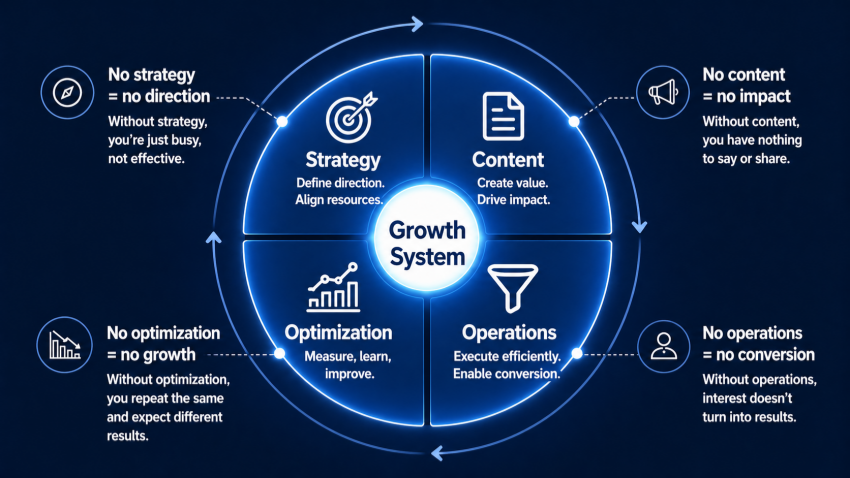
2. The Four-Layer Value Model That Drives Lead Generation
Why do some companies generate real inquiries through social media, while others only generate noise? The difference lies in whether a complete four-layer value model is in place. This model is not just a breakdown of services—it is also a framework for evaluating vendors.
(1) Strategy Layer: Determines Whether Content Is Relevant
Key question: Is the content based on generic templates—or your specific growth stage?
Value logic: Effective services begin with strategic planning. For example, early-stage market entry focuses on trust-building, while mature stages emphasize case validation.
Risk if missing: Content becomes directionless. The more you post, the further you drift from business goals.
Evaluation tip: Ask vendors how they define content themes and whether they adapt strategies based on your expansion stage.
(2) Content Layer: Determines Whether Customers Understand
Key question: Does the content resemble corporate marketing—or a decision-making tool?
Value logic: Content should be structured from the customer's perspective, focusing on solutions and validated outcomes.
Risk if missing: Content becomes self-referential. Customers cannot see value and therefore do not engage.
Evaluation tip: Review case studies—do they emphasize product specs or customer problems?
(3) Operations Layer: Determines Whether Leads Are Captured
Key question: Is the process just mechanical posting—or does it include engagement and lead handling?
Value logic: This layer includes account management, audience interaction, and initial lead qualification. It may also involve cross-regional collaboration to ensure responsiveness and compliance.
Risk if missing: Traffic remains transient. Without engagement and capture mechanisms, leads are lost.
Evaluation tip: Ask how interactions are managed and how leads are filtered and categorized.
(4) Optimization Layer: Determines Whether Investment Improves Over Time
Key question: Does the service only report data—or provide actionable optimization?
Value logic: Data should inform strategy adjustments—identifying high-conversion content and high-performing channels.
Risk if missing: Budget becomes consumption rather than investment. Without iteration, performance stagnates.
Evaluation tip: Review reporting samples—do they include recommendations or just metrics?
💡 Landelion Insight:
All four layers are essential. Without strategy, efforts are blind; without content, ineffective; without operations, leads are lost; without optimization, growth stalls.
3. How to Evaluate Service Providers Effectively
Using this framework, companies can quickly distinguish between execution-based vendors and system-based partners by asking three key questions:
(1) How do you ensure content direction stays aligned with business goals?
Execution-based answer: "We follow standard industry practices."
System-based answer: "We develop a strategy aligned with your business objectives and adjust quarterly."
(2) How are leads managed after content is published?
Execution-based answer: "We include a website link."
System-based answer: "We design conversion pathways, implement tracking, and assist with lead categorization."
(3) How do you optimize performance when results are not ideal?
Execution-based answer: "We'll try posting more."
System-based answer: "We analyze data and adjust content and channel strategies accordingly."
💡 Landelion Insight:
The way a provider answers these questions directly impacts your future lead generation efficiency.
4. Additional Considerations: Execution Capability & Compliance
Beyond the four-layer model, companies should evaluate operational reliability and compliance—both critical for global execution.
(1) Speed of Deployment
Professional teams should be able to launch quickly—typically within 7 working days for initial content and within 15 days for a full multi-platform setup.
(2) Cross-Border Collaboration
Global social media involves time zones, cultural nuances, and financial systems. Vendors must demonstrate stable cross-border coordination capabilities.
(3) Ownership of Assets
All content, design files, and data reports should belong to the company. Upon completion, assets must be fully transferred for future reuse.
Conclusion: You Are Buying a System—Not Output
The ultimate goal of global social media marketing is not to fill a content calendar, but to build a system that consistently generates leads.
When selecting a service provider, companies should look beyond posting volume and evaluate whether a complete four-layer value model is in place.
At Landelion, the focus is not just on publishing content—but on integrating social media into a structured, scalable, and optimizable lead generation system.
Take Action: Evaluate Your Current Model
Is your social media service still measured by post volume?
Landelion offers a structured evaluation for B2B global social media marketing—assessing your current approach across strategy, content, operations, and optimization. We help identify missing links and establish a more effective procurement model.
🚀 Social Media Service Model Diagnosis
Submit your materials or book a consultation to transform your social media from content output into a true growth engine.
📚 Further Reading
B2B Manufacturing Social Media Strategy: From “Notice Board” to Lead Generation Tool
B2B Social Media Lead Validation: How to Turn Exposure into Qualified Leads
Contact us
Tel:+86 400 097 8816
E-mail:marketing@landelion.com
Products