


As global technology competition intensifies, Chinese high-tech companies—including those in semiconductors, AI, industrial software, and SaaS—are accelerating expansion into Europe, Southeast Asia, and the Middle East. At the same time, the effectiveness of traditional advertising and trade-show-centric strategies is declining. In contrast, trust-driven B2B influence marketing, particularly through KOLs (Key Opinion Leaders) and KOCs (Key Opinion Consumers), is emerging as a highly cost-effective breakthrough strategy.
In today’s B2B buying journey, decision-makers no longer rely solely on vendor websites. Gartner’s research on the B2B buying journey highlights that third-party interactions — such as reading customer references or consulting external experts — help buyers affirm value throughout their purchase process. Influencer Marketing Hub notes that in B2B marketing, working with industry thought leaders and expert influencers can build credibility and trust more effectively than relying on brand messaging alone, because these experts act as trusted advisors within their niche.
For Chinese high-tech companies going global, blindly chasing “influencer scale” often leads to wasted budgets. This guide systematically explains the core logic, collaboration models, and common pitfalls of KOL/KOC marketing in high-tech B2B scenarios, helping companies convert influence into real sales leads rather than vanity exposure.
I. Why High-Tech B2B Brands Must Leverage KOLs and KOCs
In B2B high-tech markets, the value of KOLs and KOCs goes far beyond visibility. Their role is to address three fundamental challenges: trust, education, and precise reach.
1. Opening the “Black Box” of Complex Technology
Products such as EDA tools, edge-AI chips, and industrial IoT platforms are difficult to explain through advertising alone. Industry-experienced KOLs can translate abstract technology into tangible solutions through product reviews, case breakdowns, and live demonstrations. According to a GRIN blog on B2B influencer marketing, partnering with industry thought leaders and experts can enhance credibility, expand reach, increase brand awareness, and generate quality leads — demonstrating the potential of influencer strategies in technical B2B markets.
2. Establishing Credible Third-Party Validation
B2B procurement is highly rational, and buyers are naturally skeptical of vendor self-promotion. Independent analysts, former engineers, and technically active community contributors (KOCs) provide real-world perspectives that carry far greater credibility.
3. Precisely Reaching Niche Decision-Making Circles
Unlike mass-market influencers, vertical KOLs and KOCs are deeply embedded in specific technical communities—such as GitHub, Stack Overflow, and LinkedIn professional groups—allowing brands to efficiently reach CTOs, system architects, and procurement committees.
II. High-Tech B2B KOL/KOC Collaboration Strategy: Building an “Influence Pyramid”
Strategy 1: Layered Influence Pyramid for Maximum ROI
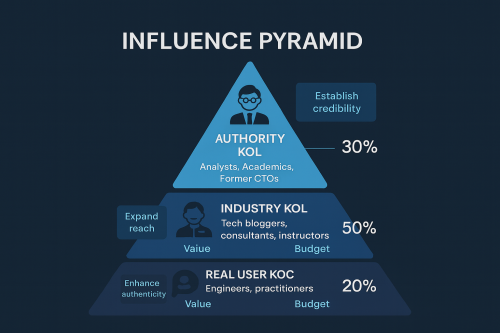
Rather than focusing only on top-tier influencers, we recommend a three-layer structure to optimize return on investment:
Layer | Type | Characteristics | Collaboration Formats | Suggested Budget Share |
Top | Industry Authority KOLs | Analysts (e.g., Gartner), academicians, former Big Tech CTOs | Co-authored white papers, roundtables, bylined articles | 30% |
Middle | Vertical Domain KOLs | Tech bloggers, open-source maintainers, certified trainers | Product reviews, tutorials, livestreams | 50% |
Base | User-Level KOCs | Overseas engineers who have deployed the product | Testimonials, case interviews, community sharing | 20% |
Advantage:
Top-tier voices establish authority, mid-tier creators expand reach, and grassroots users add authenticity—forming a complete trust chain.
Strategy 2: Prioritize Co-Creation Over Endorsement
B2B influence marketing should not focus on post volume alone. Brands should enable KOLs and KOCs to co-create content based on real usage or deep technical understanding by providing:
🔹Test environments or sandbox accounts
🔹Access to technical documentation (with sensitive data removed)
🔹One-on-one sessions with engineers
🔹Jointly designed demo scenarios
Result:
Higher technical depth, stronger credibility, and content that is more likely to be saved, shared, and referenced—creating long-tail impact.
Strategy 3: Localize by Market, Not by Translation
Different regions prioritize different values. “Translation-only” campaigns often fail:
Europe & North America: Emphasize openness, performance benchmarks, and community contribution
Southeast Asia: Highlight cost efficiency, local support, and proven success cases
Japan: Focus on compliance, long-term stability, and documentation rigor
III. Five Common Pitfalls in High-Tech KOL/KOC Campaigns—and How to Avoid Them
Pitfall 1: Focusing Only on Follower Count
Case: An AI company partnered with a million-follower tech influencer whose audience was largely consumer-focused, resulting in zero B2B leads.
Solution: Request audience demographics (roles, industries, regions). Prioritize niche KOLs with <100k followers but >5% engagement.
Pitfall 2: Ignoring Compliance and Conflict-of-Interest Risks
Case: A semiconductor KOL previously worked for a competitor, leading to legal disputes.
Solution: Clearly define disclosure obligations and non-compete clauses in contracts.
Pitfall 3: Vague KPIs
Case: Inability to distinguish brand awareness from lead generation.
Solution: Set KPIs by funnel stage—engagement and citations for awareness; tracked links and form submissions for conversion.
Pitfall 4: One-Off Collaborations Without Long-Term Nurturing
Case: Shallow content due to limited product understanding.
Solution: Establish a KOL development program with roadmap updates and beta access.
Pitfall 5: Overlooking Content Rights and Reuse
Case: High-quality review videos could not be reused on the website or in sales materials.
Solution: Explicitly secure redistribution rights, including website use and multilingual adaptation.
IV. Take Action: Free High-Tech KOL/KOC Collaboration Toolkit
To help high-tech companies systematize influence marketing, the Landelion team has created the High-Tech KOL/KOC Collaboration Checklist, including:
🔹KOL/KOC evaluation matrix (technical background, audience fit, compliance risks)
🔹Key contract clauses (IP rights, non-compete, disclosure)
🔹Content co-creation workflow templates
🔹Regional KPI benchmarks (Europe/North America, Southeast Asia, Middle East)
📥How to access:
Follow our official WeChat account “Landelion Marketing – Global Expansion” and reply “KOL” to receive the full PDF.
Conclusion: Influence Is Not Traffic—It Is a Trust Asset
In global high-tech B2B expansion, KOL/KOC marketing is not about buying exposure—it is about using credible voices to communicate real expertise.
Through layered influence design, deep co-creation, and localized execution, even modest budgets can build a scalable, measurable, and reusable global influence matrix—where every collaboration strengthens brand trust.
👉Need a customized KOL strategy or regional influencer resources?
Contact us to get started.