


In conversations with companies expanding internationally, we often observe a familiar lifecycle: a social media project starts with strong enthusiasm and dedicated staff, gradually shifts into part-time management after six months, and eventually falls silent after a year, with only occasional updates.
In many cases, companies initially assign a dedicated person to manage overseas social media. But once trade shows, client projects, or quarterly business targets begin piling up, social media quickly becomes something handled"when there's time."
During post-project reviews, companies often blame the issue on"poor strategy"or"weak content."Yet the deeper problem is usually this: the company doesn't necessarily lack knowledge of what to do—it lacks the organizational ability to keep doing the right things consistently.
Global social media marketing is a marathon, not a sprint. Recent B2B content research shows that high-performing teams prioritize content relevance and quality rather than simply increasing publishing volume. Sustainable overseas social media requires consistent content production, ongoing audience engagement, and continuous strategic optimization. Without a stable organizational structure to support these long-term activities, project stagnation becomes inevitable.
The real challenge of global social media is not strategic complexity—it is organizational sustainability.
I. Why Many Companies Initially Believe"We Can Handle It Internally"
At the beginning of a project, companies often prefer building internal teams. From a cost and control perspective, this decision appears rational. The real problems usually emerge not during launch, but during long-term execution.
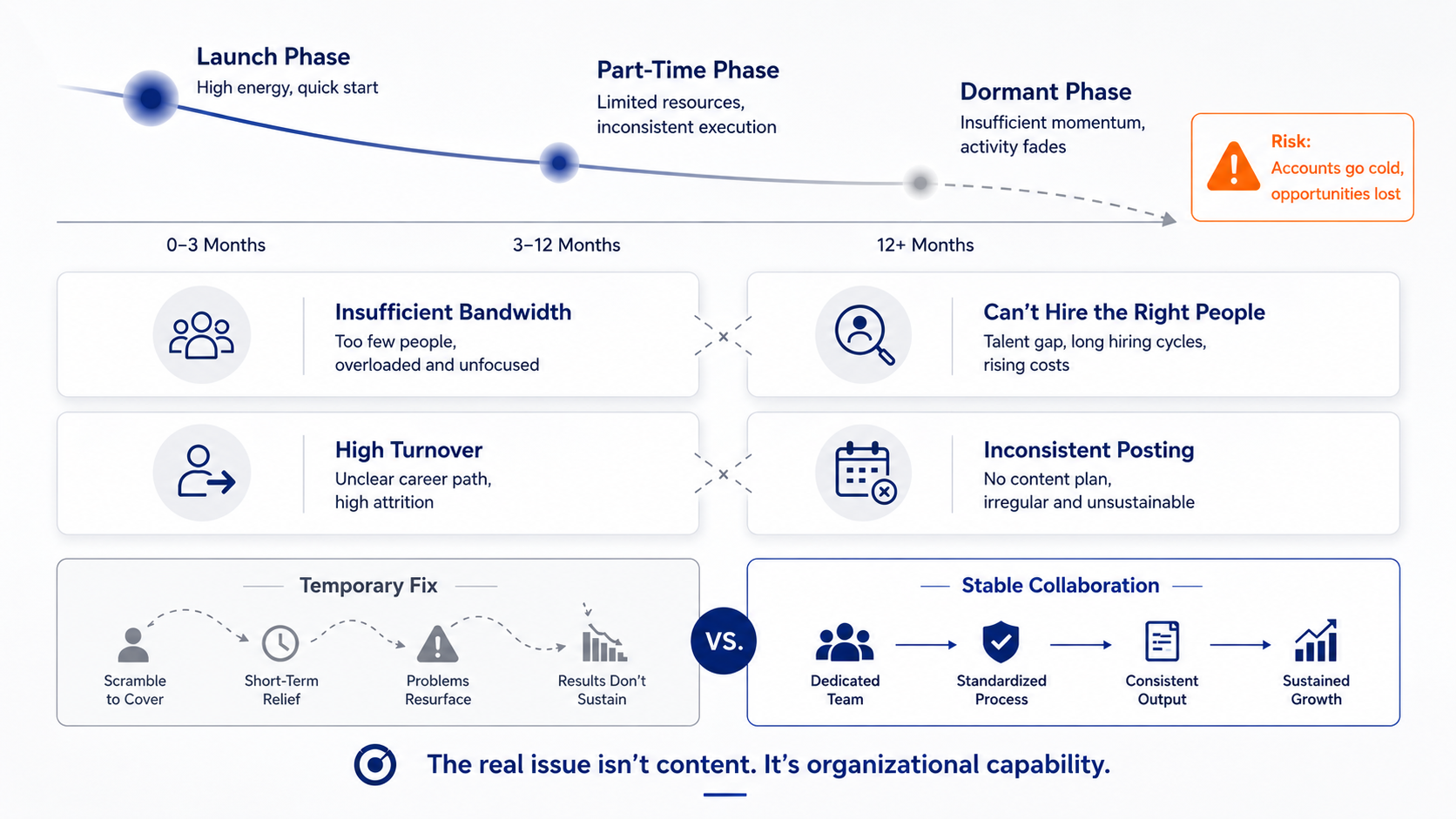
The Organizational Gaps Behind Unsustainable Global Social Media Operations for B2B Companies
1. The Illusion of Cost Control
Compared with outsourcing, fixed internal salaries appear easier to control. However, companies often underestimate hidden costs such as hiring, training, management overhead, and trial-and-error expenses.
2. Confidence in Product Knowledge
"No one understands our products better than we do." Many companies believe internal employees can communicate technical advantages more accurately and avoid misunderstandings from external teams.
3. Expectations of Faster Response
Internal communication appears more direct, allowing immediate adjustments without external coordination processes.
These assumptions may hold true in the short term. But as projects move into long-term operation, challenges related to talent scarcity, workload saturation, and specialized expertise begin to emerge—gradually weakening the original logic behind the decision.
💡 Landelion Insight: Launching depends on determination; sustaining depends on capability. Initial cost advantages are often offset by long-term efficiency losses.
II. The Four Most Common Organizational Capability Gaps
Based on Landelion's project experience, most overseas social media failures are not caused by strategy itself, but by four recurring organizational gaps.
1. Insufficient Internal Resources: Teams Become Overloaded
Global social media management is often assigned to marketing managers as an additional responsibility—or delegated to junior staff members. As a result, social media becomes something managed with"leftover energy."
Consequence: Inconsistent posting schedules, delayed responses, and constantly deprioritized projects.
2. Difficulty Hiring the Right Talent
Qualified global social media professionals must understand English, marketing, industry context, and platform algorithms simultaneously. Such hybrid talent is both rare and expensive.
Consequence: Long hiring cycles, difficulty finalizing candidates, or compromised hiring standards that weaken execution from the start.
3. Difficulty Retaining Specialized Talent
Social media roles often face career ceiling issues. Without clear growth paths or incentive structures, experienced talent tends to leave.
Consequence: Teams repeatedly retrain replacements, resulting in inconsistent account styles and loss of accumulated operational experience.
4. Inability to Maintain Publishing Consistency
Trade shows, promotions, organizational restructuring, holidays, and sick leave all disrupt social media rhythm.
Consequence: Declining algorithm visibility, reduced audience recall, and devaluation of previously accumulated content assets.
💡 Landelion Insight: Organizational breakdowns rarely destroy projects overnight—but they slowly drain long-term momentum.
III. Why Companies Need Stable External Collaboration Instead of Temporary Fixes
When organizational gaps emerge, companies often rely on temporary solutions: assigning assistants, outsourcing isolated content tasks, or pausing operations temporarily. Unfortunately, these measures rarely solve the underlying issue.
1. Temporary Substitutions Have Structural Limitations
Internal temporary replacements usually focus only on task completion rather than long-term continuity. This often creates fragmented content styles and disconnected strategies.
2. The Value of Stable External Collaboration
Professional global social media services provide more than labor—they provide operational stability.
🔹 Continuity: External teams help maintain operational rhythm regardless of internal organizational fluctuations.
🔹 Professionalization: Team-based collaboration fills individual capability gaps through dedicated roles in strategy, copywriting, design, and operations.
🔹 Knowledge Retention: Standardized workflows reduce disruption caused by staff turnover and make experience easier to preserve.
3. The Best Model: Internal and External Collaboration
External collaboration does not replace internal teams. Ideally: Internal teams focus on product strategy, sales coordination, and lead conversion. External teams focus on content production, platform operations, and performance optimization. The goal is collaboration—not substitution.
💡 Landelion Insight: The purpose of external collaboration is not to replace internal teams, but to provide stable execution support and operational continuity.
IV. Identifying the Real Problem: Content, Strategy, or Organization?
When social media performance underperforms, companies should first diagnose the root cause instead of blindly adjusting tactics. Many companies do not fail at the same level. Some suffer from content issues, others from strategic problems, while many actually face organizational capability gaps.
1. Content Dimension: Is the Issue Quality or Inconsistency?
Diagnostic questions: Is the content professional? Is the visual identity consistent? Does quality fluctuate significantly across periods?
If quality varies dramatically, execution instability may be the real issue. Unstable quality often indicates the need for stronger professional content support.
2. Strategy Dimension: Is the Direction Wrong or Poorly Executed?
Diagnostic questions: Is the content actually aligned with customer decision-making?
Even excellent execution fails when strategic direction is wrong. Unclear positioning often requires more systematic strategic planning and review mechanisms.
3. Organizational Dimension: Is the Problem Capability or Structure?
Diagnostic questions: Is the team stable? Is publishing consistent?
Frequent staff turnover and interrupted publishing usually indicate organizational weakness rather than tactical issues. Companies may need external operational support to compensate for structural capability gaps.
💡 Landelion Insight: Accurate diagnosis prevents wasted investment. Diagnose first—optimize second.
Conclusion: Treat Organizational Capability as an Asset, Not a Cost
The long-term value of global social media marketing depends on whether a company has the organizational capability to sustain operations over time.
For many internationalizing companies, acknowledging organizational gaps is not a weakness—it is a practical and strategic decision.
The real question is not who temporarily fills the gap, but whether the company can build a more stable and sustainable operating mechanism. Only then can it determine whether to optimize internal collaboration or introduce external support to strengthen weak points.
At Landelion, we focus not only on publishing content, but on helping companies establish sustainable global social media operating systems that can continue running effectively over the long term.
🚀 Evaluate Your Global Social Media Organizational Capability
Is your overseas social media project struggling because of organizational capability gaps? Landelion provides organizational capability assessments for B2B companies, evaluating content quality, strategic direction, and operational stability to help determine whether the root problem lies in content, strategy, or organizational structure itself.
Submit materials for diagnosis Schedule organizational assessment
📚 Related Reading
How Global Social Media Becomes Trust Infrastructure for Manufacturing Companies
Global Social Media for Tech Manufacturers: From"Speaking"to"Being Remembered"