


The marketing team consistently publishes professional content on LinkedIn, and ads are driving traffic. But the sales team reports: prospects click through to the company page, spend very little time there, and take no further action.
It's not that the content isn't good enough – it's that the page isn't ready to support the customer's evaluation needs.
The typical path for an overseas customer encountering an unfamiliar supplier is: see a piece of content, receive a document, search for the company name – then click through to the social page. Research from RAIN Group on LinkedIn sales outreach shows that 82% of buyers view a salesperson's LinkedIn profile before agreeing to a meeting. While this data points to individual sales profiles, it also indicates that before any B2B relationship is established, LinkedIn company pages and profiles have already become a key entry point for customers to verify professional credibility.
If the page is just a scattered pile of updates – exhibition photos, new product specs, award announcements, holiday greetings – customers cannot build a clear understanding of the company in a limited time. The page is not a collection of content; it is the first stop for customer evaluation.
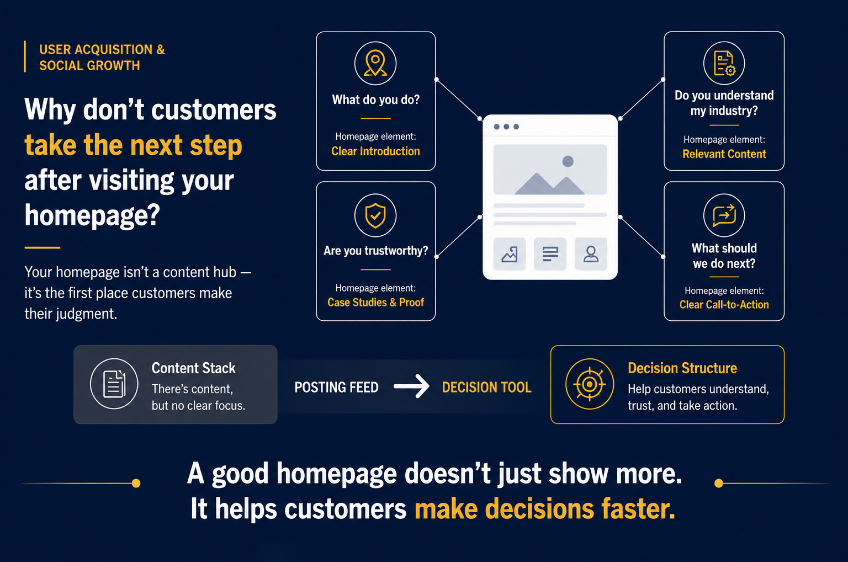
I. What are customers evaluating when they land on your page?
B2B purchasing decisions involve long cycles and high risk. When customers land on a social page, they typically decide within a short time whether the company is worth further exploration. They tend to quickly answer four questions:
Question 1: What do you do?
When customers enter the page, the first things they see are the About section, profile image, and cover image. If the About section uses generic language like "founded in XXXX, focused on XXXX", customers cannot determine "what this has to do with me". The core of a B2B company page is not self‑introduction, but a value promise – one that directly addresses customer pain points.
Question 2: Do you understand my industry?
Customers quickly scan recent posts to see if the content is relevant to their industry and scenario. If the page is filled with internal company news and holiday greetings, customers will feel that "this company is just talking to itself". If the posts include analysis of industry pain points, verifiable case studies, or scenario‑specific solutions, customers will perceive that "they understand my problems".
Question 3: Can you be trusted?
Customers look for verifiable information on the page – client case studies, certifications, project results, industry recognition. The completeness and credibility of modules like product information, website links, pinned content, and call‑to‑action buttons all serve as the basis for customers to judge "whether this company is reliable".
Question 4: What can I do next?
Is there clear next‑step guidance on the page – website link, contact information, call to action? If customers don't know how to proceed after viewing the page, they will leave – and likely never return.
II. Six touchpoints on your page influence a customer's first impression
A customer's judgment on your page is not random – it is typically influenced by the following six touchpoints:
Touchpoint 1: Profile image and cover image
The profile image and cover image are the first touchpoints for brand visuals. Visual consistency is the foundation of a professional impression – logo display, colour palette, and typography should all remain consistent. If the visual style is inconsistent, customers will perceive the company as unprofessional.
Touchpoint 2: About section
The About section is the core basis for customers to judge "what you do". An effective About section should avoid generic descriptions of company size or history, and instead directly address customer pain points. For example, "helping manufacturers reduce equipment downtime risk" is far more valuable to customers than "founded in 2005, focused on industrial equipment".
Touchpoint 3: Pinned content
Pinned content occupies the most prominent position on the page and is among the first things customers see. If the pinned post is an outdated company announcement or holiday greeting, it wastes the most valuable display space. Effective pinned content should be: the case that best represents your core capabilities, the white paper that best articulates your value proposition, or the client testimonial that best builds trust.
Touchpoint 4: Recent posts
Customers quickly scan the most recent posts to judge content quality and professionalism. If recent posts are a jumble – exhibition photos one day, holiday posters the next, product specs the day after – customers cannot quickly identify the company's core capabilities. Effective posts should follow a structured content plan, organised around the validation information customers need for their decisions.
Touchpoint 5: Product information and business modules
Modules like product information, website links, and business descriptions serve as the basis for customers to judge "what you can offer". If these modules are incomplete or outdated, customers will perceive that the company doesn't take this channel seriously.
Touchpoint 6: Contact information and call to action
The website link, contact information, and call‑to‑action buttons on the page are the entry points for customers to move from "understanding" to "action". If this information is missing or unclear, customers won't know what to do next.
III. Why can't scattered posts support customer judgment?
Many company pages appear to have plenty of content – regular updates, neat formatting, good visuals. But when customers click through, they still cannot form a clear judgment.
The problem is: posts are scattered, but customer judgment needs structure.
A single piece of content can address the display of "a particular topic", but customers need a complete set of judgment criteria: who you serve, what problems you solve, what evidence you have, and how to proceed. This information needs to be organised into a structure, not scattered across posts from different dates.
One common mistake is: treating the page as a "notice board" rather than a "customer judgment tool". The former logic is "what I have posted", while the latter is "what the customer needs to see". If the page's operating logic stays at "maintaining update frequency" rather than "supporting customer judgment", the more posts there are, the harder it becomes for customers to find the key information.
Another mistake is: the page content is disconnected from individual posts. A customer may land on the page through a specific piece of content – they read a technical article, a case study, or a product introduction, became interested, and clicked through to learn more. But if the page doesn't have extended information that corresponds to that content, the customer will feel that "the homepage and the content are talking about different things".
IV. Evolution from "scattered posts" to "judgment structure"
To transform the page from a "content publishing board" into a "customer judgment tool", it needs to be reorganised around modules such as profile positioning, pinned content, recent post structure, product information, and calls to action. The page is not a content warehouse – it is the starting point for customer judgment.
| Dimension | "Scattered posts" page | "Judgment structure" page |
|---|---|---|
| Positioning | Content publishing board, regular updates are enough | Customer judgment tool, organised around validation needs |
| About section | Generic company introduction | Directly addresses customer pain points, explains what problems you solve |
| Pinned content | Latest updates or company news | The case or white paper that best represents your core capabilities |
| Post structure | Scattered publishing, no thematic planning | Organised by topic around the information customers need for decisions, delivered consistently |
| Product information and business modules | Incomplete or outdated information | Product information, website links, and business descriptions are complete and up‑to‑date |
| Call to action | Contact information only | Clear next‑step guidance and call to action |
The goal of restructuring your page is not to display more content, but to help customers more quickly judge whether the company is trustworthy and worth further exploration. When customers land on your page, they should be able to quickly answer four questions: what you do, whether you understand their industry, whether you can be trusted, and what they can do next.
V. Does your page support customer judgment?
If you are unsure about your team's current state, use these quick self‑check questions:
⬜ Does the About section directly address customer pain points?
Open the About section of your LinkedIn company page – does it describe "who we are", or does it explain "what problems we can solve"? If it still reads as a generic company introduction, positioning has a break.
⬜ Does pinned content showcase your core capabilities?
Can a new visitor understand your core value within seconds through your pinned content? If it's outdated news or holiday greetings, your pinned strategy has a break.
⬜ Do recent posts follow a thematic structure?
Randomly review the last 10 posts – is there a clear thematic thread, or is it a pile of random company news? Without thematic planning, customers will struggle to quickly identify your core capabilities.
⬜ Are product information, website link, and call‑to‑action modules complete and functional?
Are these modules fully filled out? Is the information aligned with your current business? If they are missing or outdated, your page's foundational structure has a break.
If any of the above issues exist, your page has not yet truly become a tool that supports customer judgment.
Conclusion: Make your page the first stop for customer judgment
An overseas social page is not a collection of content – it is the first stop for customer judgment. Customers don't click through to browse news; they do so to decide within minutes whether this company is worth further exploration.
If the page is just a pile of scattered posts, customers cannot build a clear perception in a limited time. Whether the About section addresses pain points, whether pinned content showcases core capabilities, whether posts follow a thematic structure, and whether product information and calls to action are complete – these details collectively determine whether the customer will move forward.
Target Audience Reach & Conversion addresses the break from "content touchpoint" to "page‑based judgment capture". Landelion can help B2B companies, before launching or optimising overseas social media, complete the structured design of their page – from profile positioning, pinned strategy, and content planning to business module development – making the page the first stop for building customer trust, rather than a bulletin board for content accumulation.
Act now Is your overseas social page a pile of scattered posts, or has it formed a structure that supports customer judgment?Landelion can help B2B companies examine the page's capture capability from the perspective of Target Audience Reach & Conversion – diagnosing whether the issue lies in profile positioning, pinned strategy, content planning, or business module development. Explore Target Audience Reach & Conversion solution Book a page capture diagnosis |
📚 Further reading
Manufacturing Overseas Social Media Strategy: Why Most B2B Companies Get the Launch Sequence Wrong
Why B2B Companies Need Both Content and Advertising Before Launching Global Social Media
B2B Manufacturing Social Media Strategy: From “Notice Board” to Lead Generation Tool