


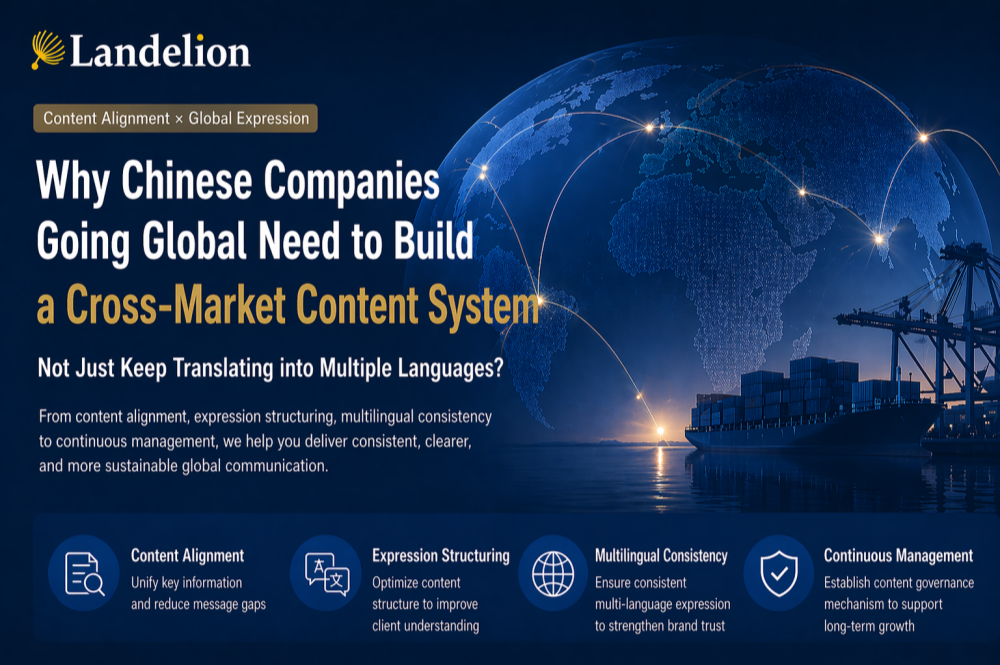
— Landelion's Cross-Market Content System helps align messaging, restructure expression, unify languages, and enable long-term governance.
When Chinese companies first expand overseas, the most immediate need they recognize is translation. Websites need English versions. Product materials must be localized into multiple languages. Exhibition assets, sales documents, video subtitles, and brand introductions all need to be adapted for different markets.
At the early stage, this approach works. There is a Chinese master version, defined target languages, and clear delivery timelines—translation or localization vendors can handle execution effectively.
However, once a company truly enters multiple international markets and content updates become continuous, problems begin to surface. The website may already be translated, yet overseas sales teams still rewrite product descriptions. English and German versions may both be delivered, but distributors report inconsistencies in priorities. The same product is described differently across websites, brochures, exhibition materials, and sales presentations.
With each additional language, what increases is not just translation cost—but repeated rounds of communication, alignment, revisions, and internal coordination.
At this point, the issue is no longer translation. The real question becomes: Is your cross-market content correctly understood, consistently expressed, and sustainably managed? This is the core challenge many Chinese companies face as they scale globally.
I. The Real Gap: Not More Content, But a System That Works Over Time
Many companies going global are not lacking content—they are trapped in inefficient cycles of rework. Three common signals reveal this problem.
1. Content is constantly revised—internally and externally
Headquarters produces a Chinese version, which is translated into English and sent to overseas teams. Local teams then adjust it for market relevance. Sales teams simplify it for clarity. Distributors shift the focus. Marketing revises again for brand alignment.
If this happens once, it is normal collaboration. But when it repeats across websites, product pages, brochures, white papers, exhibition materials, and sales assets, the cost is no longer translation—it becomes organizational friction.
2. More languages, less consistency
The same product is described differently across languages. The same brand sounds different across channels. Even core value propositions shift over time.
As content volume grows, contributors multiply, and update cycles accelerate, what companies lose is not individual page quality—but overall consistency and manageability.
3. Content exists—but customers still don't understand you
Websites get traffic, materials are downloaded, and content keeps updating—yet lead quality remains unstable, customer understanding shallow, and sales efficiency low.
Companies often blame channels, ads, or sales execution. But a critical issue is overlooked: content is produced, but not truly understood. Accurate technical parameters do not guarantee perceived value. Correct wording does not drive decision-making.
These issues may appear scattered, but they stem from the same root cause: the company no longer lacks multilingual output—it lacks a cross-market content system.
II. Why This Matters Even More in the AI Era
AI is rapidly improving language conversion and content generation efficiency. It enables faster production and reduces basic translation costs.
But for companies operating across multiple markets, languages, and product lines, the real challenge is not generating content—it is managing meaning.
The critical questions are:
🔹 Which information must be clearly understood?
🔹 Which expressions must remain stable?
🔹 Are different markets still communicating the same core message?
🔹 Are websites, brochures, sales materials, and marketing content truly aligned?
🔹 As products, markets, and languages expand, can content be reused—or must everything restart from scratch?
This is why, in the AI era, companies are increasingly paying not for translation itself, but for judgment, alignment, governance, and long-term management of complexity.
Translation remains necessary—but it is no longer sufficient.
III. What Landelion Productizes as a Solution
Based on these real-world challenges, Landelion has developed a structured offering: Cross-Market Content System Development.
This is not fragmented execution, nor simple multilingual delivery. It focuses on four core questions:
🔹 What exactly is the company communicating externally?
🔹 Are different markets aligned on the same core message?
🔹 Are multilingual expressions truly unified?
🔹 Can future content scale without starting from zero each time?
Cross-Market Content System Development |
In essence, this service shifts the focus from "translating content" to building a system that is understandable, consistent, reusable, and manageable over time.
IV. Key Modules of the Service
To ensure practical, scalable, and sustainable implementation, the system typically includes three modules:
Module 1: Content Diagnosis & Core Message Alignment
Before translation begins, the existing content structure must be understood. The focus is not translation—but clarity:
🔹 Which pages and materials influence customer understanding?
🔹 Which messages must remain consistent?
🔹 Where are redundancies, conflicts, or disconnects?
🔹 Which markets already show misalignment?
Outputs include content audits, priority mapping, and core message alignment frameworks.
Module 2: Content Restructuring & Multilingual Unification
This phase goes beyond sentence-level translation. It restructures logic, prioritization, and expression.
Key questions: Can target audiences understand content more quickly? Do different languages communicate the same meaning?
Outputs include optimized core materials, aligned messaging frameworks, terminology systems, and cross-language consistency mapping.
Module 3: Governance & Long-Term Management
The biggest challenge is not initial delivery—but ongoing control. Without governance, content quickly returns to chaos.
This phase establishes:
🔹 Terminology and expression standards
🔹 Version control systems
🔹 Update workflows for key materials
🔹 Integration frameworks for new markets and languages
The goal is not just better content today—but avoiding repeated costs in the future.
V. Who Should Prioritize This Approach
This system is particularly valuable for:
1. Manufacturing or technology companies expanding across multiple markets
High product complexity, multiple materials, and continuous updates create high risk of inconsistency.
2. Brand-driven companies with local market expansion
Headquarters content exists, but local teams continuously rewrite it—indicating lack of a shared expression system.
3. High-precision industries (tech, medical, industrial, professional services)
Accuracy alone is not enough—clarity and structure directly impact decision-making.
VI. When This May Not Be Necessary (Yet)
If a company only translates occasional materials, operates in limited markets, and has low content complexity, traditional translation may still suffice.
This system becomes critical once content is used continuously across teams, languages, and markets.
VII. Rethinking Procurement: Beyond Translation Cost
When facing cross-market content challenges, procurement logic must evolve. Instead of focusing on per-word pricing, companies should evaluate:
🔹 Reduction in rework and communication cost
🔹 Consistency across languages and channels
🔹 Reusability of content as an asset
🔹 Impact on customer understanding and sales efficiency
At this level, the service is no longer translation—it is content infrastructure.
VIII. What Companies Truly Lack: Not Vendors, But Governance
Most companies have already worked with translation, localization, design, and marketing vendors. The problem is not lack of suppliers—it is lack of a central layer responsible for content consistency.
That is the gap Landelion addresses.
We are not making translation more complex—we are recognizing a reality: as companies scale globally, content challenges evolve from execution problems into management problems.
What companies need is not more fragmented delivery, but a system that keeps global content consistent, scalable, and sustainable.
Conclusion
Most Chinese companies begin global expansion by buying translation. But over time, they realize the real cost lies elsewhere:
🔹Is the same message clear across markets?
🔹Are multilingual versions consistent?
🔹Do new products, markets, and teams require restarting from scratch?
At this stage, multilingual content becomes a management challenge—not just a task.
Companies that shift from fragmented outsourcing to controlled systems will achieve more stable global communication—and turn content into a long-term asset, rather than a recurring cost.
🚀 Cross-Market Content Structure Diagnosis
Start with a cross-market content structure diagnosis to identify content fragmentation, version drift, and cross-language communication pain points.
If your company is already experiencing frequent rework of multilingual versions, inconsistent messaging between your website and sales materials, or overseas teams finding headquarters content "not usable enough," submit your existing website, product materials, or multilingual content samples for a professional diagnosis with Landelion.