


As global competition intensifies, Chinese high-tech companies—including SaaS, AI platforms, industrial software, digital health, and smart hardware providers—are accelerating their expansion into Europe, the Middle East, and Southeast Asia.
Yet many teams discover a frustrating reality: even after completing language translation and regulatory compliance, overseas conversion rates remain far below expectations.
In most cases, the problem is not functionality or copywriting. It lies in a factor that has long been underestimated: design localization.
In 2023, Airbnb carried out a systematic visual redesign for the Middle East market—switching the reading direction to right-to-left, optimizing color contrast, and restructuring icon semantics and information hierarchy. The results were clear: longer session durations and improved conversion rates on key pages.
This case illustrates a fundamental truth of global markets: trust is formed before understanding—and design is often the first trigger of trust. This aligns closely with the research direction of the Stanford Web Credibility Project on how users assess website credibility.
Global companies such as Google, Microsoft, and SAP have long elevated design localization to the same strategic level as language and legal compliance. For high-tech B2B companies, this is not merely about aesthetics—it is about whether global users trust you enough to engage, evaluate, and convert.
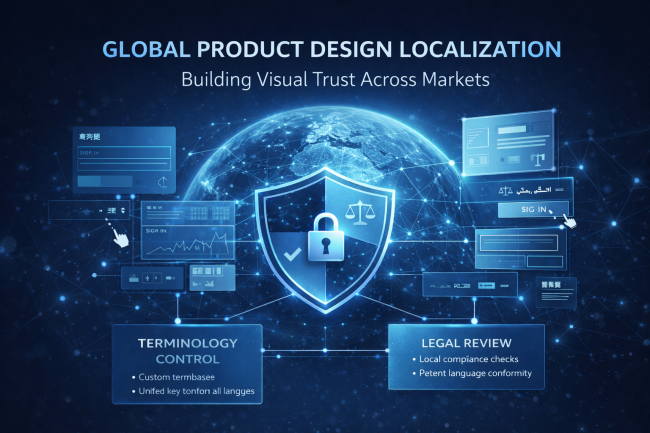
I. Why Design Becomes a Hidden Conversion Barrier in Global Markets
1. “Professional” at Headquarters Can Feel “Distant” Locally
Minimalist, high-contrast, tech-driven design styles are often seen as professional at headquarters. However, in certain markets they may be perceived as:
🔹Unclear information and weak emphasis
🔹Emotionally distant and lacking approachability
🔹Overly “foreign,” making trust harder to establish
In B2B, healthcare, and industrial sectors—where decision thresholds are high—users value clarity and reliability far more than visual sophistication.
2. Colors and Icons Carry Hidden Cultural Conflicts
Visual symbols often speak louder than words.
👉Color perception differences
Red conveys vitality and celebration in China, but in Western financial or medical contexts it often signals risk or warning.
Blue represents professionalism and trust in Western markets, yet in some emerging markets it can feel cold or emotionally distant.
👉Icon and symbol ambiguity
A ✔️ may indicate “completed” in some cultures, but merely “optional” in others.
Hand gestures, arrows, and system icons may trigger taboos or misunderstandings in the Middle East or parts of East Asia.
👉Layout logic mismatches
Middle Eastern users read from right to left; without adjusting visual flow, key information is easily overlooked. Microsoft’s global UI guidelines explicitly note that RTL languages affect scan paths and interface layout.
European users are highly sensitive to information hierarchy and whitespace; dense layouts can quickly signal “unprofessional.”
These issues are rarely reported directly by users—but they surface clearly in metrics such as high bounce rates, form abandonment, and low trial conversion.
3. Language Is Localized, but Design Works Against Trust
Common problems include:
🔹Button compression and broken line spacing after text expansion
🔹Key value propositions weakened by imbalanced layout hierarchy
🔹Completely different information structures across language versions
The result is subtle but damaging: language works hard to explain, while design silently undermines trust.
II. The Real Goal of Design Localization: Credibility, Not Beauty
Effective design localization must answer three core questions:
👉Does your design communicate locally recognized professionalism?
Do typography, spacing, and color choices signal reliability rather than marketing exaggeration?
Is information density aligned with industry expectations?
👉Does your interaction design respect local decision-making rhythms?
Are CTAs too aggressive for markets like Europe and the US, or too subtle for Japan and Korea?
Is more explanatory context needed before conversion prompts?
👉Is your brand being understood—or misread?
Users may not remember design details, but they form a lasting judgment:
“Is this a professional partner I can trust long-term, or a foreign vendor I should be cautious about?”
III. Landelion’s Methodology: A Systematic Approach to Design Localization
At Landelion, we treat design localization as a cross-language, cross-cultural, and cross-market system, not a cosmetic exercise. Our approach focuses on five key dimensions:
1. From Headquarters Aesthetics to Market Trust Standards
We benchmark against leading local players in target markets, adjusting information density, whitespace, and typography to reinforce credibility rather than technical showmanship.
2. Managing Colors and Icons as a Cross-Cultural Language
We build visual semantics checklists for key markets—covering colors, icons, and gesture sensitivities—while preserving core brand recognition.
3. Synchronizing Language and Design from the Start
Design structure is addressed at the early stage of content localization, not as a post-translation fix. Layout elasticity is planned based on language characteristics such as German compound words or Arabic expansion rates.
4. Rebuilding Information Hierarchy Around User Decision Paths
We establish market-level design standards to ensure consistency across websites, products, and marketing materials, creating reusable and scalable design logic for core regions.
5. Treating Design Localization as a Long-Term Capability
From pilot markets to large-scale rollout, we support iterative design evolution—ensuring the visual experience matures alongside market adoption.
Conclusion: Global Competition Is Won Through Invisible Trust Signals
In the deep waters of global expansion, users often decide whether to trust your solution before they fully understand your product.
True globalization begins with language, is strengthened by design, and ultimately succeeds through trust.
When design, language, and market insight work in alignment, global growth gains a truly sustainable foundation.
Landelion has supported multiple Chinese high-tech companies—across semiconductors, AI, enterprise software, and medical devices—in building professional, credible, and consistent global user experiences.
If you are planning or optimizing the visual experience of your global products, Landelion can help you evaluate and design a localization strategy that builds trust—not just translation.
and execution support.
📩 Contact us | Explore localization solutions
💬 Add us on WeChat for a tailored solution
📚Further Reading
B2B KOL & KOC Marketing for Global High-Tech Expansion
UI Localization for Tech Products: 5 Key Dimensions to Improve Global UX in 2025