


Many manufacturing companies have experienced the same scenario.
🔹You attract a crowd of industry professionals at Hannover Messe with an impressive AR product demonstration. Yet the product video you posted on LinkedIn last week receives little engagement.
🔹You collect hundreds of business cards at a trade show, but struggle to follow up with meaningful content.
🔹Your website’s “Solutions” page hasn’t been updated in months, forcing sales teams to explain product advantages verbally.
At first glance, this may appear to be a channel management issue. In reality, the deeper problem is content fragmentation. Trade show materials remain buried on hard drives. Social media posts stay surface-level. Website information remains static. Content production keeps increasing, but like scattered puzzle pieces, it never forms a complete trust-building system.
?What Is Content Compounding?At Landelion, we define content compounding as the process of transforming one high-value content source into multiple reusable assets across the entire buyer journey. |
I. The Content Challenge for Global Manufacturing Companies: When Channels Become the Goal
In many manufacturing organizations, content is still managed by channel. Each team focuses on its own platform, which appears efficient but ultimately wastes valuable content assets.
| Channel | Typical Approach | Lost Content Value |
|---|---|---|
| Trade Shows | Focus on on-site impact; footage archived afterward | Customer testimonials, technical discussions, and demos remain unused after the event |
| Social Media | Focus on likes and views with generic product posts | Content lacks depth and fails to drive traffic to the website or sales conversations |
| Website | Emphasizes authority with parameter-heavy pages | Visitors struggle to connect technical specs with real business value |
| Sales | Relies on individual experience | Teams lack standardized tools, updated cases, or competitor response guides |

A B2B marketing study shows that enterprise buyers heavily rely on professional content—such as case studies, technical articles, and industry insights—when evaluating suppliers. This type of content helps procurement teams assess a vendor’s technical capabilities and industry expertise.
💡 Landelion Insight: The real bottleneck isn’t at the execution level—it’s in top-level strategy. Companies still treat content as a one-off “task”, rather than a portable, composable, and evolving “asset”.
II. The Content Compounding Strategy: One Source, Multiple Activations
Content compounding does not mean publishing the same material on ten platforms. Instead, it means activating one high-value content source in multiple ways across different touchpoints. Trade shows provide an excellent example.
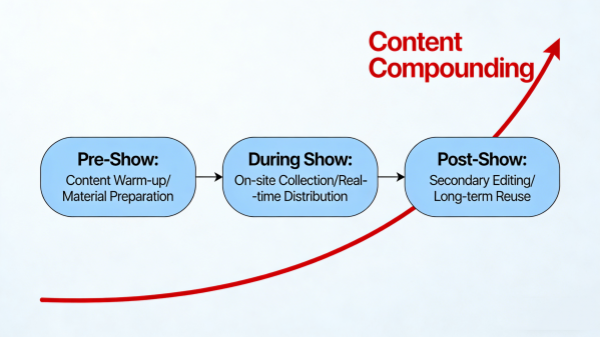
▶ Before the Trade Show: Build Anticipation Through Social Media
Social media marketing (SMM) before an event should do more than promote attendance. It should also help identify high-intent visitors and improve the quality of conversations on site.
Examples include:
🔹 Preview posts such as “Three production bottlenecks we will solve at Hannover Messe”
🔹 Short customer recommendation videos: A 15-second testimonial from an existing client provides early credibility and helps new prospects understand your value.
▶ During the Trade Show: Capture Reusable Signals
Trade shows are the best moment to capture authentic and credible material.
These signals can support marketing long after the event.
| Content Type | Example | Purpose |
|---|---|---|
| Customer questions | Record the top five technical questions visitors ask | Reveal real customer concerns |
| Demonstration videos | Film equipment operating in simulated scenarios | Show practical problem-solving capability |
| Customer testimonials | Obtain permission to quote client feedback | Build trust through social proof |
▶ After the Trade Show: Release Content in Phases
The key to content compounding lies in structured release.
| Timeline | Action | Channel | Goal |
|---|---|---|---|
| Within 48 hours | Personalized follow-up email | Email marketing | Provide tailored technical materials |
| Within 7 days | Short multilingual testimonial videos | LinkedIn / YouTube | Expand reach and credibility |
| Within 30 days | Dedicated trade show recap page | Website | Consolidate results and authority |
| Within 60 days | Convert common questions into FAQ entries | Website / Sales tools | Improve sales efficiency |
With this approach, one trade show investment can generate six or more reusable content assets supporting awareness, evaluation, and purchase decisions.
III. The Core Mechanism: Building a Manufacturing Language Asset Center
To truly connect trade shows, social media, and websites, the key is not increasing content volume but improving collaboration across marketing, sales, and engineering teams. In our work with companies in industrial automation, new energy, and equipment manufacturing, high-performing teams consistently establish three mechanisms.
| Collaboration Dimension | Traditional Approach | Compounding Practice |
|---|---|---|
| Content Planning Origin | Channel-siloed output (e.g., social = videos, shows = booths) | Unified around 1–2 customer pain points across all channels |
| Asset Management | “Done-and-archived” mindset | Lightweight inventory with type, owner, reuse scenarios & lifecycle |
| Workflow Tools | Files scattered; coordination via chat/email | Cloud folder + repurposing map + dealer microsite |
| Language Assets | Inconsistent terms across channels (e.g., “auto” vs. “smart” changeover) | Central glossary + standardized translation source (e.g., Landelion) |
Conclusion: Let Content Grow Along the Customer Journey
When the system works, content begins to reinforce itself. Social media questions feed into website FAQs. White paper downloads identify high-intent leads for sales teams. Customer stories shared in meetings become new marketing materials.
Content no longer depends on manual promotion. It moves naturally through the customer journey.
This is the true meaning of content compounding: marginal production costs decrease while trust assets continue to grow.
Take Action
If your marketing team struggles with disconnected channels—trade shows, website, and social media operating separately—content compounding may be the missing link. At Landelion, we help global manufacturing companies transform fragmented content into a scalable trust-building system that supports marketing, sales, and global growth.
📩Contact Us | Explore marketing solutions
💬Add us on WeChat to receive the full Content Asset Inventory Template and Terminology Consistency Checklist.