


In global expansion, a common misconception is treating SEO and paid search as a binary choice—either going all in on paid for short-term results, or all in on SEO while waiting patiently for long-term returns.
However, in the first two articles of our Global SEO Growth Framework series, we have already highlighted a critical reality:
an all-paid strategy easily falls into a cost trap, while relying solely on SEO makes cold starts painfully slow.
The most effective approach is not choosing one over the other, but orchestrating them together—using paid search to explore demand, and SEO to build trust and long-term momentum.
This raises the real question: how should that coordination evolve over time?
When should paid search take priority? When should SEO become the core investment?
The answer depends on where a company sits in its global expansion lifecycle. This article focuses on three key stages—early-stage, growth-stage, and mature-stage—and explains how to allocate SEO and paid search strategically so that every dollar supports the right growth objective at the right time.
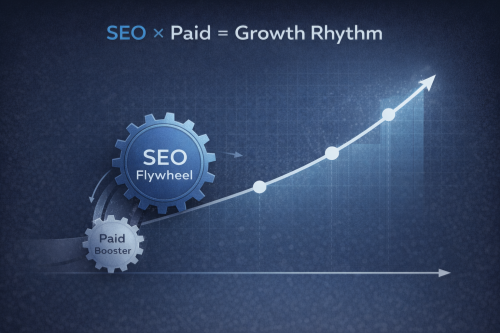
I. Early Stage (0–6 Months): Paid Search Leads Exploration, SEO Builds the Foundation
When a Chinese company enters an overseas market for the first time, the most urgent need is rarely brand building. It is validating whether the product is accepted and whether customers are willing to pay.
At this point, organic search traffic is nearly zero. Brand keywords are unknown. Content systems are incomplete. Waiting for SEO alone to take effect often means missing the market window altogether.
1. Paid Search as Market Sensor and Traffic First Aid
In the early stage, paid search should play a leading role. By running Google Ads on high-intent keywords—such as brand terms, competitor comparison terms, and functional demand queries—companies can obtain real user feedback within days and test which value propositions convert best.
✅Core principle: use paid search to buy time and quickly validate demand and positioning.
2. Build SEO Foundations in Parallel: Technology + Content
This does not mean SEO can wait. On the contrary, SEO foundations must be built while paid traffic is flowing. Otherwise, once paid campaigns stop, traffic drops to zero.
🔹Technical SEO: ensure clean site architecture, mobile optimization, fast load speed, and solid Core Web Vitals.
🔹Content SEO: based on high-performing paid keywords, rapidly build 3–5 core landing pages (product pages, solution pages, case studies). These pages will serve both future organic traffic and paid conversions.
✅Core principle: let SEO accumulate long-term assets—content, keywords, and insights that can be reused.
3. Practical Case: From Paid Exploration to Organic Capture
In a project supporting an industrial sensor manufacturer expanding globally, Landelion observed that by Month 2, the company captured early leads through brand and competitor keyword ads. The highest-clicked “installation guide” query was then turned into a long-form blog post with strong technical SEO optimization. By Month 5, the article ranked on the first page organically, generating 27 high-quality leads per month—while paid budgets dropped by 30%.
✅Key takeaway: paid search opens the path; SEO captures and compounds it.
II. Growth Stage (6–18 Months): Coordinated Momentum and the Growth Flywheel
Once product–market fit is validated and scaling begins, the objective shifts from “acquiring first customers” to reducing acquisition cost, expanding share, and building authority.
At this stage, SEO content begins generating steady traffic, with some keywords ranking in the top three positions. Meanwhile, paid CPCs rise as competition intensifies. Continuing to rely heavily on paid search inevitably compresses ROI.
The strategy here is to evolve from parallel execution to a true SEO–paid flywheel. SEO should now become the primary traffic engine—systematically expanding content around validated long-tail keywords and covering the full buyer journey from awareness to decision. Paid search becomes more surgical: remarketing visitors who consumed SEO content but did not convert, or temporarily boosting visibility around trade shows or seasonal demand spikes.
A critical effect emerges here: dual exposure. When users see both organic results and paid ads from the same brand, trust and click-through rates increase significantly. Landelion data shows that in B2B tech sectors, branded keywords with dual exposure achieve on average 42% higher total CTR than single-channel visibility.
At this stage, SEO gradually takes over as the main engine, while paid search becomes an amplifier and defensive layer.
III. Mature Stage (18+ Months): SEO as the Moat, Paid Search as Precision Support
In the mature stage, companies typically have strong brand recognition and a stable organic traffic base. The goal shifts again—from acquisition to defense, leadership, and selective expansion.
SEO now functions as a true “free traffic engine.” High-quality content continues to rank, backlinks strengthen, and E-E-A-T signals (Experience, Expertise, Authoritativeness, Trustworthiness) form a barrier that short-term advertising cannot easily disrupt.
Paid search narrows its role to three strategic scenarios:
Brand defense, preventing competitors from bidding on your brand terms;
New market entry, using paid search to test local demand before launching localized SEO;
Key moments, such as earnings releases or major industry events.
At this stage, the focus of SEO shifts from creation to activation—refreshing existing content, improving internal linking, and enhancing structured data. One European medical device company achieved 38% year-on-year organic growth without publishing new blogs, simply by systematically updating existing content.
The wisdom of maturity lies in restraint: SEO carries over 80% of search traffic, while paid search strikes only when strategically necessary.
IV. Dynamic Adjustment: No “Best Ratio,” Only the Right Ratio for the Moment
Global expansion is rarely linear. Entering a new language market or experiencing a sudden traffic drop due to algorithm updates may require temporary shifts—raising paid spend above 60% to rebuild presence, or using paid search as a buffer during SEO recovery.
Yet one principle remains constant: the ultimate goal of search marketing is to build compounding digital assets, not to depend on perpetual traffic purchases.
Conclusion: Allocation Reflects Your Understanding of Growth Rhythm
So how should SEO and paid search be allocated? The answer is not a fixed percentage, but a clear understanding of your current stage.
🔹In the early stage, use paid search boldly—but plant SEO seeds early.
🔹In the growth stage, let SEO and paid search reinforce each other through a flywheel.
🔹In the mature stage, protect the SEO moat and deploy paid search like a strategic task force.
This is not just budget management—it is respect for the true nature of global growth. Growth is not a sprint, but a disciplined, well-paced marathon.
If you would like to tailor your SEO and paid search allocation to your specific business stage, Landelion can help. We design dynamic, executable search marketing strategies based on your industry, target markets, and growth objectives.
📩 Contact us | Explore marketing solutions
💬 Add us on WeChat for a tailored solution
📚 Further Reading