


As regulatory requirements continue to tighten worldwide, the translation of official corporate documents—such as company registration files, tender documents, due diligence reports, and bank account certificates—has become far more than a linguistic task. It is now a critical compliance factor that determines whether an overseas process can even begin.
In practice, many international expansion projects are delayed or rejected not because the translation is inaccurate, but because the translation format itself is not legally recognized by the target country’s administrative or judicial system.
This article provides a systematic comparison of Sworn Translation, Certified Translation, and Notarization / Apostille, explaining their legal nature, applicable scenarios, and common pitfalls—so companies can make the right decision upfront and avoid costly rework.
I. The Fundamental Differences Between Three Translation Formats
1. Sworn Translation

Legal Status: Court-recognized translation within a judicial system
Key characteristics:
🔹Translators must be officially registered or sworn in by a court or government authority
🔹Translators bear legal liability for the accuracy of the translation
🔹The translated document usually carries the same legal effect as the original
Common countries:
Germany, France, Spain, Italy, Portugal, Poland, and other civil-law jurisdictions. These countries typically maintain an official registry of sworn translators (e.g., Öffentlich bestellter Übersetzer in Germany). Only translations issued by listed translators are legally valid.
Typical use cases:
Articles of association, court judgments, arbitration documents, company incorporation filings, birth/marriage certificates, and other documents involving legal identity or corporate status.
Critical note:
If sworn translation is legally required, any non-sworn translation will be rejected outright, regardless of linguistic accuracy. For example, when registering a subsidiary in Spain, articles of association translated without a Spanish Ministry of Justice–certified sworn translator will not be accepted by the Commercial Registry.
2. Certified Translation
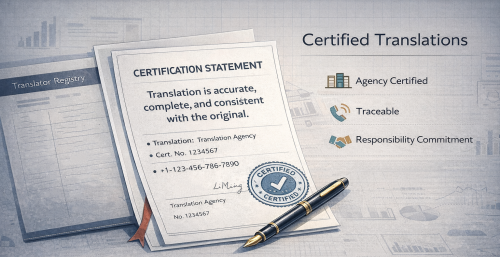
Legal Status: Professionally certified translation accepted in commercial and administrative contexts
Key characteristics:
🔹Issued by a qualified translation agency or translator
🔹Includes a certification statement confirming the translation is complete and accurate
🔹Signed and stamped, with traceable credentials and contact details
Common countries:
United States, United Kingdom, Canada, Australia, Singapore, and other common-law or Commonwealth jurisdictions. These countries generally do not require government-registered translators, but accept certified translations backed by professional responsibility.
Typical use cases:
Financial statements, technical documentation, regulatory filings, tender materials, corporate profiles, and product manuals.
Critical note:
This is the most widely used translation format in international business. For example, USCIS explicitly accepts certified translations for immigration and visa applications, provided the translator signs a certification statement and provides contact information (USCIS – Translations).
3. Notarization and Apostille
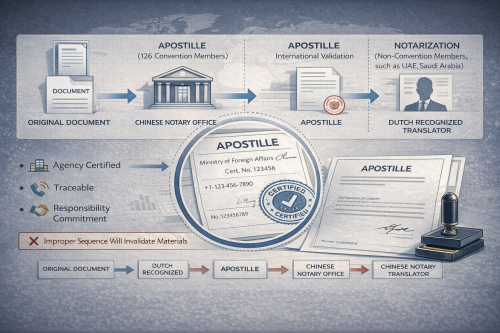
Legal Status: Cross-border authentication of documents
Important clarification:
Notarization and Apostille are not translation methods. They are legal authentication processes applied to original documents or translations.
How it works:
🔹Apostille applies between countries that are signatories to the Hague Apostille Convention (currently 126 countries). It is issued by a designated authority (e.g., China’s Ministry of Foreign Affairs) (HCCH)
🔹Notarization is performed by a notary public and is commonly used for non-Hague countries (e.g., Saudi Arabia, UAE)
Common workflows:
🔹Original document notarized in China → translated by a recognized translator
🔹Translation itself notarized
🔹Translation declaration submitted for Apostille
Typical use cases:
Power of attorney, business licenses, contracts, diplomas, criminal record certificates, and other documents used across borders.
Critical note:
The order matters. Using the wrong sequence can invalidate the entire document set. For example, when using a Chinese business license in the Netherlands, the usual process is:
License → Chinese notarization → Apostille → translation by a Dutch-recognized translator.
If you translate first and then apply for Apostille, the translated document may not be apostilled.
II. Quick Matching Guide by Country and Purpose
Translation | Typical Countries | Legal Effect | Common Combination | Special Notes |
Sworn Translation | Germany, France, Spain, Italy | Full legal equivalence | Sworn translation + Apostille | Some countries require the translation itself to be apostilled |
Certified Translation | US, UK, Canada, Australia | Administrative/commercial acceptance | Certified translation + notarization (if needed) | Most US cases do not require notarization |
Apostille / Notarization | Hague Convention countries (126) | Cross-border recognition | Original or translation + Apostille | Non-Hague countries require consular legalization |
Reminder:
Apostille does not replace translation format requirements. For example, Germany may still require sworn translation even if the document already carries an Apostille.
III. Common Corporate Pitfalls—and How to Avoid Them
Pitfall 1: Treating translation as the final step
Outcome: Documents rejected due to format issues; timelines reset
Recommendation: Define translation requirements at the start of the project, alongside legal and regulatory planning.
Pitfall 2: Translating before confirming document purpose
Outcome: Existing translations fail to meet upgraded regulatory use cases
Recommendation: Translate according to the highest potential use case (e.g., IPO due diligence vs. internal reference).
Pitfall 3: Confusing certified translation with sworn translation
Outcome: Immediate rejection in civil-law jurisdictions
Recommendation: Follow country-specific legal terminology, not generic labels like “official translation.”
Pitfall 4: Choosing vendors by price alone
Outcome: Translation completed but unusable in legal workflows
Recommendation: Prioritize path feasibility over unit price. Request proof of prior successful cases in the target country.
IV. A Safer Decision-Making Framework
Companies can follow this four-step process to cover over 90% of international document scenarios:
1. Define the document’s purpose (registration, tender, litigation, immigration, M&A)
2. Identify the target country and receiving authority (court, registry, bank, regulator)
3. Confirm legal requirements for translation format and authentication
4. Determine the correct execution order (notarization → translation → Apostille, or vice versa)
For high-risk projects such as M&A, IPOs, or litigation, it is strongly recommended to involve a translation partner with local compliance experience, working in parallel with legal counsel.
Conclusion: Translation Is the Starting Point of Compliance—Not the Final Step
In global expansion, document translation should be elevated from a back-office task to a strategic compliance decision. Choosing the correct translation pathway saves time, reduces risk, and demonstrates respect for the legal culture of the target market.
If you are preparing official corporate documents for international use, Landelion can help you design compliant translation and certification pathways tailored to your destination country and use case.
📩 Contact us | Explore translation solutions
💬 Add us on WeChat for a tailored solution
📚 Further Reading
Precision in Legal Translation: Overcoming Challenges in Business Contracts and Legal Documents
Avoid Compliance Risks in Manufacturing Certification Translation