


Every year, manufacturing companies invest heavily in global trade shows—Hannover Messe, Canton Fair, Automechanika Frankfurt, and The Big 5 Dubai. Booths are professionally designed, product demos are ready, and sales teams work intensively to collect hundreds of business cards and inquiries.
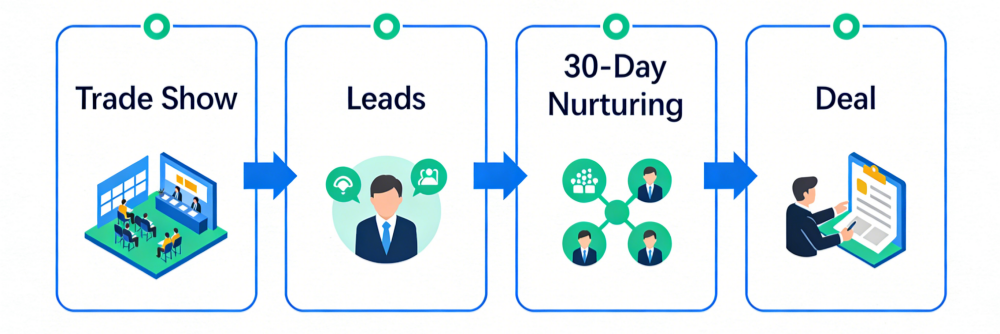
Yet after the event ends, only a small fraction of these leads actually convert into real deals.
The problem rarely lies in the sales team’s effort. More often, companies lack a systematic nurturing mechanism that moves prospects from initial contact to decision-stage trust.
Trade shows are short-term, high-intensity exposure events. But manufacturing procurement decisions typically involve three characteristics:
🔹 Long decision chains (technical evaluation → procurement approval → financial review)
🔹 High contract value and high perceived risk
🔹 Decision cycles that often span several months
Without a structured follow-up system, many high-value leads naturally disappear during the silent period after the exhibition.
I. Diagnosis: Three Critical Gaps Behind Low Trade Show Conversion
Gap 1: Information Gap
Lead data collected during exhibitions is often fragmented.
If business cards and digital questionnaires are not cleaned, structured, and prioritized within 72 hours, the emotional impact of face-to-face interaction quickly fades into vague memory.
The real problem is not the number of leads—it is the lack of data asset management.
Gap 2: Expression Gap
Many Chinese manufacturing companies face a common challenge: strong engineering capability but weak value communication.
Typical misalignment includes:
| Internal Message | What Buyers Actually Care About |
|---|---|
| “Precision of 0.001mm” | “How much does it improve efficiency or yield rate?” |
| “CE certification obtained” | “Has it been successfully implemented in my market?” |
| “20 years of industry experience” | “Do you have proven customer cases similar to ours?” |
If technical parameters cannot be translated into perceived business value, they will never enter the buyer’s internal discussion.
Gap 3: Trust Gap
In high-value procurement decisions, risk perception often outweighs price considerations.
Typical buyer concerns include:
🔹 Is the production process transparent?
🔹 Is delivery stable and predictable?
🔹 Is after-sales support reliable?
🔹 Are there regulatory or market credentials in the buyer’s region?
Without addressing these concerns, leads hesitate—even when the product is technically competitive.
II. The Solution: Landelion’s 30-Day Lead Nurturing Framework
A trade show is just a touchpoint. Real conversion happens during the follow-up cycle.
Landelion recommends a structured 30-day nurturing rhythm to guide prospects from initial interaction to commercial negotiation.
Phase 1: Memory Activation (Day 0–7)
Objective: Ensure the prospect remembers you.
Key actions:
🔹 Segment and prioritize leads within 48 hours
🔹 Send personalized follow-up emails within 72 hours, referencing the actual booth conversation
The goal is not simply sending emails. It is rebuilding the professional impression from the exhibition through high-quality multilingual content.
Phase 2: Value Demonstration (Day 8–21)
Objective: Translate technical capabilities into business value.
| Value Dimension | Content Format | Delivery Channel |
|---|---|---|
| Technical depth | Industry whitepapers, competitor comparisons | Email sequences, LinkedIn articles |
| Process transparency | Factory livestreams, quality inspection videos | Facebook Live, virtual tours |
| Proven results | ROI calculators, customer case libraries | Website resources, webinars |
At this stage, the goal is to equip buyers with materials they can use in internal discussions.
Phase 3: Conversion Acceleration (Day 22–30)
Objective: Move qualified leads into negotiation or sampling.
Three conversion strategies can be applied simultaneously:
1. Targeted Incentives (High-Intent Leads)
Trade-show exclusive discounts (3-day countdown)
Dynamic pricing calculators
First-order shipping subsidies
2. Executive-Level Engagement (Long Decision Chains)
Invitation letters signed by regional directors
Strategic partnership proposal drafts
Executive testimonial videos from existing clients
3. Sample-Driven Evaluation (Mid-Intent Leads)
Free sample + testing report packages
Localized application adaptation proposals
Competitor comparison testing data
III. Trust Stacking: The Four Evidence Layers in Manufacturing
Manufacturing deals rarely close through price incentives alone. They rely on layered trust signals across the decision chain.
| Evidence Type | Manufacturing Example | Trust Contribution |
|---|---|---|
| Process evidence | Factory livestreams, QC process recordings | 35% |
| Data evidence | ROI case studies, third-party test reports | 40% |
| Social evidence | Global client testimonials, industry endorsements | 20% |
| Institutional evidence | ISO certifications, CE/FDA approvals, delivery guarantees | 25% |
The stronger the evidence stack, the shorter the decision cycle.
IV. Coordination and Measurement: From Process Metrics to Business Results
Lead nurturing is not a single-team effort. It requires collaboration between:
Sales × Marketing × Technical Teams
Weekly Process Metrics
| Metric | Target | Optimization Threshold |
|---|---|---|
| Qualified lead ratio | >85% | <70% |
| Post-show activation (7 days) | >40% | <30% |
| Whitepaper download rate | >25% | <15% |
| Factory livestream view rate | >20% | <10% |
Monthly Business Metrics
| KPI | Industry Benchmark | Excellent Performance |
|---|---|---|
| Conversion rate | 5–8% | >12% |
| Sales cycle | 60–90 days | <45 days |
| Customer acquisition cost | $2,000–$3,000 | <$1,500 |
| Marketing ROI | 300–500% | >800% |
Conclusion: From “Lead Collection” to “Trust-Based Conversion”
Global manufacturing expansion is shifting from product export to value communication.
Trade shows are no longer just signing venues. They are the starting point of market trust.
Leads are not simply business cards—they are the foundation for long-term relationship building.
When companies implement a structured nurturing system, trade shows evolve from expensive marketing events into sustainable growth engines.
Take Action
Are you struggling with low trade show conversion rates or inconsistent follow-up processes?
Download “The 30-Day Lead Nurturing Checklist for Global Manufacturing” or schedule a consultation with Landelion’s experts to design a customized solution.
📩Contact us | Explore marketing solutions
💬Add us on WeChat for a tailored solution