


When a multinational company launched its regional website, the marketing director noticed something subtle—but deeply concerning: the same core product was described differently across markets. On the Chinese website, it appeared as Smart Packaging System; in English, it became Intelligent Packaging System; in German, it was translated as Automated Solution; and in sales emails, yet another abbreviation was used.
None of these versions were technically incorrect. But to global customers, their coexistence signals one thing: there is no single source of truth behind the company's messaging.
According to CSA Research's Localization Maturity Model, inconsistent localization directly undermines buyer trust and leads to fragmented brand perception. Yet many companies expanding globally still treat language services as isolated translation projects, overlooking a far more critical risk: the loss of control over messaging across markets, teams, and touchpoints.
💡 Landelion Insight: In global expansion, language services are no longer about translation—they are about enterprise-level content governance.
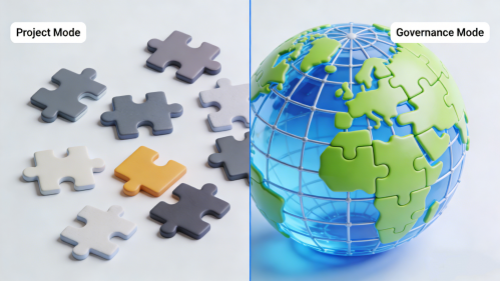
I. Why Project-Based Translation Fails in Global Markets
Most companies still operate with a fragmented translation model: the website is handled by one vendor, brochures by another, and social media content is often translated internally on an ad hoc basis. This model may function in a single market, but it breaks down entirely once a company scales globally.
For B2B buyers, inconsistent language is not merely a user experience issue—it is a signal of internal misalignment. If a U.S. engineer sees different terminology from their German counterpart, the conclusion is rarely "translation variation." Instead, it becomes: "This company lacks internal consistency and control."
ISO 17100, the international standard for translation quality, explicitly identifies terminology consistency as a core quality indicator. However, project-based translation lacks long-term terminology memory, cross-department coordination, and version synchronization. As a result, it cannot address systemic consistency risks.
💡 Landelion Insight: Translation projects fix symptoms, while content governance eliminates the root cause.
II. The Four Pillars of Multilingual Content Governance
To ensure consistent global messaging, companies must shift from translation delivery to governance systems. This transformation is built on four foundational pillars.
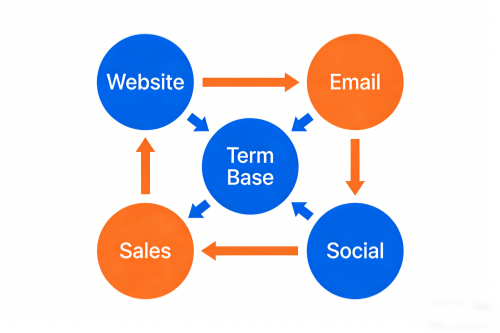
1. Terminology Management
Establishes a centralized multilingual database covering core products, technical terms, and brand language. Every new piece of content must pass terminology validation before publication, ensuring alignment across teams and markets.
2. Cross-Channel Consistency Control
Ensures that messaging remains logically aligned across all touchpoints, including websites, emails, social media, and sales materials. This requires a dual-layer approach: AI to detect inconsistencies at scale, and human experts to refine context and meaning.
3. Version Control and Synchronization
Addresses a common but critical issue: product updates are often reflected on the website but not in sales materials or localized assets. A version-controlled system ensures that all channels are updated from a single source, eliminating data mismatch risks.
4. Long-Term Language Partnerships
Replaces fragmented vendor management. Instead of one-off outsourcing, companies collaborate with partners who understand their business logic and participate earlier in the content lifecycle, enabling knowledge accumulation and consistency over time.
In essence, this shift is not just operational—it is strategic. In global markets, content consistency is a direct reflection of organizational maturity.
III. Implementing Content Governance in 90 Days
Transitioning to content governance does not require a complete overhaul of existing workflows. Instead, companies can implement a structured rollout within approximately 90 days.
▶Step 1: Audit Existing Assets
Audit existing multilingual assets, typically covering the past two years. This process identifies high-frequency terminology, core messaging, and inconsistencies that require alignment.
▶Step 2: Introduce Governance Tools
Terminology management systems should be embedded into content production processes, and a designated content owner should be assigned final approval authority to ensure consistency.
▶Step 3: Establish Partnership Model
Establish a long-term partnership model with language service providers. Evaluation criteria should shift from cost per word to consistency rate and responsiveness, with regular reviews aligned to product and market updates.
💡 Landelion Insight: In cross-border communication, consistency matters more than speed.
IV. Measuring Governance Effectiveness
For content governance to be sustainable, it must be measurable. Three key indicators are commonly used to assess effectiveness.
1. Terminology Consistency Rate
Measures the correct usage of core terms across languages. A target of over 95% is generally required to ensure alignment.
2. Cross-Channel Alignment Score
Evaluates consistency between websites, sales materials, and communication channels through AI comparison and human audits.
3. Content Asset Reuse Rate
Tracks how effectively translation memory (TM) and terminology bases (TB) are leveraged. High reuse rates indicate that knowledge is accumulating rather than being recreated, reducing long-term costs.
V. FAQ: Multilingual Content Governance
▶What is multilingual content governance?
It is a structured system that ensures consistent messaging across languages, markets, and channels, going beyond simple translation accuracy.
▶Why is translation consistency important?
Because inconsistent terminology signals poor internal alignment, which directly reduces trust—especially in high-value B2B industries.
▶How is governance different from localization?
Localization adapts content for different markets, while governance ensures all localized content remains consistent and aligned.
▶What tools are typically used?
Common tools include terminology databases, translation memory systems, AI-based consistency checks, and content management platforms.
Conclusion: From Translation Cost to Trust Infrastructure
Translation delivers content, but governance delivers trust. As companies expand globally, language is no longer a back-office function—it becomes a visible indicator of operational excellence.
Only when every language communicates the same truth can a company build a stable and scalable global trust system.
Take Action: Content Governance Checklist
Before scaling your multilingual strategy, consider the following:
Have you established a centralized terminology database?
Are your messages aligned across all channels?
Are language assets updated alongside product changes?
Do you rely on long-term partners rather than fragmented vendors?
📩 Contact us | Explore enterprise language governance solutions
💬 Add us on WeChat for a tailored plan
📚 Further Reading
Essential Document Translation Needs for Chinese Companies Going Global
Risk-Based AI Translation for Technical Documentation | Landelion