


By 2026, an increasing number of Chinese B2B companies expanding globally have reached a sobering realization: traffic no longer equals opportunity.
Google Analytics shows organic traffic doubling. LinkedIn followers surpass ten thousand. Paid media CPC continues to improve. Yet sales teams report the same concern: “High-quality inquiries are decreasing, and conversion cycles are getting longer.” The problem is not traffic itself. It lies in invisible breakpoints within the lead generation funnel.
From first content exposure to submitting contact information, a B2B buyer typically passes through five to seven critical touchpoints. If friction appears at any one of them, high-intent prospects may quietly disappear—without ever signaling dissatisfaction.
Based on Landelion’s long-term observations across global expansion projects, this article systematically breaks down the end-to-end B2B global acquisition funnel in 2026, identifies three high-frequency “breakpoints,” and explains how to repair them.
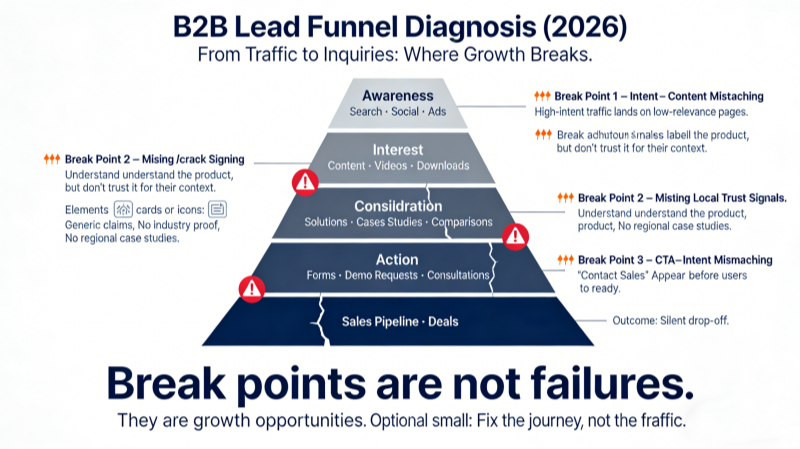
I. The Five Core Stages of the Global B2B Acquisition Funnel
Unlike B2C, B2B decision journeys are longer, involve multiple stakeholders, and require a much higher level of trust. A healthy acquisition funnel typically includes five stages:
1. Awareness: Users first encounter the brand through search, social media, or paid advertising
2. Interest: Users actively read content, watch videos, or download materials
3. Consideration: Users compare solutions, review case studies, and evaluate technical credibility
4. Action: Users submit forms, book demos, or initiate consultations
5. Conversion: Users enter the sales pipeline and eventually close
In an ideal scenario, each stage is supported by clear content handoffs and behavioral guidance. In reality, however, most funnels experience serious breakdowns between stages two and four.
II. Three High-Frequency Funnel Breakpoints
In global B2B practice, the gap between traffic and inquiries is rarely caused by channel failure. Instead, it usually stems from experience fractures embedded in the user journey. By analyzing public strategies from leading global companies, three recurring issues consistently emerge—subtle in appearance, but decisive in impact.
1. Search Intent and Content Mismatch (Landing Page Misalignment)
The problem
Many B2B companies successfully attract high-intent search traffic, yet their landing pages remain generic—focused on brand overviews or broad product introductions. Users arrive with specific industry questions but must search for answers themselves, increasing cognitive load and abandonment risk.
Why it matters
When a user’s search behavior signals that they are already in the solution evaluation stage, the landing page must immediately respond with industry context, application scenarios, and business value. Alignment between search intent and content framing is a decisive factor for conversion continuity.
Case example
Autodesk clearly separates users by industry on its B2B website, offering dedicated solution paths for manufacturing, construction, and engineering. Each industry page is structured around core workflows, common challenges, and relevant product capabilities—rather than directing all users to a generic product homepage. (Source: Autodesk Solutions; Autodesk Industry Solutions overview)
This approach is not a marketing slogan; it is embedded directly into site architecture:
🔹Separate navigation paths for different industries
🔹Content framed around industry problems, not software features
🔹Industry pages serving as primary landing destinations for search and paid traffic
💡 Landelion Insight
High-intent traffic paired with low-matching content almost guarantees conversion failure.
2. Missing Localized Trust Evidence
The problem
During the consideration stage, users may understand product capabilities yet hesitate to take action. The issue is rarely a lack of information—it is a lack of verifiable, locally relevant trust signals, especially in regulated or high-risk industries.
Why it matters
B2B trust does not come from self-claims. It comes from proof that organizations like mine have already succeeded with this solution. Local case studies, real customer stories, and implementation contexts are critical decision accelerators.
Case example
Philips Healthcare operates a dedicated Case Studies / Success Stories hub on its website, showcasing real-world implementations of its medical solutions across countries and healthcare environments. These cases are organized by application and region, not merely by product category. (Source: Philips Case Studies; Philips Healthcare Success Stories)
Visitors can clearly see hospital backgrounds, usage scenarios, implementation details, and measurable outcomes—forming a verifiable trust evidence chain, rather than abstract endorsements.
💡 Landelion Insight
In B2B, certifications open the door—but case studies are what move decisions forward.
3. CTA Misalignment with User Intent
The problem
Many B2B content assets are strong informationally but impose overly aggressive action steps. After consuming content, users are presented only with “Contact Sales” or “Request a Demo.” If they are not yet ready to speak with sales, they simply leave.
Why it matters
CTAs are not more effective just because they are closer to purchase. They must match the user’s current decision stage. Early-stage users need low-risk, low-commitment next steps, not immediate sales engagement.
Case example
HubSpot advocates and practices the concept of Contextual Calls-to-Action, dynamically presenting different CTAs based on content topic and user stage instead of using a single universal button. This approach is documented and demonstrated in HubSpot’s official blog and product examples. (Source: HubSpot Academy)
💡 Landelion Insight
The end of content is not “finished reading”—it is a low-friction, high-value trust action.
III. Building a Non-Breaking B2B Acquisition Funnel: Three Core Principles
1. Center Optimization on the User Journey
Focus on where users drop off—not just where traffic originates. The real optimization question is not “where did they come from,” but “why didn’t they continue?”
2. Content Builds Trust; Pages Enable Sales
B2B content is not brand decoration—it is pre-sales conversation. Every page should support a specific decision stage and deliver credibility-reinforcing information.
3. CTAs Must Match Current Intent
Education-stage users need learning resources. Consideration-stage users need case proof. Decision-stage users need demos. Misaligned CTAs interrupt trust progression.
IV. Frequently Asked Questions (FAQ)
Q1: How can we identify which stage a user is in?
Behavioral signals offer strong indicators:
🔹Awareness: broad searches (e.g., “what is predictive maintenance”), blog reading, short session duration
🔹Consideration: repeated visits to product or case pages, whitepaper downloads, competitor comparisons
🔹Decision: visits to pricing or demo pages, frequent return sessions
Combining GA4 event tracking with form behavior enables more precise segmentation.
Q2: Can a single page include multiple CTAs?
Yes—if hierarchy and context are clear. For example, a deep case study article may feature a primary CTA such as “Download the Full Case Study,” with a secondary CTA like “See How This Applies to Your Industry,” rather than pushing immediate sales contact.
Q3: What if B2B decision-makers refuse to fill out forms?
Offer lower-friction alternatives:
🔹Replace “Contact Sales” with “Chat with an Expert”
🔹Provide ungated ROI tools or previewable PDFs
🔹Allow direct booking via LinkedIn or Calendly
Reducing form friction often significantly improves conversion rates.
Conclusion: Breakpoints Are Where Growth Begins
By 2026, global B2B competition has shifted from who can acquire more traffic to who can convert traffic into trust. Companies that systematically identify and repair funnel breakpoints—across content, pages, and action paths—are far more likely to build durable advantages in highly competitive markets.
Take Action Now
If you want to:
🔹Identify hidden breakpoints in your global acquisition funnel
🔹Access industry-specific funnel templates
🔹Align content, landing pages, and sales workflows
📩 Contact us | Explore more services
💬 Add us on WeChat to get the full “2026 Industry-Specific B2B Acquisition Funnel Template”, including:
🔹A five-stage end-to-end diagnostic framework
🔹Industry-tailored trust-building and content strategies
🔹Breakpoint self-audit checklists and cross-team action plans
🔹Turn overseas traffic into real, high-quality opportunities.
📚 Further Reading
2026 Localization Strategy for Chinese Companies Going Global | From Translation to Trust
Breaking the Month-4 Growth Plateau: A Content Distribution Playbook for Global B2B Brands
Global SEO Growth Strategy | How to Balance SEO and Paid Search at Every Stage